Cashing in on the cashless society

While the world’s media was trying to get a handle on Russia and Ukraine, my counter-cyclical approach was to investigate the move towards a cashless society.

Retailers and banks have been (stealthily), moving away from having their shop assistants and tellers handle cash. Maybe it was already happening, but the Covid-19 pandemic accelerated the push by retailers in particular, to insist on people using a debit card to pay for goods and services. The rational was to slow the spread of germs, although one might be aghast at the results of swabbing an ATM keypad or EFTPOS machine.

A majority of Australians (55%) now has become used to internet banking, electronic bill paying and using debit or credit cards to buy goods and services.

In 2022, the Reserve Bank issued a technical bulletin about the use of and distribution of cash in Australia. The Bank’s Consumer Payments Survey (CPS) showed that the share of total retail payments made in cash fell from 69% in 2007 to 27% in 2019. The results from the 2022 study will be published later this year.

The RBA used multiple surveys to explain the rapidly declining use of cash in Australian society. The Online Banknotes Survey (OBS), commissioned by the RBA, asked individuals about their cash use behaviour. In 2022, cash was used by 25% of respondents in their most recent  transaction. Debit and credit cards remain the most popular payment method, although electronic options such as tapping with smartphones or watches are becoming more prevalent.

“The survey points to a permanent shift in payment behaviour for a significant proportion of the population; 39% of respondents said they have been using cash less often since the pandemic began. Those on lower incomes were more likely to have used cash for transactions and consider themselves high cash users.

On Sunday the host of Australia all Over, Ian McNamara, read out a letter from a listener who had taken a cache of cash to a bank branch. She was told the coins (in bags) could not be accepted as ‘we are a cashless bank’”.

“The world’s going to hell in a hand basket,” Macca opined, citing a phrase originating in mediaeval times.

The cashless bank issue was also canvassed by talkback radio 3AW, after a listener emailed to describe his run-in at a bank branch.

ANZ Victoria and Tasmania general manager Cameron Home confirmed in a statement to the radio station that “a small number” of branches “no longer handle cash at the counter”.

“At these branches cash and cheque deposits and cash withdrawals continue to be possible through a smart ATM and coin deposit machines.”

The ANZ spokesman did not quantity the number of branches refusing to take cash at the counter.

This trend poses a quandary for those of us who traditionally save coins. My pink piggy bank had reached the stage where there was no more room for the coins that accumulate like used tissues in the pockets of jeans and jackets. Many people have a piggy bank, an old cigar tin or biscuit barrel in which they throw their loose change. Nobody wants to keep $20 of loose change in their wallets, purses, handbags or pockets.

So, many of us have this habit, particularly if we are children of depression-era parents, of savings coins then banking them once the amount makes it worth the effort.

She Who Also Hoards Cash routinely throws $1 and $2 coins in a tin. Come Christmas she will count said cash, bank it, then use the $200 or so to buy ‘Christmas plonk’.

This week I laboriously counted and separated the cash into the correct denominations (in plastic bank bags).

All banks have scales and machines which can quickly and accurately confirm that a bag indeed contains $50 in $2 coins (or $7.80 in 20c pieces). Some branches can tip a mixed bag of cash into a machine which will automatically sort and count the cash in a matter of seconds.

I decided to spend an hour or so with a practical demonstration of how one fares trying to deposit $160 in coins at a bank branch. Our family bank (Suncorp) was closed – 9.30 – 2.00pm Monday to Friday). Did you know Suncorp had sold its banking business to ANZ Ltd? (No. Ed)

I then went to the Warwick Credit Union and the teller deposited the coins with no fuss at all. As part of the exercise, I learned that many banks now expect small business customers to deposit cash via a “Smart ATM”. I can only wonder how this will go with people who operate cash-only businesses (markets, busking, CD sales and so on).

The deep flaw in the concept of a cashless society is what happens when the technology (which relies on electricity and technology that works 24/7) fails. Almost on cue, we had an Australian banking example when some Commonwealth Bank customers were unable to log in to their accounts online.

The bank apologised to its customers after a major glitch left them unable to make purchases with their bank cards or access their accounts.

Customers received error messages when trying to use the NetBank online banking service and the CommBank mobile app.

It’s not the first example (for any bank or business for that matter) finding that their ‘smart’ apps can and do fail.

As dedicated readers may recall, we spent a week marooned in a regional town in New Zealand without mobile phones, internet or ATMs. Good thing the hire car had a full tank, eh! The town was cut off from the world in the aftermath of a catastrophic cyclone. A small supermarket near where we were staying had fired up its generator and served customers on the basis of ‘cash is king.’ EFTPOS payments were possible, but only after a long wait in a queue.Despite these occasional ‘hiccups,’ the banking industry seems  determined to introduce labour-saving technology, even if it sends their customers to hell in a hand basket.

A survey by RFI global asked merchants what their future intentions were towards accepting cash. The data suggest that half of merchants that accepted cash in April 2022 planned on actively discouraging cash payments or displaying signage to that effect at some point in the future. Those merchants that plan to move away from accepting cash were more likely to have higher turnover and be in metropolitan areas. The pandemic appears to have influenced some merchants’ plans to dissuade cash use, with hygiene concerns around cash handling as the most prominent reason. The risk of theft and the cost of sourcing cash are other reasons.

Meanwhile, the traditional source of cash for so many Australians (automatic teller machines or ATMS), is in decline. Since 2016, when ATM numbers peaked at 8,000, 25% have closed. Most of these closures have been ATMs owned by authorised deposit-taking institutions. Some of these ADIs, as they are known, will charge you a fee of up to $3.00 to make a withdrawal.

The latter is yet another argument I have against the banking system in general. Banks charge fees for almost every aspect of banking, be it in person or via internet banking. Virtually all merchants charge a fee when you use a credit card to make purchases (e.g, $5.90 added to a return ticket to NZ). Many banks charge a monthly fee for maintaining business and even personal accounts. Moreover, these fees increase over time.

It could be a mistake to ascribe the tap and go trend on Millennials or Generation Z.

I was at a choir reunion last month when an elegant 70-something woman, having ordered a pizza, leaned over towards the EFTPOS machine and waved her smart watch at it. Ka-ching!

More reading: what can go wrong will go wrong


Carols and Christmas lights

Bob’s annual playlist of Christmas songs and a few things you never knew about the 12 Days of Christmas Take care on the roads, dear readers.

christmas-lights-carols
Photo by Laurel Wilson

We did a drive-by of Warwick’s Christmas lights last Saturday night. It would melt the Grinchiest heart. By that I mean even if you are deeply cynical about the nativity story, Santa, Elf on a Shelf and rampant consumerism, Christmas lights are a joy. Not at all energy-conserving but joyous without a doubt

She Who Took Pictures in the Dark (SWTPITD) came up with a couple of good ones. I drove and the passengers navigated, which was ‘interesting’

We had just finished two weeks of carol performances with East Street Singers. We are having a break from choir until January, so cruising the Christmas lights hotspots was the next best thing.

Lavish displays of Christmas lights cost multiple thousands, not to mention the additional burden on the household energy bill. The comparison website finder.com.au did a survey on Christmas spending which did not mention Christmas lights at all. Nevertheless, those surveyed said they were planning to spend around $1,361 on food, alcohol, presents, eating out and travel.

Two-thirds of Australians (72%), however, are slashing their spending, mindful of the impact of inflation and what the New Year may bring.

About 38% of respondents said they would start buying food and presents early to help control their spending. One quarter went shopping for bargains on Black Friday,(the US version of Boxing Day sales) with 25% implementing a gift-giving limit.

Almost a quarter of the 1,054 survey respondents said they would have to go into debt to cover their Christmas costs (up from 23% in 2021).

Inflation rose 6.9% in the year to October 2022 and there appears to be no signs of it easing. Inflationary pressures, particularly the steep rise in fuel and energy prices, prompted the Reserve Bank of Australia to raise the cash rate by 3.00% in 2022 (it’s now 3.10%). What this might mean for people with huge mortgages in 2023 is anyone’s guess.

Long-term FOMM followers will know I usually trot out a Christmas song playlist and this year is no exception. But I am swayed this year to include songs with a sentimental or even reverent message. This offsets the somewhat cynical tone of my contribution, ‘Christmas in Australia’ which can be found here.

Our five Christmas carol performances this month included a mix of traditional songs, a few which are rarely heard and that jolly old tune about figgy pudding and not going until we get some.

Number one on the 12-song FOMM Christmas playlist is the Sussex Carol with its clever counterpoint section where the men vocalise in a different time signature while the women sing the verse (then vice versa). ‘The Sussex Carol’ is performed by the choir of St Martin’s in the Fields conducted by Sir Neville Marriner.

The Sussex Carol brings to mind the wry observation in Tim Minchin’s timeless ‘White Wine in the Sun’ (number 2).

I get freaked out by churches
Some of the hymns that they sing have nice chords
But the lyrics are dodgy.

Minchin released this song in 2012 as a tribute to his baby daughter. He released this 2022 live version, all the more poignant because his child has been diagnosed as being on the autism spectrum. Minchin donates proceeds from this song over the Christmas period to Aspect (Autism Spectrum Australia). This is a touching, live rendition, just Tim and piano.

‘Once in Royal David’s City’ (3), is performed in folk style by The Seekers. This is a happy, lapsed-Methodist memory. I was given a harmonica in a Christmas stocking (I was 8) and was playing that carol by lunchtime. Later I found Sonny Terry and Brownie McGhee.

Next is the much-loved ‘How to Make Gravy’ (4) by Paul Kelly. Note for guitarists: Paul plays a guitar tuned to an open D. In ordinary tuning you need to span three or four frets to make those chords. Just saying.

‘O Holy Night’(5) is a classic Christian carol, favoured by sopranos who can hit the high note (A flat). My trusty editor Laurel Wilson is well capable of executing (ie singing, as opposed to ‘murdering’ Ed.) this song. Mariah Carey, Celine Dion and Kate Miller-Heidke are among those who have recorded Adolphe Adam’s composition, based on a French poem. This version is by the honourable Luciano Pavarotti.

‘The Christians and the Pagans’ (6) takes me back a bit – Dar Williams singing about cousin Amber (and her friend), turning up unexpectedly for a traditional family lunch.

The food was great, the tree plugged in, the meal had gone without a hitch,
Til Timmy turned to Amber and said, “Is it true that you’re a witch?”
His Mom jumped up and said, “The pies are burning, ” and she hit the kitchen,
And it was Jane who spoke, she said, “It’s true, your cousin’s not a Christian, ”
“But we love trees, we love the snow, the friends we have, the world we share,
And you find magic from your God, and we find magic everywhere.

Song 7 was recommended by the convenors of U3A Warwick’s Music Show; indigenous man Mitch Tambo singing ‘Silent Night’ in language. I shared this with my niece in New Zealand who is a big Marlon Williams fan. Mitch’s voice is equally impressive.

‘Carol of the Bells’(8)  is an old Ukrainian folk tune. This version is from the soundtrack of the 1990 hit movie Home Alone.

As we think about Ukraine, Afghanistan, Iran, Pakistan and other countries which need peaceful thoughts, here is John Lennon and Yoko Ono’s ‘Happy Christmas/War is Over’ (9).

Macca is broadcasting his last Australia all Over for 2022 on Sunday so it’s a fair bet he’ll include ‘Carol of the Birds’. (10).

This delightful Australian song with authentic Down Under imagery is from the album Bucko and Champs (Colin Buchanan and Greg Champion).

I mentioned to my niece’s witty 15-year-old last month that I’d not heard the Mariah Carey Christmas song reportedly played to death at this time of year. He replied, “Oh yes, that’s the song you hear in shopping centres, giving their poor workers PTSD.”

I’m sparing you Mariah’s vocal gymnastics on ‘All I want for Christmas is You’ in favour of a traditional Irish folk song. This recording of the ‘Wexford Carol’ (11) features Alison Krauss, better known for collaborations with bluegrass band Union Station and duets with husband Robert Plant (Raising Sand). Here she is joined by master cellist YoYo Ma and an ensemble of class musicians.

Finally, the ‘Twelve Days Of Christmas’, an annoyingly repetitive song which in 1984 gave birth to a quirky set of economic indicators. The Christmas Price Index and the True Cost of Christmas measure the nominal and cumulative values of the gifts given by the True Love. In 2021, the commodity price index assessed the nominal value at $41,205 and the cumulative value at $179,454. An example is the four calling birds (they use canaries), which are mentioned nine times. Canaries go for around $300 in the US so the cumulative value of the gift from Ms True Love is $10,700. You follow?

Not that this would have occurred to Bing Crosby when he recorded the song with the Andrews Sisters in 1949. Bing’s been dead for 45 years but regardless has 25 million Spotify followers. Now that’s what I’d call a commodity.

Have a great Christmas and drive carefully.

Keeping the Toowoomba carnival afloat

Macca-Toowoomba-carnival
Photo: Macca amongst the people at the Toowoomba carnival of flowers – by Bob Wilson

So there we were at the unaccustomed early hour of 7am in Laurel Bank Park, Toowoomba, trying to catch Macca’s eye to say, “Mate, we’re here.”

Ian McNamara,* the host of Australia all Over, who sometimes plays music by our band, The Goodwills, had invited us to attend his second OB (outside broadcast) of the year.

Laurel Bank Park was pretty as a picture, thanks to a big team of gardeners and a decision by the Toowoomba Regional Council to water the town parks, despite the drought. It makes little sense to have a famous Carnival of Flowers without making some attempt to preserve the gardens.

The Toowoomba Carnival of Flowers has been going for 69 years, attracting ever-larger crowds each year to take tours of the prize-winning gardens, watch the grand parade and dine out in the city’s eclectic ‘Eat Street’. It was sentimentally appropriate that we were in Laurel Bank Park, where rumour has it we (She and Me) once had a re-affirmation of vows ceremony, cunningly disguised as a bush dance. We lived in Toowoomba in the 1980s (and my how this sprawling country town has grown).

Last weekend, we stayed with old friends at Highfields, now a satellite suburb 10 kms north-west. Our friends bought an acre of land and a house there when it was still in the bush. Now there’s a service station on the corner (and traffic lights). We drove into town to watch the Grand Parade on Saturday, parking in a secret place known only to locals. On the way we detoured up Bridge Street, past what used to be the Toowoomba Foundry, now home to the biggest Bunnings store I’ve seen for a long time. The Foundry facade on Ruthven Street has been left standing, along with remnants of the old saw-tooth factory roof, which you don’t see much of in this era of tilt-slab concrete industrial sheds.

Toowoomba has certainly become not only bigger but more multicultural since we lived there. Walking past St James Anglican Church on Russell Street, we saw many Sudanese people gathered outside. They had just returned from the funeral of the Rev James Ajak, a respected priest and community leader among Toowoomba’s large South Sudanese community. A thousand people, some who came from as far away as Western Australia, attended his funeral at the Centenary Heights State High School Assembly Hall.

Multicultural-Toowoomba-carnival
Multicultural Toowoomba carnival

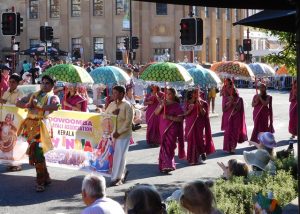
Multicultural groups were well represented in the grand parade of floats, bands, vintage cars and dancing schools. Our host told us an amusing story about a grand parade from years gone by when it rained relentlessly. There were two elephants on a flat-bed truck, he said, and one of them heeded nature’s call, leaving a wet pile of dung for the people following behind to negotiate.

It wasn’t really the right mental picture for a lovely Spring day with a big crowd of good-natured people enjoying the hour-long parade, led by the Toowoomba Caledonian Pipe Band. I was never very good at estimating crowds, even though I was given a few tips by Toowoomba police back in the day when I worked at The Chronicle as a general reporter and columnist.

Thousands, let’s say, drifting down Margaret Street to Queens Park where floats were lined up for inspection (and judging). Our host’s grandkids cunningly detoured Pop to sideshow alley, while we strolled hand in hand through one of our special places. If Queens Park had been watered lately, it was still thirsty, not surprising given the city has had only 70mm of rain in the past six months. Only one of those rainy days amounted to much (20.8mm). As gardeners would know, this is when you have to think about what to water and when.

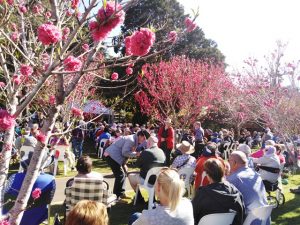
Nonetheless, Laurel Bank Park, with its topiary, flower beds, scented garden, flowering peach trees and bowling green lawns was at its showcase best. We did catch Macca’s eye, as he roamed among the 600 or so people who showed up to listen to his four and a half hour live Sunday morning broadcast.

We sang a couple of songs and listened with admiration to local duo Kay Sullivan (accordion) & Peter Freeman (double bass) accompany Mimosa, a gypsy jazz duo from Terrigal, with Toowoomba trombone player Ian Craig chiming in as required. Macca sang a couple of songs and the band played along – as if they’d all had rehearsals. It was impressive.

Later I was reminded of the column I once wrote for the Toowoomba Chronicle in the 1980s. It started life prosaically as This Week with Bob Wilson and later became Friday on My Mind. We were reminiscing about the time our local folk club built a scale model of the Glenrowan Pub on the back of a truck and entered it into the grand parade with a bush ranger theme. I satirised this in one of my old columns (September 1984). Such fun to quote yourself:

“The float-building gang were having a right old bludge. There was Bluey swarming all over the back of his smash repair truck pulling ropes and lugging hay bales while the gang of nine procrastinated beneath a tree where someone had thoughtfully erected a makeshift bar, keg and 10 seven ounce glasses. Ted and Hughie arrived with their contribution to the float – a four-metre high model of the Ryebuck Shearer complete with black singlet, hand shears and a big placard which read “One out, all out”. Bluey inspected the newcomer and tapped its 44-gallon drum chest.

“Good welding job. Thing must weigh a ton.”

“He used to shear 100 sheep a day, mate,” said Molly.

Ben turned up in his bright green Ute with two sheep in the back. Hollering things like ‘Bewdy’ and ‘Have a go’, Ben carted the bewildered animals (one under each arm like Colin Meads), and plonked them on the back of the truck.

“I’ll bet we need a permit to transport live sheep on an open truck during a street parade,” said Cautious Col.

By midnight the day before the grand parade, the Ryebuck Shearer had been bolted to the back of the truck cab, a sheep chained to each of his formidable legs.

“You’re not going to leave them sheep here all night are you?” Bluey said. “They could clean up my back yard before tomorrow.

“It is tomorrow,” said Molly, “And I’m going home.”

Later, about noon, the Rybebuck Shearer was disqualified from the parade because stewards ruled that neither he nor his placard could pass safely beneath overhead power lines. Ben’s sheep (Banjo and Henry), were also pulled out of the race. Rain fell on the parade and the bloke who’d lent the hay bales said they weren’t worth a pinch of sheep now and charged them $2 a bale. Bluey’s truck got a flat tyre as he tried to turn it round in the marshalling yards. Molly started crying into her rum and coke and the barmaid from across the road came over and said anyone with pub glasses please take them back or she’d lose her job.

“I told you so,” said Col.

*Rebecca Levingston interviews Ian McNamara on South Bank’s Ferris wheel, August 2017 (log in to Facebook first).

https://www.facebook.com/abcinbrisbane/videos/10155634496309669/

Clarification: Last week I referred to the cost of a visitor visa to Nauru as $800. It is $8,000 for a journalist.