Knowing how newspapers work on the inside, and sometimes wishing that I didn’t, it is a fair bet that all newspapers had two versions of Page One ready to run after the second State of Origin. It’s a hell of a tight deadline, with commercial television stringing it out so they can catch the morning audiences in the UK and stack the broadcast with as many ads as possible. The game didn’t start until 8.15, so it would have been tight going for rugby league writers to file their finished match reports.
Mind you, they are all seasoned pros who file rugby league reports under these sorts of conditions every week from February to September. They write to a formula so it isn’t high art, but they can come up with a pithy summary like this one, in Thursday’s Sunshine Coast Daily: “High shots, late hits, forearms and facials figured in almost every tackle as each side tried to gain a physical edge,” wrote Wayne Heming. Nice, although I can imagine my Canadian friends puzzling over “facials”. I can imagine Media Watch having a jolly time panning The Courier Mail’s consecutive front page splashes this week – on Wednesday (a maroon wrap around with just one word “Believe.”) On Thursday, Page One morphed into a breezy tribute to the Sunshine State, saying that the Blues (that’s New South Wales if you come from somewhere else), might have won their first State of Origin series in nine years, but Queenslanders are winners because we have better weather, better food and better lifestyle (than where?). Who knows what they would have done had something truly newsworthy occurred overnight, prompting a late Page One makeover. (Military junta takes control in New Zealand – Abbot repeals Howard’s gun laws).
The Courier-Mail’s first State of Origin game day edition was printed arse-about, with sport on the front page and news on the back. I was curious, as I don’t think I’d ever seen it done, so I turned to what would have been page three and there was the infamous picture of Kate Middleton, accidently showing a fair bit of leg, along with a non-story about the photographer having a pang of conscience and (almost) not selling the paparazzi shot of the year.
Crikey, what tosh, as my mate Lyn says. For another dollar fifty, we could have a coffee in the UpFront Club and read The Range News for nothing. At least then I can find out why Council is digging holes in my street and whether our hinterland bus service will last another year. Now that’s worth Page One around here.
Mining the Keating Reserves
We discovered a bottomless pit of Australian political history while mining data for this week’s Friday on My Mind. I searched “Paul Keating opens McArthur River Mine” because I could not remember the year it happened. What I found was a Federal Government archive of all speeches made by Australian prime ministers. I asked my trusty ideologue and research assistant Little Brother to plough this fallow field. He remarked: “Mate, that’ll be like pushing a barrow load of bricks along the Canning Stock Route.”
Paul Keating flew in the RAAF VIP jet to a tiny private airstrip at McArthur River, one of the early fly-in fly-out operations, to officiate at the mine opening in September 1995. He was welcomed by the then owners, Mt Isa Mines and a Japanese consortium (Nippon, Mitsui and Marubeni). Keating was asked to open the McArthur River zinc mine because the Commonwealth had made it possible, buying Bauhinia Downs cattle station and giving it to the Gurdanji people as part of a compensation package that included mining jobs.
The Feds also spent $6 million diverting the road around the Borroloola Aboriginal Community “to make this a much more pleasant project for them”. Zinc concentrate from McArthur River is transported by road to the company’s Bing Bong loading facility where it is loaded onto barges and transported to ships in the Gulf of Carpentaria. When I attended the opening, scribbling away in my notebook, promises were made about ensuring the trucks making the 100 km road trip would have their loads of zinc/lead concentrate covered and fully secured.
These days McArthur River mine is owned by international mining giant Glencore which like all such companies focuses on maximising volume and keeping production costs down.
Paul Keating’s 1995 speech made much of Australia’s then still powerful commercial relationship with Japan and made comparisons between the egalitarianism which existed in both countries. (Comments in parenthesis are by Little Brother)
“I would say to our colleagues in Japan, I hope they understand that when they deal with an Australian business, and I’m sure they do, that it is real and it will be here in five years or 10 years or 15 years (right so far, Paul) and that when you do business with Australia, you don’t wake up in the morning, some morning, to find a general in charge of the country, that it is the solid democracy, that our word matters (semi-colon) that you can litigate your interests here in our courts and like you (comma) we are a democracy and also like you we don’t have a two-tiered society. We used to have the remnants of our failed upper class, they have disappeared (oh yeah?), thankfully, into obscurity.”
Little Brother sighs: “That bloke could talk under wet cement.”
No doubt the articulate, quick-thinking Keating would have ad libbed his way through the prepared text. I do recall he did not tarry long at McArthur River, jetting off to another in a series of ribbon snippings to promote One Nation, (not to be confused with the right wing political party launched by Pauline Hanson in 1997). Keating’s One Nation was a programme of infrastructure works carried out from 1991 to 1996, including the single gauge rail from Brisbane to Perth via Melbourne and the Brisbane Airport international terminal.
I’d like to thank Paul for unwittingly providing me with fodder for Deadly Diary, all these years later, and for unwittingly participating in my song Paul Who, which satirises the (male) cult of personality. You have to say he was one of our more colourful PMs. Political life in Australia must indeed be dreary when brief TV interviews with Keating, Malcolm Fraser and even John Howard seem vital and perspicacious by comparison with the present lot.
Every story deserves a picture

Other people at the Winton caravan park were trying to get the same sunset photo of a horse in a paddock. I took a few with my Iphone but none were as good as the one taken by Laurel Wilson. Our mate Giulio Saggin, photo editor for ABC online, wrote and asked if he could include it in the audience submitted photos section of the website. Flattering as that may be, news organisations who offer this kind of “exposure” do not pay their contributors. Our local paper the Sunshine Coast Daily publishes a reader’s picture Monday to Saturday. Same deal, you get the byline and the thrill of seeing your work in print, but sorry, no cash.
As we noted in an earlier column, there are 31 million mobile phones in Australia and all have cameras, some rivalling the most expensive digital cameras. If you are first on the scene at an accident or newsworthy event, your Iphone photo will be on page 3 tomorrow or even in today’s online edition. You may or may not get paid.
News photography is not the life-time career it once was and the smart snappers figured that out years ago, drifting off into photo-journalism, free-lancing, specialisation and book publishing. The aforementioned Giulio Saggin is one such entrepreneurial snapper. His evocative book So I Did captures black and white images of everyone who gave him a lift on a hitch-hiking trip around Australia in 1998. Giulio has done a few other things since then. His current gig as photo editor for ABC, is a classic case of a job that did not exist 10 years ago.
Back in 1995 I was among a small contingent of journalists flown to Mt Isa, Darwin and eventually, to Borroloola in the Northern Territory and next day to the McArthur River mine, which was due to be officially opened by then Prime Minister Paul Keating. I remember this well, as it was my first ever taste of the top end (it took 12 hours to get there by commercial airliner, private jets and a bus).
The miners put on an NT barbie with buffalo, kangaroo, crocodile and barramundi and they opened the wet canteen for the regulation couple of hours. There I met an unusual character, a fiercely independent free-lance photographer who clocked up huge mileages every year taking assignment-specific and what the trade calls “stock” photos around the top end. He was constantly on the road, this bloke, saving news media outlets the hideous expense of sending photographers from Sydney or Melbourne on an outback assignment.
Who knows what this enterprising fellow is doing now, but clearly his business model will have changed. Recent developments suggest that all news organisations, Fairfax in particular, plan to lay off full-time photographers and rely more on agencies and the few determined free-lancers still in the game. There is just too much competition and the agencies that pay have all but given up the fight to chase people republishing material in blogs and on Facebook without permission or attribution.
The BBC reported in March this year that Getty Images, the world’s largest photo agency, would release up to 35 million photos free to use. This move, said to be an effort to combat piracy, infuriated professionals who have been submitting their work to Getty for years.
Photography journalist Daniela Bowker told the BBC News website her Twitter feed lit up as angry photographers vented their feelings.
“They feel very strongly about that because photographers don’t work for free and they don’t work for exposure.”
“But at the same time, the genie is out of the bottle. There are so many images that are being shared and liked and tweeted and clicked on.”
Getty will continue to charge “commercial users” like news outlets, televisions stations and advertisers, to use images. But some images may never be used commercially and the photographers who took them will never get paid.
Maleny photographer Steve Swayne has taken some stunning pictures of the outback on his lengthy tours. He says it is now too difficult to make a living taking photographs.
“About two years ago the image agency I use (Getty Images) radically changed their royalty policies and now the income that used to be up to $700 for a photo for use in advertising has diminished to a few dollars per image.
“The proliferation of good DSLR cameras means that millions of people have the gear and are willing to sell their photos for a few dollars due to the flattery angle as much as anything. Lots of agencies now scour the internet to find suitable photos and then they approach the photographer to use the original full sized image.”
Some former newspaper journalists I keep in touch with occasionally get ticked off with the whole business to the point where they vocalise on Facebook. The most recent kerfuffle was when Tennis Australia opened up opportunities for “volunteers” to take photographs during the two-week Australian Open. A special Facebook page was set up “Tennis Australia – pay your photographers” which attracted 967 “likes.” Tennis Australia (no doubt horrified by the Facebook outrage), issued a statement which described their initiative as more of a way of encouraging an army of young photographers to gain high level experience and that (of course) TA would continue to employ professional photographers.
Dr Sabrina Caldwell, thinks professional photographers are in the same position as someone reapplying for their own job.
“They have to show that they can create better things than others. They need an edge not just over others, but over who they once were.”

I took my brother-in-law Jon to Kings Beach Caloundra when he was over here from Canadia. We were watching a couple doing a tandem surfing exhibition for a television crew. While Jon got a couple of great photos with a telephoto lens, what interested us was the film crew’s remote-controlled helicopter camera. Anyone can buy one of these helicopters for as little as $160 (you also need one of those tiny sports cameras and attach it to the chopper). Of course you can pay thousands for sophisticated models which come with 20 megapixel cameras. Whatever the level, it is demonstrably cheaper and easier to take aerial photos and video using a remote-controlled drone than it is to commission a professional aerial photographer.
As for the privacy issues…well, that’s a topic for another Friday
Perils of the click track
I’m enjoying regaining all those lovely shimmering high frequencies my audiologist says are gone forever. All I have to do is wear these smart hearing aids that adjust automatically to zoom in on what they think you’re listening to – like the person opposite you in a noisy coffee shop. That was interesting, working in the studio yesterday. You have to listen to a click track and try to follow it. It gets harder later when you over-dub a vocal. I was doing OK until we did one of my songs that slows to half-time at the beginning of verses and picks up the tempo on the third line. That is so easy to do when you’re playing live. But recording a guitar track first then trying to make the vocal fit – that’s an entirely different process. We got there in the end. My producer Pix then wasn’t all that happy with my next guitar track as it didn’t sound “awesome” like my home demo. Thinks: why not produce the home demo then? It’s not that easy. My home recording system is incompatible with software based programmes like Pro Tools and QBase. Nevertheless I now have to extract my two guitar tracks from the demo and we are going to try to replicate that in the studio (next week). It’s all to do with the “feel” or the “vibe.” As all songwriters know, turning out an ambient, cruisy version of your newest song at home, when you’re still all excited about it and it shows in your voice, changes quite a bit when you’re alone in a sound booth, trying not to think about what a wasted hour costs in a professional studio when you’re not completely prepared.
All producers and sound engineers will do their best with all your songs, but when one particular song excites them, they will be so far into the detail you’ll be sick to death of it the time you’re done. That’s how it is for Bed 27 – Pix loves it and I’m glad he does because the few people I have played the demo to have given me the “It’s a bit much, isn’t it?” raised eyebrow look.
So now I have to revisit my multi-tracked home demo from six months ago and work out what the hell I was doing. I’ve never played the song live, so in a way it is like giving birth when nobody knew you were pregnant.
Meanwhile we now have 12 songs “bedded down” which means other musicians can come in and add their creativity to the songs with no issues about tempo or out of tune instruments. My Maton six-string has a serious intonation problem so I have been borrowing other people’s guitars for this project, although my Yamaha 12-string is getting a work-out. We’re off on a three month road trip in a couple of weeks* so there won’t be time to do the other three songs – maybe some vocals and harmonies on the others. So we’ll come back in late September and take up where we left off. You can’t rush these things!
Whether you have done a lot of studio recording or none at all, I hope you find these insights useful. Songwriters tend to be too controlling about their material. I was lucky in a way that a 25-year career in journalism where editors are sometimes literally looking over your shoulder and saying “That’s boring as bat-shit, Bobby,” makes you less precious about changing lyrics. If you meet a sound engineer/producer you feel right about working with, you’re half-way there. Now go home and spend six months doing home demos and knocking those half-done songs into shape.
*lucky house-sitters!
All ears on Day 5
This will be interesting, trying out my new hearing aids in the confines of a recording studio. I had been in denial about the loss of high frequencies in both ears but finally trotted along to an audiologist and parted with a four-figure sum for what so far seems to be a much-enhanced living experience. The acid test will be when I go into the sound booth and put on the cans (enclosed noise-cancelling headphones), and record a couple of guitar tracks and then some vocals. This is my fifth half-day session at Pix Vane-Mason’s studio near Conondale. We have been working with multi-instrumentalist and all-round good bloke Steve Cook and so far have 10 songs “bedded down”.
For those of you who have no experience of the sound recording process, the usual deal is to record guitar tracks to a click or metronome without vocals. There may be a “guide” vocal to keep the guitarist on track. Guitarists follow a chord chart hopefully prepared by the songwriter (who, we assume, has done a lot of pre-production on the song). That is, the song has been recorded at home and then dissected. The more work done before you go into the studio the less time it should take.
I have a Roland 16-track recording desk at home. In theory I should be able to record my own album at home. So far I have managed to turn out some useful “demos” but let me tell you, there is a big gap between what you can do at home with one good microphone and putting yourself in the hands of an experienced producer with lots of microphones, audio gear and years of experience.
Home-based recording studios are doing it tough at the moment, with so many singer songwriters and bands choosing to buy an Apple Mac and Pro Tools (a computer-based multi-track recording system) and churning out downloadable albums. The DYI trend has come about because of rapidly dropping CD sales (a global trend), the rising popularity of downloads (Itunes) and a festering mind-set among the general populace that music should be free, or at least cheap.
After I finish the so-far untitled legacy album with Pix I will probably buy a computer-based programme and go that way, although for a relatively small investment, a professionally produced recording will have a much better chance of being played on radio. Our first EP “Courting the Net” was produced by award-winning record producer Rupert Pletzer, who was between jobs (at the time he was Tina Arena’s tour manager). His studio was across the road from my employ so we teamed up with Silas Palmer, a brilliant young musician we’d met at Woodford Folk Festival, and plunged in (I so did not know what I was doing). Straight away Rupert identified two songs he thought might get played on the ABC, so on the strength of that I sent it out to a few radio stations, including Ian McNamara’s Australia all Over. Some 12 years later we have had a long association with Australia all Over. Three of my songs have been included on Macca’s compilation CDs and we have toured with Macca and the band.
So yes, I trust the professional studio approach. Steve and Pix have already ironed out a few kinks in what I thought were watertight songs (they never are) and come up with the all-important “feel” or groove.
Too many songwriters spend months and year locked away in a bedroom perfecting their masterpieces with no input from anyone else and consequently develop a controlling attitude about the “finished” songs, brooking no criticism and refusing to make changes (I used to be guilty as charged).
Putting yourself in the hands of gifted professionals can rid you of many bad habits. Of course you have to jump in when you think they are doing a Deen Brothers on your song.
“Mate, the banjo is great on the train song but it needs to be just behind everything else, OK?”
So I’m off in an hour or so. I’ll let you know how I went with my new hearing aids. Last week I went in to the sound booth to record a 12-string with a capo on the fifth fret (we were aiming for that shimmering harp-like sound).
“Pix, mate, I can’t hear myself – turn me up!”
“Mate, you are turned up!”
Like I said, my high frequencies are shot to pieces. But now I can hear a crow fart 200m away.
Fixing your PC with a hairdryer

The thing about my generation is we expect things to last for years, if not decades. My 12-year-old laptop, for example, has recently gone to a good home for a parcel of bunyas (more about that later). The new laptop, meanwhile, bosses me about, telling me to back up data in the cloud, wherever that is. The why of that appears to be based on the need to keep a retrievable copy of all your irreplaceable photos, videos, and music in the likely event your cheap new laptop, tablet or PC blows a fuse. Most of the computer-savvy people I know buy a portable hard drive from the Post Office and back up their own data. Then they will spend countless hours tweaking, customising, and nursing their computers along into the old age they were never designed to have. The wastemakers have been at this game for a long time, and the constantly evolving world of computers and consumer goods has delivered a highly profitable new generation of planned obsolescence.
So no surprise to learn I’m patiently waiting for the next Fixit Café (a fortnightly community effort in our village), to yet again repair our ancient lawn mower. This time it needs a perished fuel line replaced (I paid $3 for the part). Last time a Fixit Cafe volunteer replaced the mower’s broken starter cord ($4 for a length of cord). The time before that the front wheels fell off. I took the mower to a repair shop. The bloke looked at me like I was an impractical folk musician with long fingernails. “Mate,’ he said. “It’s not worth fixing.” I looked up petrol mowers on Google and decided I didn’t need to pay $700 to mow a garage-sized piece of lawn every three weeks or so. I tied the front wheels on with fencing wire and carried on regardless. It reminded me of the time I took the then new-ish mower in for a service in Brisbane. The mechanic looked in the oil reservoir then looked at me as if I had just played the first two bars of Duelling Banjos: “Mate, there’s no oil in here! It’s a wonder it was working at all.”
Dear old mower, with your fist-sized rust holes, wired-up wheels and blue smoke. I’m sure the friendly folk at the Fixit Café will do the right thing by you.
The Fixit Café is a concept started in Amsterdam, with the primary aim of making things last longer and sending less garbage to landfill. We go along to the Community Centre every second Thursday with our broken stuff, pay $5 and wait for a volunteer to fix it.
Around the same time as the mower cord broke, I was having this weird problem with my desktop computer. The bloody thing is only six years old! Most mornings it would not power up (although the green power light on the back was flashing). I found the solution on an HP support site.
The best way to fix this problem, they said, was to get a hair dryer and blow warm air into the power vent for a few minutes. (It may not work for you, but it worked for me). The only issue was when She Who Reads Newspapers wanted to use the hairdryer.
Eventually I accepted that I would have to replace the desktop with something more reliable. The local computer shop had a new laptop for $849. My first laptop (the one mentioned at the outset), cost $3360 in 2002. The $849 version has 8GB of RAM, a 2GB video card, 750GB of hard drive storage, card readers and other stuff that no-one understands except Geek Boys (and girls).
IT equipment and accessories are now very cheap, but don’t expect anything to last. They are being assembled at warp speed in offshore sweatshops by poor people earning $1 an hour. The young guy in the computer shop told me that while laptops are getting cheaper all the time, they don’t last. He seemed genuinely amazed that my old laptop was still working (on Windows XP). The battery died, so I kept it plugged in all the time. The keyboard was also dead so I used a $20 USB keyboard. The fan no longer worked so I bought one of those USB fan bases for $20 and no longer got the message that the cooling system had failed and to shut down the machine and return it to the authorised dealer. Whatever.
So I bought the $849 laptop, stapled the receipt to the 12-month warranty and retired the old desktop PC to the music studio (it just needed a new power supply unit). Then I decided to let go of the XP laptop, which happily coincided with a local LETS (Local Energy Transfer System) market. LETS is a local, not-for-profit community enterprise that records transactions of members exchanging goods and services by using LETS Credits (known as ‘bunyas’ in The Village). So the 2002 laptop went to a good home for 50 bunyas, which I plan to “spend” by employing a young person to mow my lawns (using the old mower, soon to be resurrected by the Fixit Café).
This will give me time to confront the daunting nature of Windows 7 (“at least you didn’t get Windows 8”) I hear you say. Times have moved on since Windows 98 and XP. Computer users are encouraged to trust people they don’t know who live who knows where to store all of their confidential files, contact lists, photos, videos, audio files and so on in anonymous data banks located, well, somewhere.
Many of us do this already without realising. Like on Facebook, where we post photos, videos, audio clips and inane or inflammatory comments that are stored off-site for what may end up being a very long time. Far too many of us have our confidential banking details stored in the cloud. If the recent hacking of Ebay was not a warning sign I don’t know what is.
Like it or not, we are all enslaved to this brilliantly flawed technology – its makers rolling out new versions and updates so fast it makes planned obsolescence seem obsolete. I’ll bet that when the late Vance Packard wrote The Waste Makers in 1960 he was probably not thinking it would still be around 54 years later – in paperback and ebook!
Read our privacy policy and disclaimer and more essays at: www.bobwords.com.au
Zipline subject to council DA
The Obi Obi Gorge zip line proposal will ultimately be submitted to Sunshine Coast Regional Council for development approval, with opportunities for public comment. The Department of Tourism contacted Friday on My Mind this week to assure us that a high level of scrutiny would be applied to the proposal at local, state and federal level “because it is in a national park and it is the first time.” For those who just came in, the Queensland Government has opened up national parks to allow private commercial enterprises, in this case an “eco-tourism” zip line project. A zip line is akin to a flying fox. In this instance cables would be strung down the Obi Obi gorge to “cloud stations” anchored to the trunks of trees. Punters will pay $150 each to get kitted out in safety gear and speed 2 kms down the wires at up to 80 kmh. Last week Tourism Minister Jann Stuckey announced the state government had chosen a preferred tenderer, Australian Zip Line Canopy Tours. There was little information in the departmental press release about the approval process. Last week we drew attention to the lack of public input during the “expressions of interest” process and criticised the state government for adopting a “commercial-in-confidence” process.
A Department of Tourism spokesman told us the proposal would need various permissions from organisations and individuals including the Department of Natural Resources, SEQ Water and private landholders adjacent to the Kondalilla National Park. There would be a “robust” assessment by the Department of National Parks, which has made it clear the proponent would have to “tick all the boxes.” The department would also require the proponent to refer the proposal to the Commonwealth Department of the Environment which would then determine if the zip line project should be subject to an Environmental Impact Assessment. In any event, the community would have an opportunity to provide feedback during the development application process.
We appreciate the department taking us seriously and answering our questions thus far. This is not a new idea – it was first mooted in 2009, in the Sunshine Coast Hinterland Nature Based Tourism Plan, which contained an eight-page conceptual outline. This time around, the State government engaged engineering and environment consulting group GHD to prepare a preliminary environment risk assessment report. It runs to 73 pages, but here it is if you want to have a read.
Housing in the new millenium
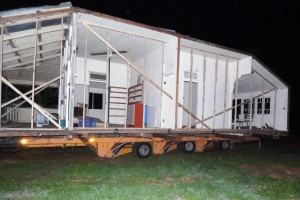 My old mate Kev the Carpenter was apt to say, “If a house was meant to be moved, it would have wheels.” That witticism from decades gone by came back with a rush when I found a note in the letter box from house movers informing us that the original farm house in our street would be moved off the land at midnight. I walked down to the end of our street and sure enough, half the house was perched on the back of a semi-trailer, ready to roll, with the other half on a trailer, still on the land where it had sat for many years, but also ready to go. The owner of the land, who has donated the house to a worthy cause, is developing a small, sustainable estate. We did not get up at midnight to see the house off, but our fond wishes to whoever lives there in the future (once they put the two halves together again).
At least this house will be re-used and continue to give people shelter and succour for years to come. In our larger capital cities, developers think nothing of blithely knocking down a perfectly sound two-bedroom cottage on a large block to replace it with two or more, two-level concrete boxes, each of which will sell for more than the developer paid for the original property. This is called “infill” in the trade, and it is happening anywhere local Councils will allow subdivision of standard residential housing allotments. Not that we live in the past, here at the desk of Friday on My Mind, but we fondly remember when the great Australasian home owner’s dream meant an older, timber house on a quarter acre lot (or section, as they say in Aotearoa). There would usually be an ancient orchard, a half-falling-down garage, a laundry with a copper, two concrete tubs with a mangle and a long drop toilet out the back, covered in passionfruit and morning glory.
In 2014, your typical master-planned estate on the outskirts of capital cities now crams four properties into a quarter acre (1011 square metres) block. In the 20 or so years this trend has been evolving, some property owners have made a motza subdividing large suburban blocks and then parlaying their profits into a bigger, better home or one or more investment properties.
As we enter the second year of record low interest rates and rising prices, property investors are piling back into the market. A Roy Morgan Research survey found that the number of Australians with an investment property loan increased 37% to 1.31 million between March 2010 and 2014. The number of Australians with an owner-occupied home loan increased just 4% to 4.83 million over the same period.
A lot is said in the mainstream media about housing affordability and whether it is worse now than it ever was. It isn’t, according to the Housing Industry Association. But it will always be an issue for people who borrow 100% of the value of their new home, only to see interest rates start to rise.
This is a hot topic. Michael Janda’s ABC article “Home buyer beware: the illusion of affordability” generated 42 pages of online comments. Janda says the “bipolar commentary” about affordability is particularly confusing for first home buyers. He astutely notes that while aspiring home owners earned 2.5% to 4% in interest while saving for a deposit, the average home price rose 10% in just 12 months.
The Housing Industry Association (its members build houses), said yesterday that affordability was at its best in 12 years – cold comfort for those living under the 30/40 rule. If your mortgage (or rent), is costing you more than a third of your income, you will start to suffer housing stress. The situation is more dire for those on low incomes. The Australian Housing and Research Institute (AHURI) calls it the 30/40 rule, in which housing affordability stress is most acute for those earning in the bottom 40% of the income range and paying over 30% (sometimes up to 50%) of their income on rent or home re-payments. University academics Ernest Healy and Bob Birrell writing for The Conversation say the 2011 Census revealed that a third of younger households were paying more than 30% of their household income on mortgage repayments.
In case you had been living in a cave on Great Barrier Island for the last few decades, negative gearing (introduced in 1985), allows property investors to run their rental home/s at a loss (two thirds of them do just that), claiming tax deductions for all manner of inputs. So little wonder the number of rental properties is growing. AHURI estimates that some 4.5 million people live in private rental accommodation (23% of households). These numbers are expected to grow as more young people abandon the notion of owning property.
AHURI researcher Judy Yates says affordability problems began 30 to 40 years ago when inflation switched the focus on housing from providing shelter security to providing wealth security. This structural change was exacerbated by changes in to capital gains tax in1986 which favoured owner-occupiers and CGT tax changes in 1999 favouring investors.
Healy and Birrell say the ranks of property investors have surged since changes to Self Managed Superannuation Fund (SMSF) rules in 2007. Regulators changed the rules to allow investors to borrow through their SMSFs to finance a property investment using negative gearing.
Whatever else happens, don’t expect the Federal Government to do anything meaningful about housing affordability. Too many potential votes would be lost.
On the other side of the Abbot-proof fence that separates the haves from the have-nots, embattled tycoon Nathan Tinkler is reportedly selling his sprawling ranch at Pullenvale in Brisbane’s western suburbs.
News.com.au reported that agents have fielded offers of $3 million for the mansion; well below what is wanted (the spread was bought for $5.2 million in 2007). Photos of this property on realestate.com.au suggest that prospective buyers will probably need to hire a couple of gardeners to maintain the 4ha of land, or at the very least, buy a reliable mower.
Down in the Village, someone has tacked a “mower wanted” sign on a noticeboard (“Will pay Bunyas”). Thinks: perhaps I can upgrade to the $99 electric mower I saw in a hardware store?
Next week: More about mowers, bunyas and things that don’t last.
Zipline? What zipline?

For whatever reason, we have become engaged in the free-spirited, public protest movement of our youth. In the past few months we’ve been to more protest meetings and marches than in the past 20 years. They include a small but quietly outraged rally in Brisbane’s King George Square where men of the cloth appealed to the Federal Government to have compassion on the people seeking asylum in this country. There was much analysis of the Tory rhetoric about asylum seekers (the correct description is ‘irregulars,’ not “illegals”). We marched around a few city blocks, spotting people young and old we had either seen yesterday or not for a decade or two − not since the march to tell John Howard we did not want to send our troops to Iraq.
More recently, we fronted up on a dismal day in Maleny to mark the day 10 years ago that the infamous Deen brothers came to town and started clearing the site for the much-opposed Woolworths supermarket (we still won’t shop there). The local papers reported us as a small but vocal crowd.
What we don’t quite understand is why there has been no call to arms over a potent threat to the cardinal principle governing management of national parks. Almost three million Queenslanders are said to visit national parks every year – yet less than 5% of the State enjoys national park status. People visit national parks mainly to bush walk, bird watch, camp, swim and teach their kids about nature. They leave their trail bikes, quad bikes and dogs at home; they walk in and walk out and (hopefully), take their rubbish away with them. These simple pleasures, which do the most to ensure the wildlife in national parks is not overly-disturbed, are clearly not enough for the Queensland Government, which in October last year amended the State Conservation Act to allow commercial ventures into National Parks. This was ostensibly to allow cattle to graze in times of extreme drought.
But behind doors closed to the process of public debate, the government has been encouraging an “eco-tourism” venture in Kondalilla National Park, at Montville on the Sunshine Coast hinterland.
Expressions of interest were called last year from private operators to set up a Zip Line canopy “eco-tourism” experience. What is proposed is a line of steel cables traversing the tree canopy two kilometres down the Obi Obi Gorge. A Zip Line works not unlike a flying fox, where people kitted out in safety gear slide along cables at speeds of up to 80kmh to “cloud stations” – platforms fixed to eucalyptus trees at varying heights above the ground. In this case, a sketch on the department website (the best you will find), shows a dotted line zigzagging back and forth across the gorge. The experience is expected to cost punters $150 each. An information meeting in Montville in April was told that the Zip Line was expected to attract 20,000 people a year. It would cost about $3.8 million to construct and the successful proponent would likely be given a 15-year lease. There are successful Zip Lines around the world, including a handful in Australia, but none are located in our National Parks.
Queensland Premier Campbell Newman ‘opened up’ five national parks to allow cattle grazing at the end of 2013. Anyone who has been out west in Queensland over the last 12 months would find that hard to argue against as a temporary/emergency measure. But the “eco-tourism” proposal is something else again.
Expressions of interest campaigns are shrouded in “commercial-in-confidence” provisions, which effectively lock the public and the media out of the process. The information meeting panel had few insights beyond what anyone could glean from googling “Zip Line Obi Obi Gorge” and perusing the relevant government website. The process moved to Stage Two in January and this week Tourism Minister Jann Stuckey and National Park Minister Steve Dickson announced that the government had selected a preferred tenderer (Australian Canopy Zip Line Tours).
Minister Stuckey said she had asked the company to submit a more detailed proposal, ensuring “environmental checks and balances” are incorporated into the planning, design and operation of the zip line.
“Subject to the concept being fully assessed through this next stage, the Queensland Government, traditional owners, the Jinibara People, and Australian Zip Line Canopy Tours will work together to achieve the best possible outcome for all parties,’’ Ms Stuckey said in a statement.
The lack of detail and input locks out those most likely to object: residents of Montville and surrounds, environmental groups and those who believe national park status should permanently preserve the area’s natural condition as much as possible.
Concerns already raised about potential issues include irreversible changes to the canopy, noise impacts on wildlife and neighbours and a lack of public transport to the site. We could also ask why no other location was considered, although according to the government’s statement, the Kondalilla plan has been on the Sunshine Coast tourism agenda since 2009.
The first section of the 327ha Kondalilla National Park, now a focal point of the Great Walks network, was gazetted national park in 1945. The Department of Environment website notes that Kondalilla is home to eight species of wildlife which are rare, endangered or of cultural significance. Kondalilla’s lower altitude rainforest is of endangered conservation status, as less than 10% of this type of forest remains in south east Queensland.
Earlier this week, we asked Federal Environment Minister Greg Hunt what interest Canberra would have in the Obi Obi Gorge proposal. A spokesman said (a) it has not been submitted to the Department and (b) projects likely to have a significant impact on a matter protected under national environment law, such as a threatened species, must be submitted (by the proponent) to the federal environment department to see whether federal assessment is needed.
All conservationists should be aware of the bigger picture. More people seem to be craving high risk experiences such as rock climbing, jet-boating, white-water rafting, skydiving, canyoning and abseiling. What’s next – paintball? Other States have already opened up some national parks to fossickers, prospectors and amateur hunters. Queensland’s foray into national parks goes much further, with private operators to build and manage a high-end adventure tourism experience not unlike bungee jumping.
For those of us who go to national parks to quietly observe wildlife, keep our hearts and lungs working, or just listen to nature doing its own thing, bringing a Zip Line into a national park is like doofers moving in next door to a yoga retreat.
Goose moves back home

This has been a trying month for a pair of big city empty-nesters and their luckless 20-year-old son. We should call this fellow Goose.
After several years of stop-start employment and periods of being subsidised by Centrelink, Goose scored a night job as a car park attendant in the city. Alas, he fell asleep on the job. Hundreds of motorists retrieving their cars after the ballet, the big hit musical, the opera and that tedious Chekov play drove out without paying. They have CCTV footage of the driver of the first car getting out, reaching inside the booth and opening the boom gate. The management board had a meeting about what to do about the other vehicles that drove out without paying. If this was a true story, and you had any interest in the subject at all, you’d find the total sum written off in their annual accounts.
Goose’s parents, meanwhile, have been relishing life in the big rambling McMansion now that their daughter has married and moved to Saudi Arabia with her oil executive husband, their elder son has moved to Western Australia to work in the mines and the dear old Labrador, Doris, has gone to doggie heaven. Life has been sweet, especially since the youngest lad moved out to live with his mates because, as Goose found on many occasions, you can’t exactly play the music you like as loud as you like it and have a bong sitting on the coffee table when you live at home with the folks.
But uh-oh, Goose has turned up at the front door, letting himself in with the key he still has (mistake), interrupting Foyle’s War to announce that he is moving back in. Dad puts the recorded show on pause, Mum puts the kettle on and an uncomfortable atmosphere ensues, much like pressing ‘start’ on a flea bomb and then not leaving the house.
Goose and his folks are among the victims of the 2014 Federal Budget and a policy decision to shift unemployed youngsters off Newstart and on to the Youth Allowance until they turn 25. Unemployed people under 25 will get Youth Allowance instead of Newstart, while recipients of either will have to wait six months before receiving payments. And they will have to prove they were looking for work. From January 1, young people approved for this new scheme will have to log a minimum 25 hours on the Work for the Dole scheme.
The Budget measures follow the heartless Commission of Audit report, which among other things recommended forcing young job-seekers to re-locate or lose welfare benefits. While both allowances are income and asset tested, the bare bones of this decision means someone under 25 living at home will receive $272.80 per fortnight (as opposed to $510.51 under Newstart). That is just under $20 per day.
Fair to say that anyone seriously engaged in looking for work would spend a lot of this money on public transport and keeping their pre-paid mobile phones topped up lest they miss that elusive second-interview call. Organisations like The Australian Council of Social Service (ACOSS) have been grumbling about the unsustainable nature of Newstart, asking the obvious question: who can live on $35 a day in any of Australia’s capital cities or large regional towns? Now they have an even more urgent issue to review.
Certainly there will be many who agree with Treasurer Joe Hockey’s position – Australians under 30 should be “earning or learning”. But surely his tough stance on youth unemployment need not have been so harsh? Why not give a Job Seeker Package to everyone in that age group who has been unemployed for more than six months? This would include a one-off payment to allow recipients to buy interview clothes, get a haircut and budget for mobile phones and public transport smart cards. Oh, and have a decent breakfast. The JSP would also offer free out-placement services similar to those offered to newly redundant executives. Why should they have all the fun?
Our fictional empty-nesters, meanwhile, thinking about noise-baffling insulation downstairs, where Goose has reclaimed his old room, have been reading the fine-print on Centrelink’s website, which, as you might surmise, may need to be updated to accommodate this particular change, which comes into effect on January 1. Those who know little or nothing about Youth Allowance and New Start may be surprised to know that this new legislation merely increases the age range of those required to apply for the Youth Allowance (it is currently 16-20).
Statistics on youth unemployment gleaned by the Brotherhood of St Lawrence put it at 12.4%, compared with 6% for the working population overall. Those January 2014 stats are alarming enough, but downright awful when you look at youth unemployment “hot spots” – West and North-West Tasmania (21%), Cairns (20.5%), Northern Adelaide (19.7%), South East Tasmania (19.6%), Outback Northern Territory (18.5%), Moreton Bay North – including Caboolture and Redcliffe – (18.1%) and Mandurah in WA (17.3%) head the list. Blacktown Mayor Len Robinson says youth unemployment in Mount Druitt is about 25%, and he should know.
They say that in Mount Druitt, if you look skywards at dusk, you can sometimes see flocks of geese, braying loudly as they head inland.