When Gough turned his back

Life’s most embarrassing moments. It is sometime in 1996 and I am attending a corporate function as a business reporter for The Courier-Mail. I am about as excited as I get, because for the first time I have the prospect of meeting the great Gough Whitlam. He has been invited to the conference to engage in a debate with Sir James Killen. Firebrands of the left and right; true intellectual discourse, brimful of wit and rhetoric and demonstrating a transparent fondness for one another.

I spot the man in the lunch break standing by himself near a platter of fruit, cheese and crackers. I approach, shake his hand and offer my business card. I look up (Gough was very tall), as he inspects the card.
“Oh, The Courier-Mail!” (an orator’s voice, laced with gathering opprobrium). “That’s what’shisname, that crank who keeps going on about Manning Clark.” And with that he turned and walked away.

He was referring to a series of articles in The Courier-Mail in 1996 that claimed the late historian Manning Clark was an “agent of influence” of the Soviet Union. I returned to work that day and confided the story to a few of my colleagues. We agreed it indicated a degree of haughty arrogance, but given the long friendship between Gough and Manning Clark, it was an understandable reaction. Crikey, I didn’t want an interview, I just wanted to shake his hand.

The series of articles mentioned above caused a great fuss at the time. Later that year, the Press Council upheld a complaint by 15 prominent Australians, saying the newspaper had insufficient evidence to claim Professor Clark was an agent of the Soviet Union or that he was awarded the Order of Lenin. But, as is the case with all daily newspapers, the content has long been forgotten, the paper recycled as garbage wrap or garden mulch.

That’s the problem when great men or women die – their lives get picked over by journalists, each as keen as the next to find that little untold vignette. I was not even in Australia when Gough was sacked in 1975 by the then Governor-General John Kerr.
I remember reading coverage in the UK newspapers and wondering if there would be a revolution in Australia as a result. Gough would probably find it amusing that his passing alone was the news event that pushed Tony Abbott off social media. Most of the FB tributes to Gough were touching, some even overly-emotional. I posted a link to the Whitlam Institute and a summary of the Whitlam Government’s achievements. It is almost 40 years ago, so for those not even born then, here’s a summary:

“The Whitlam Government brought about a vast range of reforms in the 1071 days it held office between December 5, 1972 and November 11, 1975. In its first year alone, it passed 203 bills – more legislation than any other federal government had passed in a single year.”

Under Whitlam, women trapped in loveless, abusive marriages were able to escape and apply for the Supporting Mothers’ Pension (or men for the lesser known Lone Parent Pension). Pregnant women without a partner were able to keep their babies instead of adopting them out. Under Whitlam, bright children from poor families were given a free university education (this continued until HECs was introduced in 1989).

Medibank, Medicare and Medibank Private

In 1974, Whitlam created Medibank, a national health insurance system providing free access to hospitals and other medical services. Medibank (re-named ‘Medicare’ in 1984) provided health coverage for the 17% of Australians who then could not afford private insurance. A year later, Liberal Prime Minister Malcolm Fraser introduced the government- owned Medibank Private, with the aim of providing competition in the insurance sector.
Labor governments opposed any notion of Medibank Private being sold/privatised/floated, just as Liberal politicians, starting with John Howard, swore that if elected they would sell off Medibank Private.
Medibank was a national public authority until PM John Howard made legal and accounting changes in 1997.
These changes made it easier for Tony Abbott to appoint agents of private enterprise as Joint Lead Managers (ie float promoters) to run a public float. The heavy irony is that the prospectus for Medibank Private, which is going public this year, emerged the day before Gough passed on.

It is an expensive business. If you delve into the 204-page prospectus you will find that $17.5 million has already been set aside for fees paid to accountants, auditors, lawyers and business and capital market advisors. The float promoters, Deutsche Bank, Goldman Sachs and Macquarie Bank, will collect a $5 million fee and up to $5 million in incentive management fees if the float goes well (plus commissions).
You will hear a lot about Medibank Private now that the prospectus is out and about. A 2012 Harvard University survey found that two-thirds of investors do not read a prospectus before applying for shares. They rely on people like me, sifting out a few key points.

• There is a restriction on any one shareholder (or its nominees) holding more than 15% of Medibank Private. This ensures that a predator cannot build a 20% stake, which triggers a takeover;
• Unhappily for some, this provision will lapse after five years;
• The government is selling 100% of Medibank Private – in previous privatisations the government has usually kept an interest;
• The nominal share price is between $1.55 and $2.00; but you have to send your cheque before you find out the final price;
• The dividend yield of between 4.2% and 5.2% is not generous. Retail punters and SMSFs could leave their $20,000 in a fixed term deposit at 3.5% without any risk at all;
• Medibank’s four million policyholders will be able to buy more shares, and earlier, but otherwise derive no bonus from the float.

There is a lot more in this document as the promoters cover all the bases by making sure you know about the risks and the competitive pressures in the health insurance business. The Abbott government says it will spend the proceeds of the float (up to $5.5 billion), on its Asset Recycling Initiative, providing payments to States and Territories that sell assets

and re-invest in Australian infrastructure.
I am aware there are people out there who think Medibank Private should remain a government asset. In 2013 it paid the government a dividend of $450 million, so it’s a handy investment.
There are also people who say all health care should be free. Or at the very least, a poor person needing elective surgery should not have to wait two or three years when those with private insurance can have it done next week.

In his 1972 election campaign speech, Whitlam outlined his reasons for introducing universal health insurance.
“I personally find quite unacceptable a system (ie in which private medical insurance was tax deductible) whereby the man who drives my Commonwealth car in Sydney pays twice as much for the same family (medical insurance) cover as I have, not despite the fact that my income is 4 or 5 times higher than his, but precisely because of my higher income.”
Hear, hear, Sir.

Short little span of attention

the-easybeats-friday-on-my-mind-1967-68This week I choose to quote Paul Simon out of context for my own purposes. I’m sure he won’t mind. The short/little tautology aside, this is one of the hookiest lines from “You Can Call Me Al” where a man (probably), questions his mid-life existence – “Why am I soft in the middle when the rest of my life is so hard? Every songwriter on the planet yearns for just one of the multiple hooks residing in Call Me Al, from the bouncy, repetitive brass intro to the impossible bass solo (which much later I found out was just a normal jazz bass run played backwards).
This is not about Call Me Al, but it is a little bit about the “hooks” songwriters use to grab our attention, in much the same way newspapers use shock horror headlines. If you’ve never heard of a “hook” in the pop song genre, here’s a classic example. Think of that well-known song by Australian 60s band, The Easybeats, its title appropriated by yours truly. Venerable English songwriter and guitarist Richard Thompson tipped his hat to songwriters Vanda and Young when he included Friday on My Mind as one of the 22 songs he chose to represent 1,000 years of popular music.

When it comes to analysing what Vanda and Young were up to in the composition of their 1966 hit, I defer to learned US professor Paul Smith who dissects the song in his blog, appropriately enough called Hooks. You have to acknowledge the master songwriters of the 1960s as the experts at gaining people’s attention.
George Young and Harry Vanda penned Friday on My Mind in 1966, three years before the UCLA issued a press release introducing the public to “the Internet”.
In just 222 words and 2 minutes 37 seconds, employing one of the most recognisable riffs in the world of contemporary music, Vanda and Young created a worldwide hit. It was No 1 in Australia and Holland (The Easybeats had two Dutch band members), No. 6 in the UK and No.16 on the US Billboard Hot 100 chart. And they didn’t have to crowdsource, tweet or annoy people on Facebook to do that.

The Internet and our attention span
There is quite a discussion online about how the Internet has destroyed people’s span of attention. According to <psych.com>, our attention span has more than halved in 10 years from 12 minutes to five. I would really like to know the concentration span of the “always on” generation.
You know them – the not always young people with smart phones, tablets and laptops who are always connected. They’re the ones you invite over for dinner who furtively glance down into their laps every few minutes while their fingers and thumbs dance across the keyboard. Or they chime into a conversation with “I’ll just google that” and flop their Ipad out on the table to regale you with Wikipedia’s version of events.
A reader suggested I join Twitter, because apparently, that is where all the intellectuals, journalists, activists and commentators hang out. Well, OK, I’m there, but now what? Mr Shiraz advised: “say something brief and bright”.
As the length of a tweet is limited to 140 characters, by definition it has to be pithy. I haven’t tweeted much (said reader has promised me a tutorial later this month). I did find out via twitter that a former colleague of my vintage had died. I was also able to send a tweet to Guardian online columnist Van Badham saying how much I admired her rare, first-person account of a depressive episode.

The short span of attention is the biggest obstacle to building an online audience, we’re told. FastCompany says the ideal Facebook post is just 40 characters. Forty characters – about this much, give or take.
It is clear that a lot of my Facebook friends do not know this. All the same, 40 characters is a bit drastic. “One small step for man, one giant leap for mankind” would fail this test. So would “Well may they say God Save the Queen, because nothing will save the Governor-General.”
When I started writing Friday on My Mind in May this year, the question of word length was uppermost in my mind. I sent a 1,750-word draft of the first one to Mr Shiraz who replied, “Very good, but I’d like to see that cut by a third.”
So perhaps we have him to thank for today’s 1,190-word essay. As it turns out, 1100 words is the optimum length for a blog. There are those who say blogs running to 2,650 words or more are likely to be taken seriously, as the word-length indicates a degree of research has been done. The problem with longer articles is that today’s student (anyone aged between 5 and 35) will lose concentration and not finish reading.
A Pew Internet study found that while students hooked up to the connected world system have instant access to an infinite body of wisdom, their attention span and hunger for in-depth analysis is diminished.
“The current generation of internet consumers live in a world of ‘instant gratification and quick fixes’ which leads to a loss of patience and a lack of deep thinking,” says a Pew analyst. The Pew study also found that while websites and blogs use videos, images and sound clips to capture that short little span of attention, videos disrupt concentration abilities. (Sorry about that).

I was browsing a list of the world’s longest books last night. Every one of you will jump to the wrong conclusion, as I did. War and Peace isn’t even on the list. No, the privilege goes to Artamène/Cyrus the Great, a 17th century novel of 2.1 million words spread over ten volumes. The work is credited to Georges de Scudéry and/or his sister Madeleine. According to <shortlist.com>, it is a romantic novel, with endless twists to keep the suspense, and the action, going.
While popular in its time, Cyrus the Great was not re-published until a (French) academic project was launched to make it available on the internet.
I provide the link because intensive research of my readership suggests that for some, a 2.1 million word book in French would be une promenade de santé.
I set about this week’s musings with three goals in mind. After banishing the black dog to the shed, I agreed to my friend Little Bird’s request to “write something happy”. I wanted to turn my head towards music, as (a) it gets me out of a funk and (b) we are going back into the studio soon to finish the new album. I also thought it was time to look at FOMM and see if it is doing what columns of this nature are meant to do (entertain, inform and amuse).

According to in-depth research carried out between 6.55am and 7.03am today, Friday on My Mind (the column) meets all the criteria of a successful blog. It can be read in less than seven minutes, its headline is six words or less, it uses sub-headings and it is free. All else, apparently, is irrelevant.

Who me, depressed?

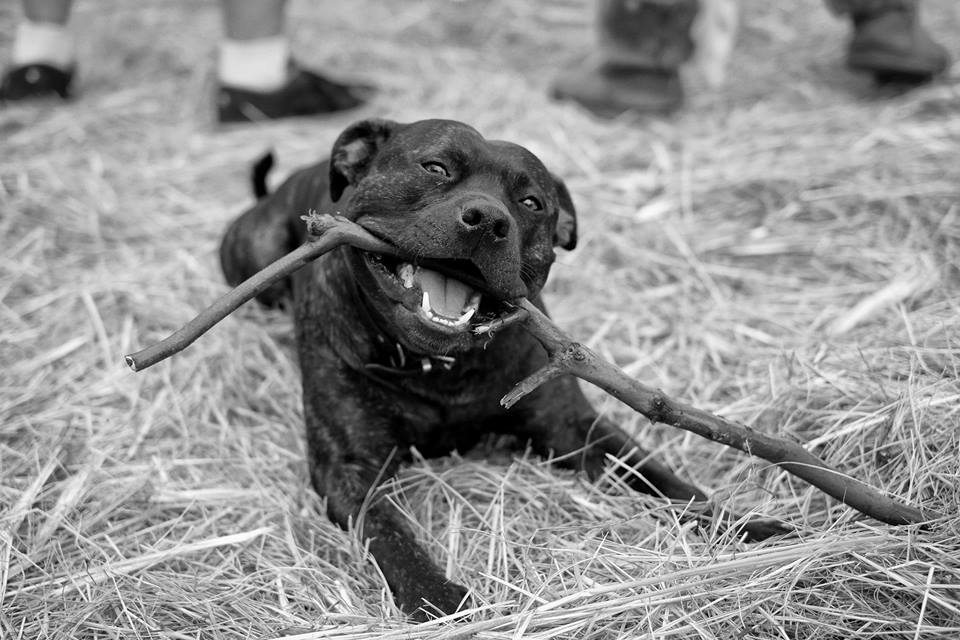
This black dog alleviates depression
Photo by Dennis Vogelsang


What timing! It is Mental Health Awareness Week and I am slowly, slowly sinking into the mire. She Who Hates Acronyms (SWHA) gently chides me: “Don’t be depressed – it’s boring.” Maybe, but it’s not like I can duck down to the Co-op and buy a happy mood.
The Black Dog* started sniffing around my door a fortnight ago, after we arrived home from a three-month road adventure. Aaah, I hear you say. It’s inevitable that you will go into a slump after a big, carefree colourful adventure, driving around the wondrous continent of Australia. (Theatre people report the same big mood swing when the performance finishes and the cast and crew “strike” the set.)
If I knew why my mood switched from carefree and energetic to pulling the blankets over my head and saying “no” to just about every encouragement to go and do something, then I wouldn’t be like this.
But let’s steer the conversation away from me and look at the numbers on depression in Australia. Beyond Blue is an organisation started to create awareness of depression and anxiety and the tendency of the average male to throw another beer down his throat and ignore his deepening mood.
Beyond Blue reckons that 45% of people will experience a mental health condition in their lifetime. In any one year, around 1 million Australian adults have depression, and over 2 million have anxiety. There is a tendency among men and women to self-medicate by drinking alcohol and/or smoking marijuana. Neither of these activities eases the blues nor makes one feel less anxious.
Both drugs tend to make the user feel as if he is happy and carefree again, but it is like throwing a doona over you in the nippy dawn – it will slide off and you will feel cold again.
Women often experience depression after childbirth and both sexes can be tipped into the blues after a bad bout of ‘flu’ or similar illness. Depression can be situational – it’s hard to stay upbeat when your partner is physically or emotionally abusive. Unemployment can bring on the blues, and, once entrenched, can cause an endless cycle of despair. Or, as in my case, it can be a biological imbalance.
The politicians who came up with the (now lapsed) plan that the unemployed have to make 40 job applications a month or lose the dole manifestly never suffered from depression or anxiety.
The key solution to combatting depression, I have found, is to get busy. First, make sure you are getting a good night’s sleep, even if it comes to taking sleeping pills. Next, review your diet. Skipping breakfast are we? Working right through lunch? Eat red meat at least twice a week, avoid or cut down on coffee and sugar and drink lots of water.
Exercise is a key tool. Just put on your walking shoes and go for a walk somewhere, preferably at first light. Then find at least one thing you do that brings you optimism and fulfilment (this could be anything from painting or knitting to singing in a community choir, playing guitar or the bagpipes, gardening or tackling all of those long-neglected handyperson chores). Get up on the roof and clean the gutters and the solar panels. If you don’t like heights or don’t trust yourself up there, get stuck into the garden. Bag all those weeds and take them to the dump. You are bound to meet other people there who are also “battling depression” by keeping busy.
Did I mention taking medication? It works for me, but even if you don’t trust anti-depressants and the tendency by GPs to over-prescribe, you can work on alternatives – yoga, meditation, vitamins, herbal remedies and, best of all, spend time with ebullient, optimistic people who don’t suffer from depression. They might not want to hang out with you in your current state of mind, but if you make the effort to be sociable, being around upbeat people can be therapeutic.
Blame the media – why not?
Moreover (archaic word used for effect to show I went to university), the media must take its share of the blame for the nation’s mood.
We have introduced a media ban in this house. After three months on the road and not watching the TV news, mostly not listening to radio news and only occasionally reading newspapers, we deduced that the media in general is to blame for keeping the population in a constant state of high anxiety and dread.
I asked my research assistant Little Brother to have a look at media coverage of terrorism in the past two weeks. He grizzled for a while as he’s not had much to do in the past three months. But as one of my old bosses used to say: “If you want something done, give it to an obsessive.”
LB came back from the local library, his pale English cheeks aflame.
“No wonder we’re all feeling anxious and depressed,” he said. It transpired that The Australian has published 84 items about terrorism and terrorists in just 12 days.
He says the preoccupation with Muslims under the bed is no less intense in the tabloid world, the Fairfax media or on TV or talkback radio. That’s the problem with the 24/7 news cycle – it forces media outlets to follow the herd. The haste with which news is published can force some horrible mistakes – eg Fairfax Media publishing the photo of an innocent party, claiming him to be the unfortunate teenager gunned down in Melbourne.
Little wonder there is an unquantifiable drift to what I call “Fair Trade” media – The Monthly, The Quarterly Essay, the Guardian online, Crikey, The Big Issue, The Epoch Times, The Conversation and the New Internationalist.
What messes with your head is radio and TV news (updates every hour). The nature of the beast demands attention-grabbing headlines. The print media uses the same tactics, either through its online pages or the posters outside newsagencies.
Little Brother told me there was a bit of a stir this week over a headline (“Monster Chef and the She Male”), used to describe a gruesome murder-suicide. “Don’t go there, mate,” he warned.
“Don’t they ever consider those poor people have Mums and Dads somewhere?”
He has a theory that the media is revisiting the era of Yellow journalism in a bid to shore up circulation. Yellow Journalism (using lurid headlines, exaggerations and sensationalism to sell more newspapers) was a technique used in a circulation battle in the late 1880s between William Randolph Hearst and Joseph Pulitzer.

Sigh. Time to take the dog for a walk (or do some housework – it’s a lot easier now that there isn’t a pile of newspapers to tidy up.)

*this black dog alleviates depression

What’s yours is a mine

Those of us who love the serenity and pristine nature of National Parks had better start linking arms. Governments in Australia are bending to the will of mining companies to allow mining and coal seam/shale gas projects, if not inside National Parks, then way too close for comfort.

Tom Price open cut pit

Karajini National Park in the Pilbara region of Western Australia is surely one of the 10 natural wonders this country has to offer – and it sits alongside an enormous open cut iron ore mine. The WA State government excised the Rio Tinto-owned Marandoo Mine from the national park in 1992. The WA government bans mining in all but three national parks – one of which is Karajini.
Rio Tinto operates 15 iron ore mines in the Pilbara and has spent $880 million opening up new mines. Even the 50-year-old Tom Price mine is still operating and now processing ore from the nearby Western Turner Syncline. While Tom Price is a mining town, almost all of these new mines use the preferred method of flying workers in and out of mine sites.

Kalamina Gorge

After spending three days camping in the breathtakingly beautiful Karajini National Park, we drove past the Marandoo Mine, located in a narrow valley of the Hamersley Range, effectively splitting Karajini into north and south areas.
Next day, we took a tour of Rio Tinto’s open cut iron ore mine in Tom Price. You could not develop a mine like Tom Price today. Some of its pits, like the one pictured, are 500m deep and require constant pumping, as they fill up with ground water. Big mining towns like Kalgoorlie, Tom Price, Broken Hill and Mt Isa were discovered and developed long before such inconveniences as environmental impact statements, air quality monitoring and workplace health and safety procedures.

While Rio Tinto has become the industry leader in worker safety, mining is still very dangerous work. Safe Work Australia figures show that 70 people died in the mining industry between 2003-2004 and 2009-2010. In WA, the Department of Mines and Petroleum says 52 people were killed at work between 2000 and 2012, although the incidence has dropped since then. Despite the risks, the above-average wages and the work-hard play-hard environment is attractive to healthy young men and women eager to save for a deposit on their first home or build a career.
We spent half a day in Mandurah visiting relatives and were astonished by the rapid growth of what used to be a Perth satellite suburb and is now WA’s second-biggest city. It is crammed full of big, new houses where many of the Mums (and the occasional Dad) stay at home with the kids until Dad (or Mum), comes home for their days off from one of the FIFO mine sites.
The Tom Price mine started production in 1994 and Rio Tinto approved an expansion in 2011 that will extend the life of mine to 2030. The Hamersley Range is so full of iron ore you can never afford to say that the Marandoo excision was a one-off. Indeed, the hill behind the Karajini National Park information centre is of particular interest for its high iron ore content. Mines appear in all kinds of unexpected corners of the country. We headed down a dirt road toward Sandy Point, south of Geraldton, attracted by stories of a friendly, laid-back beachside campground with sparkling white sand, great fishing and safe swimming.
It was just as beautiful as we’d been told, but its immediate neighbours are two big sand mines. Sand dunes along the WA coast are exploited for their heavy mineral content – ilmenite, zircon, rutile and monazite.

Fracking comes to WA
The one thing I did not expect to see, driving along Western Australia’s Coral Coast via the Brand Highway, was a large sign denouncing the process of ‘fracking’. The 2-metre high neon sign simply says “Fracking Poisons Water”, a matter for debate, but in this instance serving as a “What’s going on around here?” prompt for motorists. (Fracking involves pumping high pressure water, sand and chemicals into subterranean rocks to release the gas trapped there).
What’s going on is that Sydney-based listed company AWE has made a significant new shale gas discovery in the Dongara/Wagina reservoir. Anyone familiar with the terrain along WA’s Coral Coast would realise that Dongara, south of Geraldton, is on the doorstep of Lesueur National Park.

Leseur National Park, WA

Prior to our recent trip to WA, we were unaware of Lesueur National Park, a unique bio-diversity hotspot of some 27,000ha. It protects 900 different plant species, more than 10% of the flora of WA, and seven species of rare fauna. Lesueur, which is a must-do on the tourism wild flower trail, has already once been saved from the rapacious advances of the extractive industries.
In 1990 there was a rare meeting of minds between conservationists, lefties, righties, local land owners, fishermen and farmers to rebuff the mining/energy industries.
The Hill River Station proponents wanted a 2.5 million tonnes a year open cut coal mine and a 600MW power plant near Mount Lesueur, 25 kms from Jurien Bay and the Coral Coast.
The Environmental Protection Agency rejected the proposal as a result of overwhelming public protest and two years later the park was gazetted.
AWE has all but dismissed claims that its plan to exploit tight and shale gas reserves poses a threat to groundwater. The West Australian’s Daniel Mercer was invited to travel to the Senecio well site where AWE managing director Bruce Clement put his side of the story. He stated that horizontally-fractured wells found in WA’s mid-west were always at least 1.5 km deeper than aquifers and there is “invariably” an impermeable layer of rock between the gas and the water.
Conservation Council of WA director Piers Verstegen told the West Australian that if AWE was so comfortable with fracking it would have been more upfront in telling locals of its intentions. Land owners and environmentalists are concerned about the progress of drilling by AWE and others, given that a Parliamentary Inquiry into fracking is ongoing and unlikely to be completed this year.
The Green Left Weekly says if unconventional gas exploration and fracking is allowed on the border of Lesueur National Park, it would set a precedent that would allow fracking throughout the mid-west of WA.

Meanwhile, Queensland shuts the gate
It is probably worth pointing out that in Queensland, this kind of public support to oppose a mining proposal can no longer happen. A controversial new mining bill shuffled through Queensland Parliament last month (September), has restricted the right of appeal on “philosophical” grounds. The right to object is restricted to neighbouring property owners of the land to be mined, drilled or otherwise developed.
Understandably, the Lock the Gate Alliance does not think much of this new law, and the Greens are likewise upset.
You should be too. In theory, a drilling crew could set up at the end of your street and start looking for coal seam gas and only the people in the adjacent houses would have a right to object.

The return of Slideshow Bob

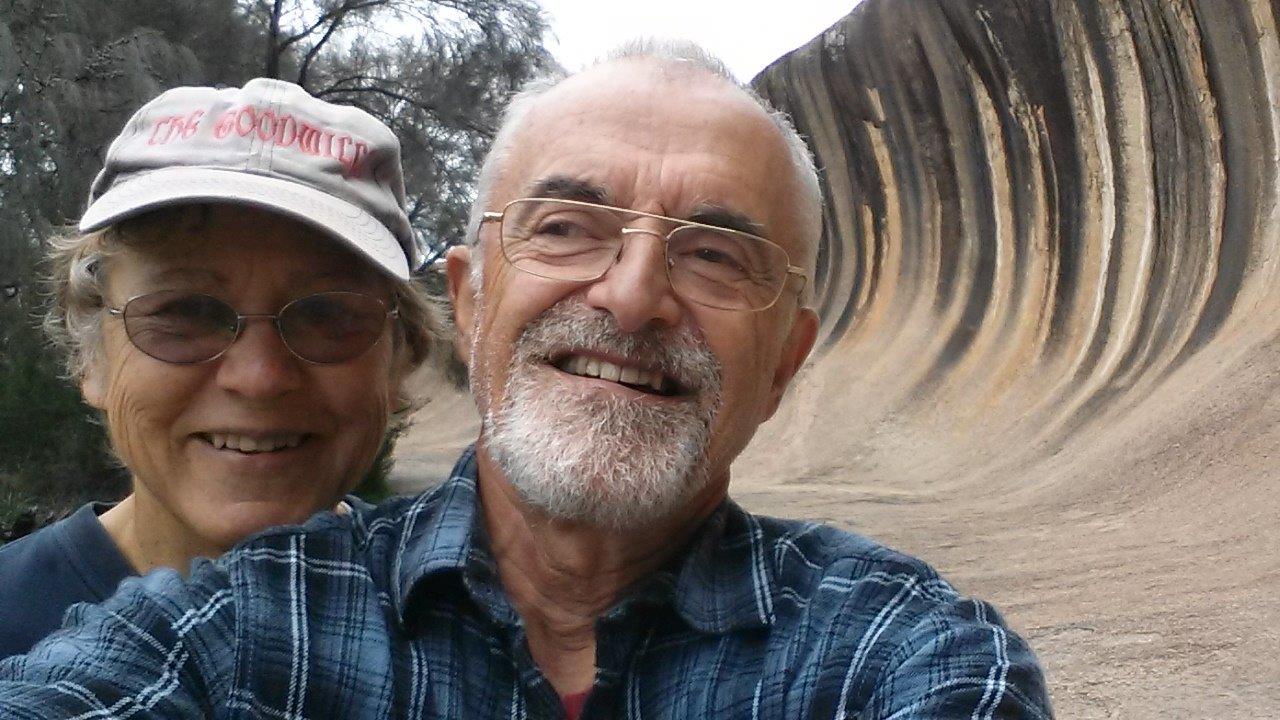
Wave Rock selfie

Welcome to Bob and Laurel’s truly excellent slideshow of Western Australia and all the States and Territories we went through to get there (and back). Come on in and find yourselves a seat – you two can sit over there, Fred can sit here and Mary thanks for coming and sorry to hear Trevor has a cold. Now tonight’s show, just so you know, will go for about nine hours, but the good news is we’ll have a supper break, a midnight snack, frequent comfort stops and breakfast.
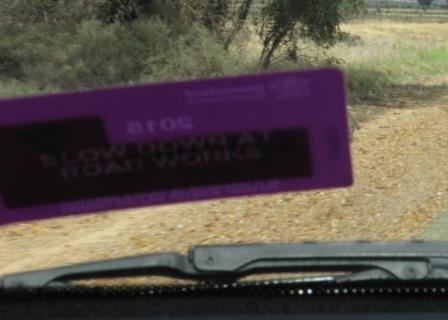
This second slide needs some explaining – Laurel took it through the windscreen. Admittedly it’s a bit fuzzy, but there is a cat in there… Unlike last year, that’s the only feral cat we spotted, but we needed a photo because I wrote a song about feral cats. Oh you didn’t know? It’ll be on my new album, out soon!
As you might have gathered, we’re home, and I’m talking to trees again. She Who No Longer Watches ABCNews24 (hereafter referred to as Ed. for the sake of brevity), plans to select her ‘Top 10’ photos once she downloads and goes through the 8,000 or so images. All I know about the 9,000-odd photos and videos that I took is that I will need to be very disciplined and employ my hard-earned editing skills (writers call it “murdering your darlings”). We both became keen twitchers (bird-watchers), on our three month sojourn, so there are at least 12 photos of every bird that caught our eye, even the everyday Willy Wagtail.
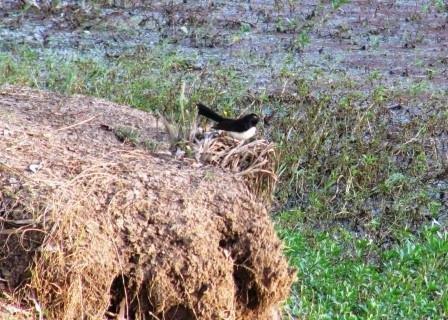
This particular Willy Wagtail followed us wherever we went. Even when we pulled into the driveway of our friend’s place at Warwick on the penultimate afternoon of the journey, there was Ms Wagtail, flitting about, harassing other birds and generally singing its merry little song that somehow reminds me of the song “Baby I’ve been watching you”. The Wagtail (and its Kiwi cousin the Fantail), are said to be messengers or spirit guides by the indigenous cultures of Australia and New Zealand. Just thought you’d like to know that.
Ah, the photos (some of which have already ended up on Facebook). There are so many wondrous vistas, close-ups of wild flowers, peerless sunsets, verdant gorges, wind-tossed deserts and wide open spaces, our friends are surely expecting a home-made calendar in the mail for Christmas.
Today’s technology is a long way from the old-fashioned slide evenings of our childhood. Someone would come over with a slide projector, one of those round cartridges that holds 300 slides and a suitcase full of 35mm colour slides. Mum would pin a sheet to the wall and we would all be herded into the living room where Dad had the kero heater going, puffing away on his Capstans. It was a struggle to stay awake through what seemed like hours of happy snaps from Harry’s two weeks in Japan at the 1964 Olympics.
“Now this is my favourite shot – there’s Peter Snell (record-breaking middle distance runner), leading the NZ team around the arena.” Taken with an Instamatic from seat 73, row 110 on the eastern stand looking into the sun. (New Zealand won three gold medals in Tokyo. Just thought you’d like to know that, too).
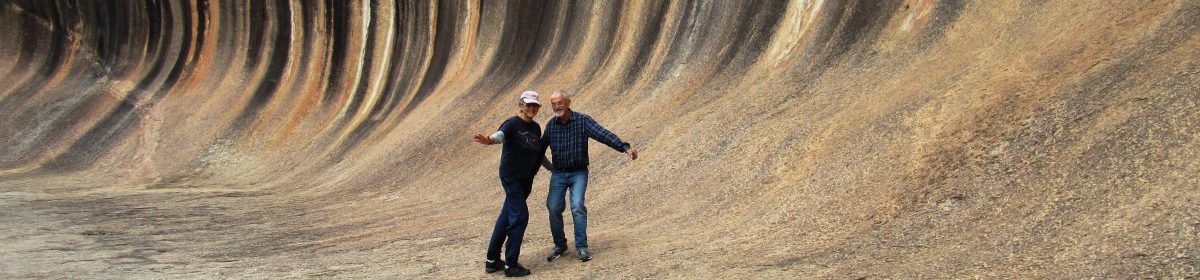
Now that we have all this amazing digital photo technology, it’s a shame not to use it as often as possible. We tried to be groovy old folks and took a few selfies (see opening photo at Wave Rock in Western Australia).
We noticed some people cheating – taking selfies with extendable kits – a monopod arm and a shutter release cable. Our preferred method is to chat to people who are admiring the same scenery and ask them to take a photo. Or you can prop your camera on a rock, set the 10-second auto button then run back into the picture. In most of those photos I look like a bloke who has suddenly discovered his fly is not done up.
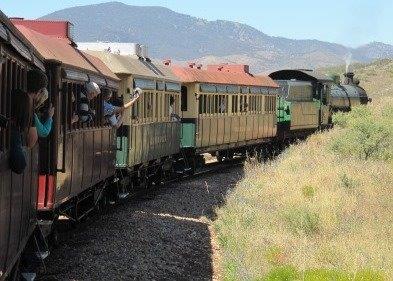
We went on a steam train excursion in South Australia – from Quorn in the lower Flinders Ranges to a hamlet called Woolshed Flat. Whenever the train went around a bend, everyone would rush to the other side of the carriage and stick their heads, elbows and cameras out the window.
The typical photo is like this one (left) – mostly other people’s heads. It hardly seemed worth the risk of getting cinders in your eyes. The best photos and videos of this particular excursion, of course, were those taken by the people stopped at level crossings who waved as we chuffed our way up the next hill.
I chatted to a fellow passenger from Melbourne who was on the last leg of what Grey Nomads call “the lap”. Like me, she had taken thousands of photos and at this late stage of the game was a bit burned-out and was having a rest from the camera.
“What’s the point,” she said with a sigh. “When you get home the only people interested in looking at them are us.”
It did not escape our attention that taking photographs of landmarks and scenery is a low priority for people who are travelling the country on some sort of a mission. They rely on their support crew to document their journey.
The Black Dog Ride is a 32-day, 14,500 kms circumnavigation of the country by 65 bike riders who share the founder’s passion for raising awareness of depression and suicide prevention. This well organised adventure has raised more than $1.6 million for mental health services over the years.
Then there was the intrepid group of over-65s riding 50cc scooters from Port Augusta to Perth to raise money for Beyond Blue, an organisation dedicated to raising awareness of depression and suicide in Australian communities. The Scootarbor Challenge has so far raised more than $50,000 for Beyond Blue. The participants stop every 70kms or so and swap riders, probably a good idea as the day we saw them outside Ceduna, they were about to ride into strong head winds.
We also came across a group of 40 men and women riding 110cc ex-postie bikes from Brisbane to Adelaide via Birdsville and remote desert roads, for no other reason than they thought it was fun. Members of this group pay about $5,000 for the privilege, which includes an ex-postie bike, all accommodation and support while en-route and a flight home. Riders are encouraged to donate their bikes to Rotary at the end of the ride.
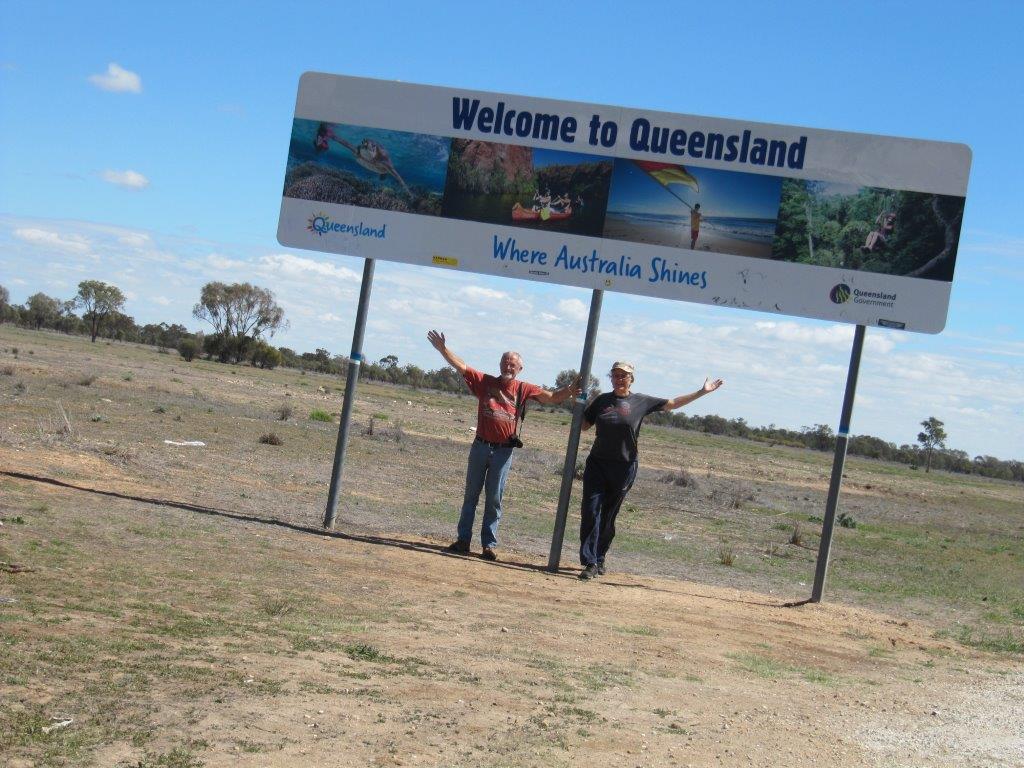
The above has renewed my resolve to delve into our documentary material and prepare a summary of our journey. It may well be this time next year before it’s done. It will probably include this photo taken on a timer when we arrived at the Welcome to Queensland sign on the NSW side of Goondiwindi. (Run, it’s flashing!)Welcome to Qld

Killjoy was here

Mary Pool
Mary Pool, WA

You are probably wondering why, of the 2.04 billion disposable nappies Australians dump every year, I chose to write about one in particular. It was a while ago now − we had just discovered our first truly appealing free camp, on the banks of Mary Pool in the Kimberley. After setting up camp, we walked over a concrete causeway and spotted a (used) nappy thoughtlessly left lying on a flat rock next to the pool. She Who Keeps Changing Her Pseudonym hates it when I get on a rant about things like this (“bloody selfish idiots spoiling my “quiet enjoyment,” is one of my oft repeated comments).
I was going to puff and bluster this week about bloody Iraq and why are we going there (again), on a mission yet to be sanctioned by the United Nations. But I’m OK now. Alert, but not alarmed, apart from concern over the common law rights of the six people still being detained without charge after a counter-terrorism raid. They can do that, you know – it won’t happen to you, though, so worry not.
But let’s get back to the nappy story. While disposable nappies have been around since 1948, their almost universal use in first-world countries today is supported by those who say they are a safer, easier, more hygienic option than cotton nappies. But Robyn Barker, retired family health nurse and author of Baby Love, says single-use nappies have changed our behaviour. “Many otherwise fastidious people forgo the rules of normal hygiene and dump human poo in domestic wheelie bins, waste paper baskets, and public rubbish bins in parks, streets and shopping centres,” she wrote on The Drum.
From our own observations travelling many a kilometre in WA, it was no surprise to learn that Western Australia has the worst outback road litter problem of any Australian State or Territory.
The State Government makes “Outback Packs” available to people to keep in their cars so they can pick up after themselves (and others). Even so, roadside litter is often quite bad at outback rest areas and diabolical at places with no toilets. Often enough there will be more litter around the bright yellow metal bins (with heavy iron grate lids, so we can’t blame crows for the mess), than there is in the bins themselves.
Litterman 0I decided to do my own “Emu Patrol” after getting out of the car for a photo next to one of those Nullarbor road signs which warn you to watch out for camels, emus and kangaroos. I picked up a coke can, two beer cans, two stubbies, a triple-A battery (what the…?), a 1-litre plastic milk bottle, chip packets and chocolate bar wrappers and a dog-eared copy of Lazarus Rising (I made that bit up). I completely drew the line at toilet paper, ribbons of which flapped around amongst the saltbush. You’d never know where it had been, would you? I threw the bag in the back seat, irritated, swatting flies and convinced the task was only 20% accomplished. After a few more minutes down the road, SWKCHP complained about “that terrible stink” and she was right. We stopped at the next rest area and put the bag in one of the aforementioned yellow metal bins. I’m told some drivers and /or their passengers (male, obviously), pee into cans or bottles and toss them out the window.
It is this sort of deplorable behaviour that perhaps explains the excessive use of scolding signs by caravan park managers. A lot of parks have boom gates and require a $10 or $20 deposit for a key to the amenities. Upon entering said amenities, there are many and varied instructions on how to clean a toilet bowl after you have used it, and exhortations to flush twice (but not waste water, even though many of their taps need washers). One sign above a urinal said “No Smoking Grafitti” which is what you get when you use faulty ellipsis. SWKCHP particularly liked the sign that forbade men and women from sharing the same shower.
What do they expect if they are only going to give you one key? One manager wrote a mini-essay about why they lock the amenities – ‘because bludgers sneak in under cover of darkness and use the amenities and then sneak out again before sun-up without paying’.
So as usual, bad behaviour by a few tarnishes the rest and management uses bossy signs as a way of not having to hire more staff to keep an eye out for bludgers that don’t pay.
You see a lot of graffiti when you travel around this country using public amenities. Scribbling on dunny walls is a time-honoured way of leaving your thoughts, however deep or shallow, for posterity. It is also a way of declaring your public love for someone, or to leave a mobile number for anyone who wants a good time. Not all graffiti is limited to toilet walls, alas. I have lately become aware that a species of humans have been tagging and scribbling on Aboriginal rock art. Some have even had a go at mimicking said art. A few even took their own chisels, apparently.
There is a natural assumption that vandalism of this order is done by people who would not know the meaning of the word desecrate. Unhappily this is not always true. If someone scales a large rock in the remote outback and sprays “Terra Nullius” in large black letters, it is surely premeditated. This probably explains why a lot of the Aboriginal rock art we saw in South Australia is locked away behind heavy metal fences.
The ABC reported recently that vandals have permanently damaged ancient Aboriginal rock art in Western Australia’s Pilbara region. The damage at the site of some of the world’s oldest and largest Aboriginal carvings on the Burrup Peninsula has left elders devastated. Elder and senior cultural ranger Geoffrey Togo said he and others had been finding examples of people spray painting on rock art, on the face of rocks, and on some other old carvings.
“It makes me angry when they do it,” Mr Togo told the ABC.
“You don’t see me going to church and doing the same thing in the church or someone’s home.”
It’s a universal problem, unfortunately. In Washington State, the Salish tribe was assailed by the vision of someone declaring his (or her) love for ‘Miranda’. Georgia Newsday said the 43-million-year-old Tamanowas Rock northwest of Seattle has been used for millennia by the tribe for hunting, refuge and spiritual renewal rituals. So yes, the 2.5m long pink slogan, I (heart) Miranda, could in this context be deemed culturally inappropriate.
Now that you are suitably outraged, I will leave you with a bit of helpful advice about culturally appropriate practises: viz
“This is were (sic) you poo”- writ large on a dunny wall on the Nullarbor.
And this gem:

???????????????????????????????

Crossing the Nullarbor

Nullarbor
The author on the Nullarbor Plain
NASA_Nullarbor
NASA satellite image of the Nullarbor Plains (public domain)

A Brisbane lawyer I know who is an ‘Australia all Over’ listener came over at a corporate function one time to say he’d heard ‘Underneath the Story Bridge’ on Macca again. “So tell me,” he said, “Are you responsible for “Not Bloody Golf Again”? (A popular tune performed by Frankie Davidson and the late Dawn Lake). He seemed agreeably pleased to hear I didn’t write the song, probably because the corporate world is serious about its golf and doesn’t like anybody dissing (Gen Y speak for disrespecting), the sport.
I was musing about the people I know who do enjoy a good round of golf when we started crossing the Nullarbor this week. The Eyre Highway Operators Association has come up with up with a magnificent tourism gimmick – the world’s longest golf course. The Nullarbor Links is an 18-hole, Par 72 course spread over 1,365 kilometres. You tee off at Kalgoorlie in WA, then throw the clubs in the car and drive a good few hundred kilometres to the next hole at Norseman. And so on across the Eyre Highway, playing one hole in each participating town or roadhouse all the way to Ceduna in South Australia. And good luck to them.
We started our run back east on Sunday, travelling from Lake Douglas Recreation Park, a quiet free camp some 12kms to the west of Kalgoorlie. We did a whistle stop tour of Kalgoorlie (the museum, the Super Pit (500m deep open cut gold mine), the Arboretum and the 24/7 IGA) and then drove to and through Norseman to Fraser Range Station. We’d become so used to good weather on this trip we failed to notice the huge low system developing across the south west. Many places had rain – some even had 40mm! But the rain came with strong, squally storms and wind gusts of up to 100kmh.
Fortunately, Fraser Range Station had good sheltered van sites so we more or less slept through the night.
After Fraser Range – beautiful granite country and part of south west WA’s vast hardwood eucalypt forest, we drove on to Cocklebiddy, another roadhouse outpost.
We got through the journey quickly (tail wind). It was so windy in Cocklebiddy (population 8), that we left the roof down on our pop-top caravan and went to the roadhouse for fish and chips (me) and lamb shanks(ed). Tuesday it was still windy, though not quite as extreme. We got up early and headed to Eucla, the first stop on the eastward crossing where you can easily get to the beach. The ruins of the Eucla Telegraph Station lie half buried in sand dunes about 4 kms down the hill from Eucla Pass. We drove to the end of the road and walked to the ruins, marvelling at the stoicism of the first Telegraph Station keeper, living way out on a salty windswept plain surrounded by white sand dunes. In 1877 the operator sent his first message: “The Eucla line is open. Hoorah!”
We walked on another 500 metres or so to a desolate beach on the Southern Ocean – thankful to get back to the car after navigating our way through disorienting salt pans, sand dunes and scrub.
Australians tend to refer to all of the land between Perth and Adelaide as ‘The Nullarbor’, but if you look at the NASA satellite photograph (left), the Nullarbor Plain is the pale brown semi-circle bounded by the Southern Ocean to the south and the Great Victorian Desert to the north. It’s big, though − 200,000 square kilometres of flat, arid and virtually treeless land. It encompasses part of the Woomera Prohibited Area, where the military has tested weapons over the last 60-plus years.
It’s not a Lawrence of Arabia-type desert. This one has saltbush, bluebush, Mallee and other hardy plants, not to mention birds, reptiles and other fauna. If you are interested in nature, conservation, bush walking, bird watching, palaeontology, botany, geology or Australian history, you could spend a year on the Nullarbor and still not be bored.
If you are on a drive (some guide books depict this as Australia’s ultimate road trip, akin to Route 66 in the US), then be aware, it is a gruelling trip. The road is in very good nick, but dead straight in many places, including the “90-Mile Straight” – 146.6 kms between Balladonia and Caiguna.
Ah, so many impressions: a P-plater out for a drive with Dad − a sort of white fella desert initiation, I guess. Cyclists cross the Nullarbor – the smart ones wear fluorescent safety vests and do their riding in the early hours of the day. Birds of prey don’t stray much from their hunting zone, but they are always there. We saw a wedge tail eagle that, intent on a road kill breakfast, only just escaped our front bumper bar. There was a big male emu outside Eucla picking his way through the foliage with six or even eight chicks trailing behind. We saw several Southern Right whales and calves frolicking in the Southern Ocean just off the Head of Bight, a conservation park with a boardwalk and lookouts just 12kms off the highway. From there you can also see ancient sand dunes and the epic Bunda Cliffs.
But each to their own − some are on a journey, some are just driving, and some are on a deadline, delivering goods from one state to another. We encountered many a road train, but no scary moments with these.
We saw a convoy of Model T Fords on their way to a convention in Busselton and just yesterday chatted with a woman who is driving solo from WA to Strathalbyn in South Australia for the Australian sheepdog championships (towing a caravan and carrying eight dogs in a cage on the back of the ute).
Many people use the Nullarbor Crossing as a way to raise funds for charity. We met a group of seniors riding 50cc scooters from Port Augusta to Perth to raise awareness about depression and suicide.
At the first lookout where you can see the eroded cliffs of the Great Australian Bight, we met a man in his 50s on a pilgrimage and taking Mum and Dad along for the ride. “I did it years ago in an XY Falcon with three Aussies and three Germans,” he said. Dad was walking slowly with a stick, but he got to the lookout and you could see how happy son was to relive his epic trip and share the joy with his folks.
They got back into his shiny red Falcon sedan and off they went, down the Eyre Highway towards the Nullarbor Roadhouse, watching out for wandering stock, camels, emus, wombats and kangaroos.

Songwriters on the road

Fred Smith’s Queensland band – Rebecca Wright (cello), Emma Nixon (violin), John Thompson (tour organiser), Erin Sulman (percussion) and Fred.

When songwriter Fred Smith brought his show Dust of Uruzgan to Maleny in November 2013, he called me and asked if the band could rehearse in our downstairs room. It seemed the venue was not available until 4pm and he needed to rehearse with his locally recruited band. So Fred and five other people arrived at our place (bringing the makings of lunch with them), which explains this happy snap (left).
Self-funded songwriters have to do these sorts of things all the time in Australia, when they can’t afford to fly people in for two gigs. I remember that concert because Fred managed to pull more than 100 people to a small town gig on a Wednesday night. They were a listening audience too, and that’s a good thing for songwriters who tell long, involved stories. Fred (I wrote about his WA tour last week), has been pursuing his passion for songwriting for 17 years and like many of us, he is finding it harder to draw an audience in a sports-obsessed country.
I have a lot of admiration for songwriters like Fred, John Thompson and Nicole Murray (Cloudstreet) and Roz Pappalardo and Chanel Lucas (Women in Docs). They have worked hard, toured hard and persevered. I decided this week to ask some of the songwriters I know who have been doing this for a long while just what it is that keeps them going.
John Thompson and Nicole Murray chose to make music their career in 2002, after working seriously at music around day jobs for two years. Since then, they have toured seven times to the UK, and have also been to USA, Denmark, Germany, Japan, New Zealand and Morocco.
“There are still plenty of places in Australia we haven’t seen,” says Nicole. “Most of our touring in Australia has been east coast, from Townsville to Tassie, with a couple of trips to Adelaide and southern WA, once as the entertainment on the (Indian Pacific) train.”
Cloudstreet sing both traditional and original songs which fit into the Australian and Anglo-Celtic traditions, using close harmony vocals and a range of instruments. After years of touring and turning out seven Cloudstreet CDs, the duo took a year off when John was cast as The Songman in the travelling stage show, War Horse. While John was away on tour, Nicole made two recordings with violinist and singer Emma Nixon as The Wish List. Now John and Nicole are planning to record again in early 2015 to take a new CD to the UK in May.
Is there is a living doing what you do?
“There is usually money to be made when touring, but the cost of the travel, food and accommodation eats a lot of it up,” says Nicole.
“We can afford our rent when touring but it’s not so easy when we come off tour. Because of this we have diversified and are concentrating on musical activities that can be sustained locally a bit more, like choirs and dance bands.”
Ah, but will you still be doing it when you’re 74?
“I think we will find a way to keep making music, because the emotional sustenance it provides is essential.”
Queensland acoustic duo Women in Docs (Roz Pappalardo and Chanel Lucas) have toured all over Australia and beyond since forming in 1998.
“We formed after years of playing in rock bands across Far North Queensland and deciding that singing our own songs, telling our own stories and using our own set list was more important than almost anything else,” Roz says on the phone from Cairns.
“It’s hard to know how many k’s we’ve driven. I wish we did know. I think we’ve probably driven from Cairns to Adelaide maybe 25 times? We’ve never driven to Perth but flown there many times and we’ve done Darwin as Women in Docs once. We’ve crisscrossed both America and Canada in a car. Goodness!
Roz and Chanel regret not listening to their intuition more – “it’s always right, you know…”
“We always ‘knew’ that we shouldn’t have done something. But, even in those situations, we always get a cracking story and a potentially a song.”
Meanwhile the Docs are quietly beavering away, writing new songs and getting ready to tour in late October, the Tamworth Country Music Festival in January and then a few festivals in 2015.
“And hopefully a new record. Why not? We love it.”
Solo singer-songwriter and multi-instrumentalist Chris Aronsten has been persevering with music for 35-40 years.
“I just love it,” he says. Chris sings original songs, traditional folk and blues, and plays Celtic and bluegrass fiddle tunes.
“I started playing and singing as a kid in Brisbane in the 1960’s and moved to Adelaide in ’74, playing gigs at folk clubs, coffee shops and pubs. I went to Melbourne on and off for gigs and started writing songs back then too.
“I’ve been scratching out a living ever since, except for a brief time in the early ’90s when I had a second-hand guitar shop with a muso mate and did gigs on the weekend. After five years of that I just went back to playing full time. Couldn’t do both.”
Chris has produced two CD’s in recent years, one of which was praised by the Sydney Morning Herald’s Bruce Elder, and is working on songs for a new one.
“These days I’ve got enough of an established circuit here and in the UK that the next few months are usually (financially) secure.
“I guess I could be more ambitious, but I’m more excited about playing music than ever.
“I can’t imagine not still doing gigs when I’m 74 if I stay fit and healthy.”
Brisbane songwriter Mark Cryle’s best-known band was Spot the Dog, which produced three CDs of Mark’s songs and though the members have gone on to other projects, they remain good friends and often join Mark on stage.
“I have always tried to surround myself with good musicians – players who can find what is right for the song. I still think that the parts of my recordings that I like best are the parts I didn’t think up myself.
“I enjoy writing for different projects and am currently planning in my head two recordings – one of chamber folky sort of stuff with the Civil Union (Rebecca Wright, Donald McKay and Alice McDowell), and another CD more in the vein of Sideshow Alley.”
The latter, with its sweet nostalgic song about first love at the Brisbane Ekka, has received radio play. Another track, Kalgoorlie Girl, was nominated in Macca’s Top 10 for 2013 and Waiting for the Ice to Thaw has been included on Macca’s just-released compilation “Well I Love It”.
Mark says his next album will have a mixture of “relationship” songs and some narratives about the nation’s past.
“But I have a thesis to finish writing first, though.” (The origins of Anzac Day).
Granite Belt-based Penny Davies and Roger Ilott perform their own songs, as well as those of other, mainly Australian, writers. They have had their own studio and record label since 1982 and released about 20 albums.
They had a long association with the late poet and folklorist Bill Scott and as a result many of their songs have become well-known on ABC radio.
“Both of us have always seriously pursued a music career – about 40 years all up (each),” says Penny.
“We both started in the folk music scene in Sydney in the early 1970’s
“We’ve performed in about 100 towns throughout Queensland including Cooktown and Weipa and out west to Boulia and a fair bit of NSW.”
And is there a living in it for you?
“We’ve always got by financially by learning to live on a little. We used to make money touring when the Arts Council used to fund it. These days it’s difficult to make money if you have to travel to gigs.”
No regrets, though?
“I hope we will be making music till our last breath – so long as we can sing and play, we’ll sing and play,” says Penny.
Independent acoustic music artist Steve Tyson is another whose work has caught the attention of mainstream CD reviewers.
“I think it just helps reinforce the necessary social media marketing these days. There is so much stuff out there, so many people doing shows, that fairly constant (not crazy bombardment), social media messages help keep your upcoming show front of mind.
“I have always looked at touring as an adventure. I don’t want to lose money, and I at least want to pay my best mates who tour with me a few dollars to buy a few beers! Fortunately most tours have ended up in the black.”
Steve is about to go on the road with a new CD, “Green Side Up”. He says he tours to take his story songs to fresh audiences, and experience that “incredible feeling” when people are listening attentively to the lyrics.
“That’s the most important thing. Sure I hope that translates to sales and I want to cover costs, but that’s not why I do it!”
The challenge for narrative songwriters like Mark Cryle, Steve Tyson and Fred Smith and yours truly, is to find a listening audience. The pubs, clubs, restaurants and cafes that hire musicians are more often meeting places for people who want to catch up with their friends and have a conversation. Unhappily, this often happens at the tables in front of the stage.
We (The Goodwills) discovered house concerts were a good way of helping songwriters find a listening audience. We’ve promoted house concerts in Brisbane and Maleny over that last 20 years.
We usually do an opening set. There’s afternoon tea, carrot cake and I can go and have a lie-down before the guest act starts. We’ll be looking to do house concerts next year when we tour with my new CD, The Last Waterhole (shy retiring songwriter seeks listening audience: apply within).
Next week: Crossing the Nullarbor

Fred Smith comes home

Fred Smith Maleny
Fred Smith in concert – Maleny 2014

Few itinerant musicians could claim to have drawn a full house to a lecture at the University of Western Australia, but Australian diplomat and singer-songwriter Fred Smith did just that, on the topic Live like an Afghan. Fred was the subject of an Australian Story episode last year, which brought him from folk circuit favourite to the mainstream, no doubt accounting for the interest shown in his lecture.
Fred is currently touring a show called Dust of Uruzgan − a narrative of his time with a multi-national peacekeeping force in a remote dusty outpost in northern Afghanistan. He and his entourage were halfway through the 13-gig tour of Western Australia when we caught up with him for a meal at the Castle Hotel bistro in York, 97 kms east of Perth, and for a quick chat after the show.
In his role as a diplomat, Fred has been to Uruzgan twice – from July 2009 to January 2011 and then May 2013 to November 2013. The time he spent there made a big impact on Fred, and in turn, the songs and stories that emerged have resonated with ordinary people around Australia, as well as those who have personally experienced what he’s talking about.
The show begins with an emotive song from bass player and singer Liz Frencham and then moves on to a narrative, interspersed with Fred’s songs (written during his time at the multinational base at Tarin Kot), accompanied by a slide show using hundreds of photos taken by Australian Defence Force photographers and civilians. It is an absorbing presentation.
Fred’s songs differ from the work of most of his contemporaries, as the subjects of his songs are often real people. The song Dust of Uruzgan, for example, is a tribute to Australian soldier Ben Ranaudo, one of 40 Australians killed in action during this country’s engagement in Afghanistan. Many of those killed or injured were sappers, the forward patrols who scout for IEDs (improvised explosive devices), placed by insurgents along the roads used by the military coalition.
Fred’s song Sapper’s Lullaby has become something of an anthem for the Australian troops in Afghanistan and the families of those who lost loved ones. The last Australian troops were withdrawn from Afghanistan in December 2013. Since coming home, Fred has been touring Dust of Uruzgan around all parts of the country.
The WA tour was 18 months in the planning, and Fred says it is a civilised tour, because the band get to stay in motels, there are proper meals and days off. There’s a PA and stage lights and someone to operate them. All the same, Broome to Esperance with 11 other stops along the way is a big commitment, more than 3,000 kms and not much time for sight-seeing.
The tour is organised by Country Arts WA and sponsored by the WA government Department of Culture and Arts, Lottery West, Healthway, GWN7, the ABC and Act Belong Commit, a movement to encourage people to achieve better mental health.
The tour covers familiar territory for Fred, whose parents were teachers in Regional WA until his father got a job with the Foreign Affairs Department in Canberra in 1969. Fred returned to Perth as an adult to study Law and Economics, completing his studies at the Australian National University. He took a job with the Department of Foreign Affairs and Trade in 1996 “about the same time I caught the songwriting bug”.
While he is making money at the moment, touring with a properly funded show and enjoying the mainstream popularity of the critically acclaimed Dust of Uruzgan, it is not a way of life he sees going on forever.
“I just don’t think (touring) is viable in Australia anymore, and especially not financially viable. The towns are too far apart and people are more interested in sport.”
Despite Fred’s pessimism about the future for independent musicians touring Australia, the Dust of Uruzgan tour is doing quite well – 100 at Exmouth Yacht Club (big military presence in Exmouth) and 60 on a Monday night in York are quite respectable numbers for this type of show.
Fred says the tour is about raising awareness of what Australian troops were doing in Afghanistan and how much they need support at home.
“The Vietnam generation got back and no-one knew what they had been through and they copped a lot of hostility, even from the RSL.
“Over the last 12 years, 20,000 young Australians have served in Afghanistan. Regardless of what you think of our involvement there, it is important that their story gets told and heard so they don’t walk the land as strangers, like a generation of Vietnam veterans did.”
Fred told the York audience that soldiers injured during the conflict have struggled on returning home, through a combination of their injuries and post-traumatic stress disorder (PTSD), and some had since taken their own lives.
Prime Minister Tony Abbott, welcoming the last troops home in December, said it was a heavy question to weigh up if the war had been worth the price paid (referring to the effects on those who had served in Afghanistan over a 12-year conflict and the cost of more than $7.5 billion).
“If you look at the benefits for our country, for Afghanistan, and for the wider world, then my conclusion is yes, it has been worth it,” the PM told the ABC.
“But not for a second would I underestimate the price that’s been paid by individuals and families, and the price that will continue to be paid because, while there are 40 dead and 261 wounded, there are hundreds, if not thousands, who will carry the psychological injuries with them for many years to come.”
Meanwhile, Fred Smith says he has come home to find balance in his life, although for now he has a fairly hectic schedule. Fortunately for Fred, DFAT seems to think a lot of what he achieved through using music to build relationships and trust during postings to Bougainville, the Solomon Islands and Uruzgan.
“I’m busy all the time. I work part-time for DFAT and because most of the gigs we get are on Friday, Saturday and Sunday, I spend the weekends doing that.”
He will be on the road again in October launching his new CD, Home, which though mostly set in the domestic frontier (home), also contains a couple of strong songs about the difficult return many soldiers face coming home from Afghanistan.
“It’s about coming home and calming down. I became a Dad in January and I’ve already written a love song for my daughter.”
I asked him if he considers what he is doing as a job, or a calling.
“The only reason to make art in this country is if you can’t stop yourself, so yes I guess it’s a calling,” says Fred.
And is the candle worth the game?
“It depends what time of day you ask me. I’m OK, if I manage to have an afternoon nap!”
But can he see himself doing a Leonard Cohen, one more comeback in his 80s?
“Never say never,” says Fred.

Royalties for Renewables

Photo by Laurel Wilson
Walkaway Wind Farm

For the past six years Western Australia has been channelling 25% of the royalties it earns from the mining and oil and gas industries – capped at $1 billion a year – into regional community projects. The Royalties for Regions programme was introduced by the WA National Party in 2008 when it had more of a say in State government than it does now.
As we travel through WA, we can see this money being put to good use in hospitals, schools, regional programmes, community assets and community programmes – for example, an Aboriginal cultural centre and art gallery in Carnarvon and new buildings in Geraldton’s thriving universities centre.
We think this distribution of mining profits goes only so far. What if all States and Territories imposed a royalty (say 5%) which would be spent on renewable energy infrastructure? She Who Is Back Reading Newspapers peered over the top of The Australian to tell me Tony Abbott looked set to break another election promise by asking Dick Warburton to review Australia’s 2020 renewable energy target with a view to scrapping it altogether. Abbott now says he was just floating the idea. We hope it will be like a helium-filled party balloon and that someone lets go of the string.
Australia is often criticised by global renewable energy supporters for apparently squandering the abundant options we have to generate solar, wind and hydro power. There are only two commercial-scale solar energy plants in Australia. The Uterne (“bright sunny day” in Arrente language) Solar Power Station is a 1MW capacity grid-connected solar photovoltaic system 5 kms south of Alice Springs (it provides 1% of the town’s power). Then there is the 10MW Greenough River Solar Farm near Geraldton. On last year’s figures, the cost of using photovoltaics is less than half the cost of using grid electricity.
But despite this, the Federal Government’s $95 million Solar Cities programme is not exactly catching on. Surely solar is a better option for remote communities and roadhouses than the ever-present 24/7 diesel generators. Timber Creek is one of six small NT townships (also Borroloola, Elliott, Daly Waters, Ti Tree and Kings Canyon), that are largely diesel-fuelled. Most of the larger towns supplied by NT power company Generation are powered by gas or diesel. Generation says it also works with independent power producers to support renewable energy power generation initiatives. From our observations, solar power in the outback is small-scale and limited to solar-powered water pumps and the like. Many remote roadhouses, caravan parks and farmstays run diesel generators, if not 24/7 then for peak demand periods.
Considering that diesel fuel has to be transported vast distances by road trains from large cities, this seems a very backward way to generate power when your average outback town enjoys many more sunny days in a year than, say, Melbourne (or Maleny).
Australia’s modest renewable energy target states that 20% of our electricity must come from renewable sources like solar, wind and hydro by 2020. The Howard government introduced this target in 2001 and it was supported by the Rudd/Gillard government, in the ensuing years it has attracted around $18 billion in investment.
The Clean Energy Council this week called the Abbott plan to scrap the target “reckless,” saying four million Australians already live or work under a solar power system and more than 21,000 people work in the renewable energy sector.
The review prompted Silex Systems to suspend its proposed 2,000-dish solar farm near Mildura − enough to run 30,000 homes. Chief executive Michael Goldsworthy told the Sydney Morning Herald the uncertainty about Federal government support for a long-term renewable energy target and low wholesale power prices were the reasons the $420 million project would not go ahead.
Nevertheless, we have seen some encouraging signs of renewable energy around the country, including hydro power from Lake Argyle that powers Kununurra, Wyndham and 85% of the Argyle Diamond Mine. Wind power is big business in WA. Alinta Energy’s Walkaway Wind Farm south of Geraldton is a popular drive-through photo opportunity for travellers. Its 54 turbines produce 90MW of power, only one megawatt less than Australia’s largest wind farm at South Australia’s Yorke Peninsula. The smaller Munbida wind farm 10kms south supplies 55MW to WA Water Corporation to offset the energy used by its desalination plant at Bunbury. The Collgar wind farm in the Merredin district of mid-west WA, owned by local farmers, produces 206MW of electricity a year from its 111 turbines – enough to power the equivalent of 125,000 houses.
In South Australia, Alinta Energy is favouring a stand-alone solar-thermal power plant (solar-thermal uses a field of mirrors to concentrate sunlight for a central receiver) to replace its ageing coal-fired power stations. Repower Port Augusta’s Dan Spencer told the ABC a solar-thermal plant would mean transition away from base load coal to base load renewable energy, “which is something we haven’t seen in Australia before”.
Germany is the world leader in renewable energy and we’d be the first to acknowledge it is easier by far to transmit electricity around a small, landlocked country. But the Germans are showing the rest of us how it can be done. The share of electricity produced from renewable energy in Germany has increased from 6.3% in 2000 to about 30% in the first half of 2014 and the country will easily meet its own target of 35% by 2020, using wind, biogas and solar power. Travelling through Bavaria in 2010, we were astonished to see the roof of a 17th century farm building covered with solar panels. In many other rural areas, sheep grazed peacefully under banks of solar panels, and we spotted a waste-to-energy plant built on top of a small town’s landfill site.
We did our bit for renewable energy a few years back, installing half a dozen solar panels as well as a solar hot water system (admittedly with a booster switch from the grid if we have a prolonged wet spell). But what to do, we asked ourselves this week, about the carbon-burning exercise of towing a caravan 15,000 kms around Australia?
She Who looks up UBIBOI (‘useless but interesting bits of information’ – thanks, Grandad Ray), calculated our carbon footprint for this epic journey. By journey’s end we will have produced 4.77 tonnes of CO2, based on driving 15,000 kms at an average 14.5 litres per 100 kilometres. On this basis, we owe $24.15 per tonne or $115.95. We plan to donate this amount to Barung Landcare http://www.barunglandcare.org.au/ on our return home so they can plant trees to offset our hypocritical squandering of resources. Given the odds against an all-States and Territories commitment to Royalties for Renewables, it’s the least we can do.