Catching the crowd funding wave

Dwarf dinosaur in Romania. Image by Mary Ann Wilson

There was a time when impecunious musicians and artists wanting to make a CD or mount an exhibition went through a tedious year of applying for grants (and waiting another year to hear if they were successful). Some did succeed, were awarded grants, made CDs, exhibited, and/or went on tour at the expense of State or Federal government or local Councils. Maverick South Australian songwriter Soursob Bob has a song about that – “Grant got a Grant”. A slacker gets a grant, puts the money in the bank and goes back to watching Mash. When someone in the Grants Department starts asking Grant what’s going on, he tells them it’s “in the developmental phases…and everyone knows that can last for ages.” Good on you, Soursob.

Fast-forward to 2015 and every man and woman and their dinosaur is raising money for creative projects in what is fast becoming a crowded field. Generically known as Crowd Funding, it works like this: the person wanting to raise money approaches one of the “platforms” (the people who run back of house, collecting money and taking their cut) – Pozible, OzCrowd, PledgeMusic and Kickstarter are just a few. If they like your idea and think it’s viable, they will help you tap your Facebook friends, family and fans.

Canadian paleontological sculptor Brian Cooley raised $25,000 on Kickstarter to help transport a commissioned work from Calgary to Romania. I know about this only because Brian is related to She Who Now Holds onto to the Rails While Walking Downstairs. Brian and his wife and business partner Mary Ann took their 7m full-sized Transylvanian Magyarosaurus on an amazing road trip.

Brian says his average donation was higher than the usual for Kickstarter, possibly because he offered incentives to those with deep pockets (Black Sea and Danube Delta nature cruises), supplied by a Romanian NGO.
“Had we not had those incentives, and people standing by to put in for them, we wouldn’t have attained our goal.
“Unless the big operators like Indiegogo or Kickstarter pick yours as one of their favourite projects, you get no promotional help.
“In reality, a lot of our donors ended up being friends, relatives and other people we knew and it was us, not the website, which brought our project to their attention.”

We’ve all heard about the famous people who did very well out of crowd funding. In just three days after parting company with Sony, Kate Miller-Heidke funded an independent CD, O Vertigo, and US songwriter Ben Folds did a similar thing, with his fans underwriting his next project. Critics say that big name-artists like Radiohead, Kate Miller-Heidke and Ben Folds did well out of crowd funding because their label created their profile in the first place. Kate Miller-Heidke acknowledges that, but points out it had been six years since her biggest album with Sony and all that time she has kept in direct contact with fans through social media and constant touring.
The concept of crowd funding involves offering your fans, supporters, mentors and patrons a choice of gifts in exchange for a financial pledge.
Kate’s husband and musical partner Keir Nuttall says one misconception they have encountered is that people think it is some kind of donation or loans system.
“But we went into the campaign with the clear intention of it being at its simplest a variation on the old model of pre-sales.
“The smallest pledge people made included a copy of the record and a bonus live album, for a little less than it would cost them anyway. The additional fundraising incentive items were everything from house gigs, Happy Birthday phone calls, handwritten lyric sheets and merchandise packs. The feedback we had was that people seemed genuinely happy with the value for money they received on all of these things.”

Brisbane artist Nicole Murray raised funds nearly three years ago through Pozible to send her Fiddle Icons series of paintings to an exhibition in Belfast. We tipped some money into that and as a result have a limited edition print of fiddler Emma Nixon on our lounge room wall. Murray says she would do it again, but only if she really needed the cash.
“The one piece of advice I’d offer is, don’t make your rewards too difficult to deliver. It took me ages to catch up with people whose reward was an art print. For some I only had an email, so I was depending on them to send me a mailing address.”

Alan Buchan’s business, fRETfEST, which involves mentoring young singer-songwriters, took something of a body blow last year when his long-running relationship with the Woodford Festival came to an end and Arts Funding dried up.
Not a man to be thwarted, Buchan took a brief holiday at the beach then launched a successful fund-raising campaign through Pozible, to take the fRETfEST roadshow to small halls in regional towns. Born in Ayr, just south of Townsville, he has experienced small town Australia first hand and he’s proved this is the place where undiscovered talent lies waiting for someone with flair enough to lure them into the spotlight.

“Nowhere Line” studio still

Crowd funding is a handy tool for the fiercely independent film maker who has something important to say but lacks the finance to finish the production.
A new campaign has been launched by animator Lukas Schrank, who needs to raise $20,000 to complete post-production on his animated documentary about life for two detainees on Manus Island.
I found out about this because I am on a couple of refugee support organisation mailing lists. If you think about it, an animated film is probably the only way this story will be told (the film makers have recorded the stories of two Manus Island detainees). I made a modest contribution to this project, with the feeling that we will be reading about this documentary after it is shown at international film festivals. The press coverage will paint Australia as a selfish, callous country.
I would like to see a one-line credit/disclaimer: “Thanks to the Australians who financially supported this film and who do not agree with their government’s refugee and asylum seeker policies.”

Crowd funding is not for everyone – as Nicole Murray says “If you had the money to fund (the project) yourself, you wouldn’t do it.” Alan Buchan says he found the 30-day time-limit quite stressful, as did Brian Cooley, who found out only after his campaign had closed that he was starting to get pledges from outside Canada.

A crowd funding campaign can also be the best sort of reality check. If you aim to raise $6,000 and don’t meet your target, the under-funded money is not collected and you’re back to square one. There the project may languish while the artist ponders whether it is worth the financial risk to dig into their own pockets.

In our case, it was so much easier to produce our studio CD by writing to my industry Super fund, saying that as I am retired and over-60, I would like some of my own money now, thanks. So we have “paid it forward,” as they say, and in six weeks or so will rely on family, friends, fans, colleagues and acquaintances to keep the faith when we offer our new CD for sale. Anything’s pozible!

A little bit of compassion

Photo by Eric.H.Parker

There was a fellow selling lottery tickets in Kuranda Village last week. He was trying to gain the attention of passers-by, 99% of whom rushed past, oblivious. Sadly, I count myself among the rushers-by. I had just dropped my wife and son at the Skyrail terminal and was on a deadline to drive down the mountain to Cairns, fuel the hire car and pick them up at the other end. Mission accomplished, but now I’m feeling a teensy bit guilty about ignoring the ticket seller (I deliberately walked behind him on the way back, to avoid the crowded village streets). On reflection, I often walked past a chap with cerebral palsy who was a Queen Street regular when I worked in Brisbane and not once bought a lottery ticket. Was I just being a cheap-arse? Or did I find cerebral palsy confronting? Did I object to this fellow’s tactic of pushing his wheelchair just far enough forward that you had to make a conscious effort to go around? Perhaps I was just lacking in compassion.

It appears to be an Australian character trait, although the 6.1 million people who volunteer for sporting, neighbourhood and charitable organisations would give me grief about that statement. Compassion is all about making room in your head and your heart to care about someone less fortunate than yourself. We’re a weird mob like that. We’ll run florists out of roses to fill Martin Place with tributes for three people we didn’t know who were killed in a hostage situation. But tens of thousands of Sydney workers brush past buskers, beggars, drunks, addicts, homeless people and Big Issue sellers every day of the week. What’s that all about?

The Federal Government isn’t helping us become more compassionate. The Abbott Government’s year-long reign so far has shown callous disregard for those less fortunate than themselves.
The new Minister for Social Services, Scott Morrison, seems hell bent on taking the razor to welfare, ostensibly to fund the National Disability Insurance Scheme, although the Labor Opposition says is already fully funded. In 2008, the new Minister for Immigration, Peter Dutton, became the only Liberal front bencher to boycott the apology to the Stolen Generations. This stance alone must raise questions about his empathy for asylum seekers and those in detention centres.

The West Australian Government could be said to be lacking in compassion, given its plans to close 100 small Aboriginal settlements in remote parts of the state. Premier Colin Barnett admits that closing communities is not a good option, but says the lack of a better one has tied his government’s hands. The Commonwealth Government has been the major funder of the 274 existing Aboriginal communities in WA but is “transitioning” that responsibility to the State over the next two years.

So here we all are, a kilo or two overweight from eating prawns, ham, pork, turkey, chicken and duck followed by Christmas pudding, fruit and custard, cream and pavlova and probably drinking more than usual if we knew we didn’t have to drive somewhere.
Did we stop to spare a thought for those who cannot afford to celebrate festive times like Christmas and New Year? Hands up those who dropped some festive fare into collection bin outside the local IGA, or who donated some money to one of the several charities collecting on behalf of needy families.

And can anyone imagine what it’s like working in an accident and emergency ward at this time of year? As of yesterday, 22 people had been killed on Australia roads over Christmas and New Year. More importantly, proportionately more people were seriously injured in car and motorbike accidents and admitted to hospital. We don’t have this year’s statistics yet, but in Queensland alone 6,173 victims of car and motorcycle accidents were admitted to hospital in 2013. Another 379 were cyclist or pedestrians, the latter two categories usually presenting with worse injuries than those who had the benefits of seat belts and air bags. So the survivors and their families need compassion as much as they need medical attention.

Since January 1, 2012, all Australian hospitals have had to admit or refer emergency department patients within four hours. This cruel deadline creates stress among medicos and nurses who routinely work 12 and 16-hour shifts. At least one of the politicians who imported this four-hour rule from the UK ought to go and spend 12 or 16 hours in the A&E of a busy city hospital and see how the workers cope with this added burden, while dealing with the human wreckage which survives road accidents.

Meanwhile we make our way in the world, perhaps developing a cynical shell from big city experiences with those less fortunate. In Adelaide last winter, a street vendor approached me waving the Big Issue. As street vendors go, this fellow was a little the worse for wear. I handed him a $20 note (the Big Issue costs $6) and he muttered something about having no change, so I left him with it. Ripped off?
A friend who has lived in Sydney for decades says professional beggars and hustlers feign homelessness in a bid to separate people from their hard cash. They can make up to $200 a day, he says, and maybe he has good reason to assume that all street beggars (Americans call them panhandlers), are on the make.
We stayed at a boutique hotel in Potts Point in March last year and were twice hustled by a women who looked a lot like the “after” photo on the posters you see of how a beautiful, bright-eyed girl turns into a smack addict. Her pleas for “Any spare coins” turned into invective after a fruitless pass along the street and back again. “Youse are all a bunch of tight-arses,” she complained.

You don’t have to give money to street people who ask you for it, be they beggars, buskers, raffle ticket sellers or Big Issue vendors. But if you allow compassion to overtake your indifference, you may at least start thinking about those less fortunate: for example, the one in 200 Australians who have nowhere to live.
There are many reputable welfare agencies which help people in need and could use donations. Or you could join the volunteer army and make a difference.
Continuing my endeavours to get my head out of the dark place it has been lately, I’ll let you know you how I’m going with my resolution to be more compassionate in 2015.

Fell into a door

She Who Missed The Last Step is the first to fire up and get offended when people, on observing her magnificently bruised face, thoughtlessly imply that I might have done the damage. I’ll get into that later, but let’s say for now that neither of us finds domestic violence remotely funny.

Laurel (SWMTLS) went head first from the second-last step of the internal stairs into the edge of the (open) back door about 11am last Friday. The impact was felt through the house. Our son was first on the scene, sensibly counselling his mother to lie still until we had assessed the damage. I rushed in saying something like: “Oh Mother, what have you done to yourself?” which says something about me (but it’s not about me).

Once we got a good look at Laurel’s head, we made a fast dash to the Maleny Soldiers’ Memorial Hospital, which just happens to be two minutes’ down the road. Laurel is well known around the hospital for her involvement with Meals on Wheels, but nurses being nurses, they assumed she had been there before as a patient.
“We can’t find your chart,” they said. “That’s because I’ve never been admitted,” she replied. While nurses attended to Laurel, it was down to me to fill in the chart and I never cope well with such administrative tasks when stressed and in shock (as we both were). There was little bleeding and the point of impact required only a couple of butterfly stitches. Concussion was mild, so it wasn’t long before we got triaged and other emergencies began taking precedence.

I had my own doctor’s appointment at 2.40 pm, so headed off to that and went home afterwards to organise a few things that had been left unattended. In the interim, Laurel,in her words, “came over all queer” – or in nurse speak, had a vasovagal incident – which basically means fainting. So it was decided to keep her in overnight. The nurse who called to tell me hastened to add: “She’s OK now – she asked if you could bring her most presentable nightie and toiletries.” Then I got a text: “Bring Scrabble…and chocolate.”

Our neighbours and a couple of other friends went to visit around 5pm while I made a pizza and got organised to visit at 7pm. She seemed in good spirits, although complained about a headache (not surprising to anyone who has checked out her Facebook page). Then we had a game of Scrabble. More often or not she would beat me by 300 points but on this occasion by only 27 points. “I had all the good letters, I just couldn’t figure out how to best use them,” she observed.
One of the nurses coming to do the hourly checks, as you do with someone with a head injury, looked at the board and said “Nothing wrong with your brain”. This had been ascertained earlier, when Laurel was taken to Maleny’s new pathology and X- ray clinic for a CT scan.

When I read that back, it occurred to me, not for the first time, that our public hospital system is a miracle. It is true that public hospitals are under-staffed and people presenting with broken bones and contusions may have to endure lengthy waits while doctors and nurses deal with more critical patients.
If you have any kind of accident over the holiday period, chances are you will end up in the ER of a public hospital. While you’re there, think about those people pulling 12 and 16-hour shifts at a time when the rest of us are stuffing our faces and sleeping off blood-sugar/alcohol overload.

White Ribbon Australia Ambassador Bill Richardson

As for the dozen or so men and women who suggested I may have given the old girl a whack around the scone, I’m sure you did not mean it in an offensive way. But I suggest you think about why that was your first reaction.
Until this happened, I had not thought much about domestic violence, probably because I find it a confronting subject. One way for men to become aware and make a statement at the same time is to join White Ribbon Australia. Men wear the white ribbon as a personal pledge that the wearer does not excuse violence against women. Sunshine Coast Hinterland White Ribbon Australia Ambassador Bill Richardson (pictured), provided me with some research for this column. He also told me something the media tend not to mention – Australian of the Year, Aboriginal AFL player Adam Goodes, is also a White Ribbon Australia Ambassador.

Bill wrote to the local newspaper this week, reminding readers that there is a substantial increase in domestic violence at this time of the year. It might be a bit of a downer to recount domestic violence statistics, but in some ways, what better time? It is commonly known that oppressively humid weather, coupled with the stresses of Christmas (the expense, the expectations, the over-indulgences), can trigger incidents of domestic violence. Then there is the Sydney siege to think about and the warning flags which went unheeded.

Let me run these numbers past you and then try to understand why we have no sense of humour at all when people say: “You could come up with a better story than that,” or “Oh, the old walked into a door excuse.”
First, 72 women are killed in Australia every year by a partner or ex-partner. Second, more than 340,000 women say they have experienced physical violence in the past 12 months. A third of women surveyed had experienced physical violence since the age of 15. Unhappily, 64% of women who experienced physical assault did not report it to police.
Domestic abuse is a major issue in all Australian communities and levels of society, and this is as good a time as any to acknowledge it. The notion of abuse also applies to those of us who would never raise a hand, but readily run off at the mouth with cruel invective.

Meanwhile, we have just been up town doing some shopping and getting the odd stare. Laurel’s still got a headache, but that didn’t stop her going to work this morning, or singing Christmas carols with our choir at the nursing home on Wednesday and she’ll be there when we perform again on Sunday.
So let’s say “Peace on earth and goodwill to all men, women and children.” Be aware of relational dynamics over Christmas and make an effort to be nice.

The Trouble with Two year Olds

Bob at 2

OMG! Our son just turned the age I was when he made his way into the world. What happened to those years, I wonder? This seems like the perfect time to introduce a very occasional flashback to my first newspaper column which appeared in the Toowoomba Chronicle every Friday for three years in the 1980s. I have dusted this one off a few times over the past decade or so as friends and relatives started having their own children. My niece sent it around to her mothers’ group and I have seen a faded copy tacked to a noticeboard in the kitchen of a house where four children were raised. (That’s me left, down in the garden, aged about two).

Parenthood has its joys and despairs, doesn’t it? My rule of thumb these days that if your kids have a loving nature, answer your phone calls and texts at least once a month and try not to write off the family’s second car, that’s all one can expect. We had one child and it still does my head in when I meet people who have had four or five kids or have twins, or foster-kids.

We were late starters when it came to having a baby, but got lots of free stuff and helpful advice from friends who had been there and done that. She Who Sometimes Calls Herself Irate Mother of One had a rich friend who donated a wardrobe full of Pru Acton maternity frocks. My endearing memory of this time was Laurel (IMOO), eight months’ gone and wearing a flowing green velvet number, singing “Careless Love.”

One of my new songs ponders the merits of people pursuing some elusive happiness by crossing things off their “Bucket List.”
Since this is something of a legacy project, I add some sage advice for the man who is now the man I was, 33 years ago.

“I watched our son come into the world, he was wearing my father’s face,
They say children change your life to a slower, gentler pace
Christmas carols in the park, you were one or maybe two,
You fell asleep on my shoulder, you won’t remember but I do
Every day you wake up, say hello to the morning star,
Take time to look in the mirror and be content with who you are”.

April 6, 1984
The Trouble with Two Year Olds
Next time you’re cleaning spaghetti off the wall or sticking the contrast button back on your TV, just tell yourself that two-year-olds are very creative. I’ve been looking for a good book that tells you how to cope with a 30-month old child without having a nervous breakdown or throwing said child out with the bath water. Such literature is rare indeed.There are any numbers of wise coffee table books which deal with the wonders of colic or breastfeeding and baby’s first steps.
But they all seem to bail out when baby gets to the stage where he can open the refrigerator and demand “bottle.” Not caring if bottle contains milk, beer or contact lens solution.

Parents who have passed the sometimes-magic-sometimes-madness time of steering a two-year-old through this frustrating learning period can be infuriatingly smug.
“He’s just two,” they’ll tell you as Horace holds his breath till he turns the azure blue of a jumpsuit. Breath-holding provokes more anxiety, but is easier on the ears than screaming.

As Phyllis Diller once said, “We spend the first twelve months of our children’s lives teaching them to walk and talk and the next twelve telling them to sit down and shut up.”

Indeed. The 12 to 15 month period when baby turns into a little person can sorely try a parent. But I wonder how many adults could acquire the same skills and weather the myriad ailments which are the lot of the two-year-old?

Measles, mumps, ear infections, cuts and bruises and teething pangs, for instance. Learning to walk, talk, run, play with other children, and distinguish between hot and cold…shall I go on?

You should never feel foolish about peering under your car every time you back out of the driveway, either. The two-year-old has no concept of danger.

Compare the world of the two-year-old with the frustration of learning French, German, shorthand, golf or a musical instrument. They say it takes astronauts a long time to learn how to brush their teeth and perform simple ablutions in space, yet we expect two-year-olds, who find the earth just as alien a place, to get it right first time.

We parents can become so blinded by the extent to which our two-year-olds commit our time that we miss out sharing in their rich fantasy world. At least adults can discuss their frustration with someone else. The super-frustrated can even talk to psychologists or psychiatrists. But the two-year-old can only scream, hold his breath, throw things, sulk, refuse to sleep (refuse to wake up) or gabble at you in that strange tongue which only the wise and patient try to understand.
Take a simple visual illusion like the moon.

“Moon, Daddy!’’ (Points skywards with sharp intake of breath).
Several nights later: “Moon gone, Daddy.”
Yes, but gone where? Do we start discussing the elements of astronomy and meteorology and the influence of tides?
“Yes, moon gone,” I reply, impotently.

I’m hardly an expert, though the trouble is by the time you become expert, the kid is in Grade 6 and pestering you for pocket money.
So how do adults cope with scenes like the ones so familiar to houses where two-year-olds live? There’s Horace sitting on the floor with a blissful grin and he’s pulled all the tissues out of the box, all 360 of them.
“Blow nose?”

Then there’s the endless games where once is never enough. The energetic two-year-old can wring the life out of the rosies or piggy-back ride till you feel like you’re carting a 60kg boar around the room. Then he’ll sink his teeth into your shoulder, cackling hysterically like me watching the A Team.

But they’re charming and delightful, two-year-olds, and 12 months is nothing when you’re caretaking a 15kg human dynamo.
You could be a fading 50, weeping softly on son’s wedding day before you figure out that the time when he was two was all yours for the enjoyment.
The real shame about the magic world of the two-year-old is our lack of acceptance of their fantasy world. They need their fantasies to fill the gaps between learning, knowing, communicating and trying to figure out those complex ogres who alternately smile, hug, or yell and brandish weapons of discipline.
We were all two, once.

Reproduced with permission © Toowoomba Newspapers 1984

Making contact

About half way through our three-month trip around Australia, She Who No Longer Reads Newspapers asked if she could contribute a guest column on our return. So here it is:

Laurel Wilson

By Laurel Wilson

On our 14 week road trip to WA and back this year, I shared a cup of tea with three ladies in Alice Springs; had a chat with a local in a pub at Fitzroy Crossing; got some directions to a campsite from a young man at Karajini National Park; learnt something of the history of the Gascoyne region of WA and bought a souvenir from a young woman there; and in Ceduna chatted to the painter of a picture of whales which caught my eye. “Well that sounds pretty unremarkable,” I hear you say. And so it should be, but in each of these conversations, I talked to one of the ‘real locals’:

Three Aboriginal women of indeterminate age are sitting on the footpath near where we’ve parked the caravan in a back street of Alice Springs. One asks me if I’d like to buy one of the paintings they are working on. “No, sorry, not buying today,” I reply. But it set me to thinking about how to approach these women. It was morning tea time, so what to do next seemed obvious. I asked them if they’d like a cup of tea – quite easy to provide, as the caravan, with its efficient gas stove, was right there. They didn’t have cups with them (or indeed any sort of container, apart from their painting equipment, so I did wonder how they would get a drink of water if they needed one). I managed to find four cups, though I kept the one with the Australian flag to myself, thinking it was a bit insensitive to offer it. Oops. Forgot the sugar at first. Bikkies were appreciated though.

I asked if I could sit down with them and received a nod of assent. Conversation ensued? No, not really. There are over 200 Aboriginal languages extant in Australia. These ladies spoke one of them. I didn’t. “Are you from around here?” I asked, after telling them where I lived. “Yes”. “What area?” I said. “Bush,” was the reply. Which may have been the extent of their English, or could well have been an admonition not to be so nosy.

“Hi – my name’s Davey. Where are you folks from?” asked the youngish Aboriginal man as we sat by ourselves in a historic pub at Fitzroy Crossing. He was drinking a glass of water. I was having a light beer, as that’s all there was on offer that day. I told him where we lived and offered practically the only word in language that I know. “Nara,” I said, then asked him what the greeting word was in his area. “That’s a hard one,” he replied. “There are people from so many language groups here that there’s not just one word.”

Karajini National Park

Onwards to the beautiful Karajini National Park – not far East of the spectacularly ugly Tom Price.
Me: I get kind of confused about directions over here – can you show me which way the campsite is?
Him: Where are you from?
Me: Queensland
Him: Well, does the sun rise in the East and set in the West over there?
Me: Um, yes.
Him: Well, what’s the problem, then?

Tom Price Mine

It’s not often that someone can take the piss in such a gentle but effective way.
This conversation was with a young Indigenous man who sold me the T-shirt which says: ‘Go with a clear open and accepting spirit and the country will not treat you badly’.

Carnarvon’s Gascoyne Aboriginal Heritage and Cultural Centre was built when local land title claimants agreed to substitute the Centre for their claim on waterfront land. Despite the dubious generosity of this bargain, the Centre is most impressive. It includes an art and craft gallery, conference rooms and a café, as well as a permanent interpretive exhibition which outlines the Aboriginal history of the area, before and after the coming of Europeans.

“Come here, sit down, listen and learn,” said the elderly Aboriginal man – projected on a screen, but it did seem as if he was talking directly to his listener. Burlganyja Wanggaya – Old People Talking. All of the elders spoke in a matter of fact way about their experiences within their family groups as well as their interactions with non-Aboriginal people. But it would be a hard heart indeed that didn’t feel a wrench at the tale of the married Aboriginal stockman whose daughter was taken away and who was denied access to her, despite numerous attempts. The young girl was told her parents didn’t want her. Only when her niece tracked her down many years later, did the young girl, by now an elderly woman with her parents long gone, become re-united with what remained of her family.

In Ceduna SA we dropped into an Art and Craft gallery run by local Indigenous people. A painting of whales caught my eye, as we had recently seen them swimming close to shore at the ‘Head of Bight’. Luckily for me, the painter of that work was at the attached studio that day. I met her and had a brief chat as she proudly showed me some of her other work in the exhibition.

According to the recent SBS TV show ‘First Contact’, 6 out of 10 Australians have had ‘very little or nothing’ to do with Indigenous people – or at least with people they recognise as Indigenous. The show took six young Australians, who had never met an Indigenous person, on a journey to various parts of Australia, where they met Indigenous people. Four of the participants had very negative attitudes, considering Aboriginal people were ‘dirty’, ‘alcoholics’, ‘welfare cheats’ and/or obtained benefits unavailable to non-Aboriginal Australians. The shock jocks would be proud of how well their propaganda has spread. By the end of the three part programme, one of the people with negative attitudes had left the show. The other three were gracious enough to acknowledge that their original prejudices were unjustified.
So, how would you go in the same situation? You’re unlikely to have Ray Martin come knocking on your door offering a month’s tour of Australia, so as an alternative, how about going out of your way to meet and talk to an Indigenous person?

Feel like helping to redress the balance?
Check out and ‘like’ local non-profit organisation Mimburi Upper Mary Aboriginal Association’ on Facebook.
Read about the remarkable Aboriginal women elders (and those who assist them) who live in the remote WA desert – Kapululangu Women’s Law and Culture Centre


Simple as ABC

ABC low res
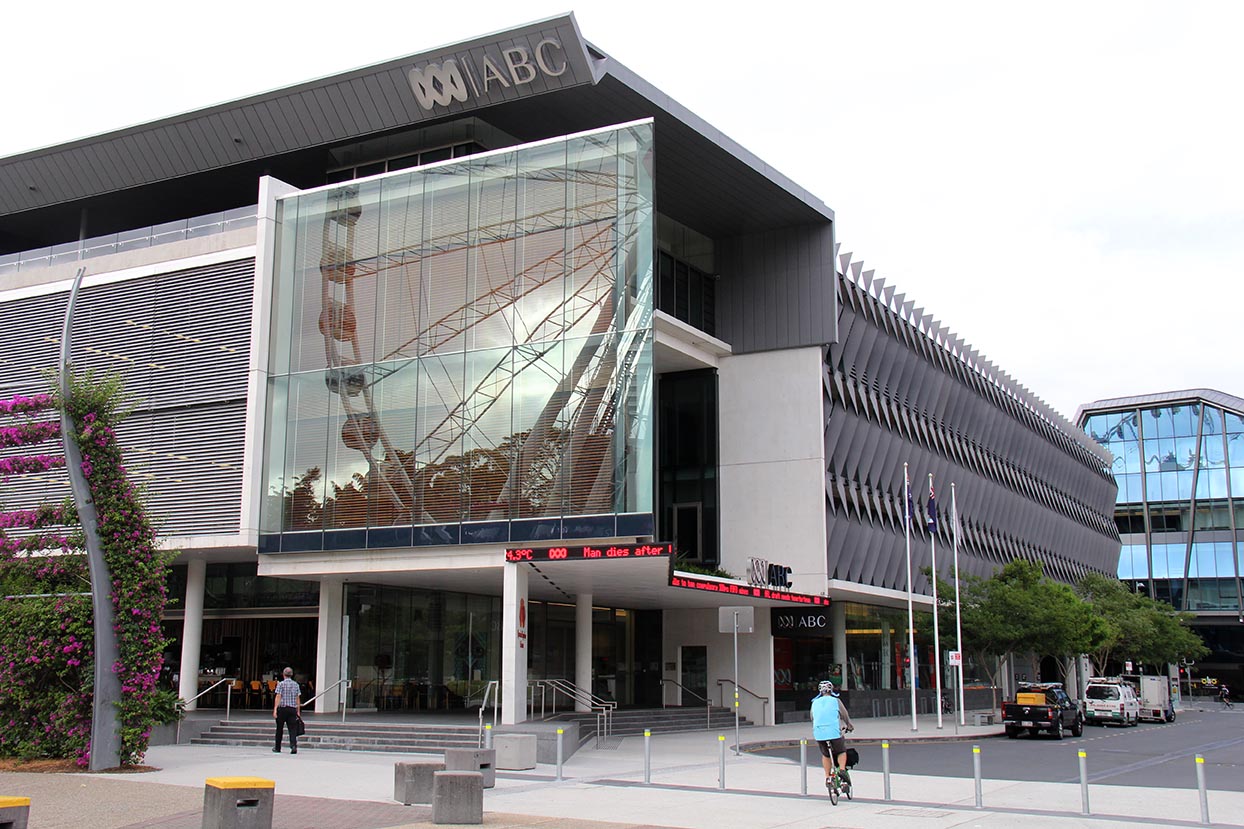
ABC South Bank

We’re hearing a lot about the national broadcaster at the moment because management has been handed an open razor by the current government and told to slash $254 million from its $1.22 billion operating budget within five years – a massive 20%+ cut. The ABC has already started making changes that will cut $207 million from its bottom line (in 2015). As you’d expect, jobs will go in ABC newsrooms, programmes will be cut or centralised in Sydney and some of our international radio services will go. Hopefully they will axe Upper Middle Bogan and It’s a Date while they’re reviewing what is valuable and what is not.

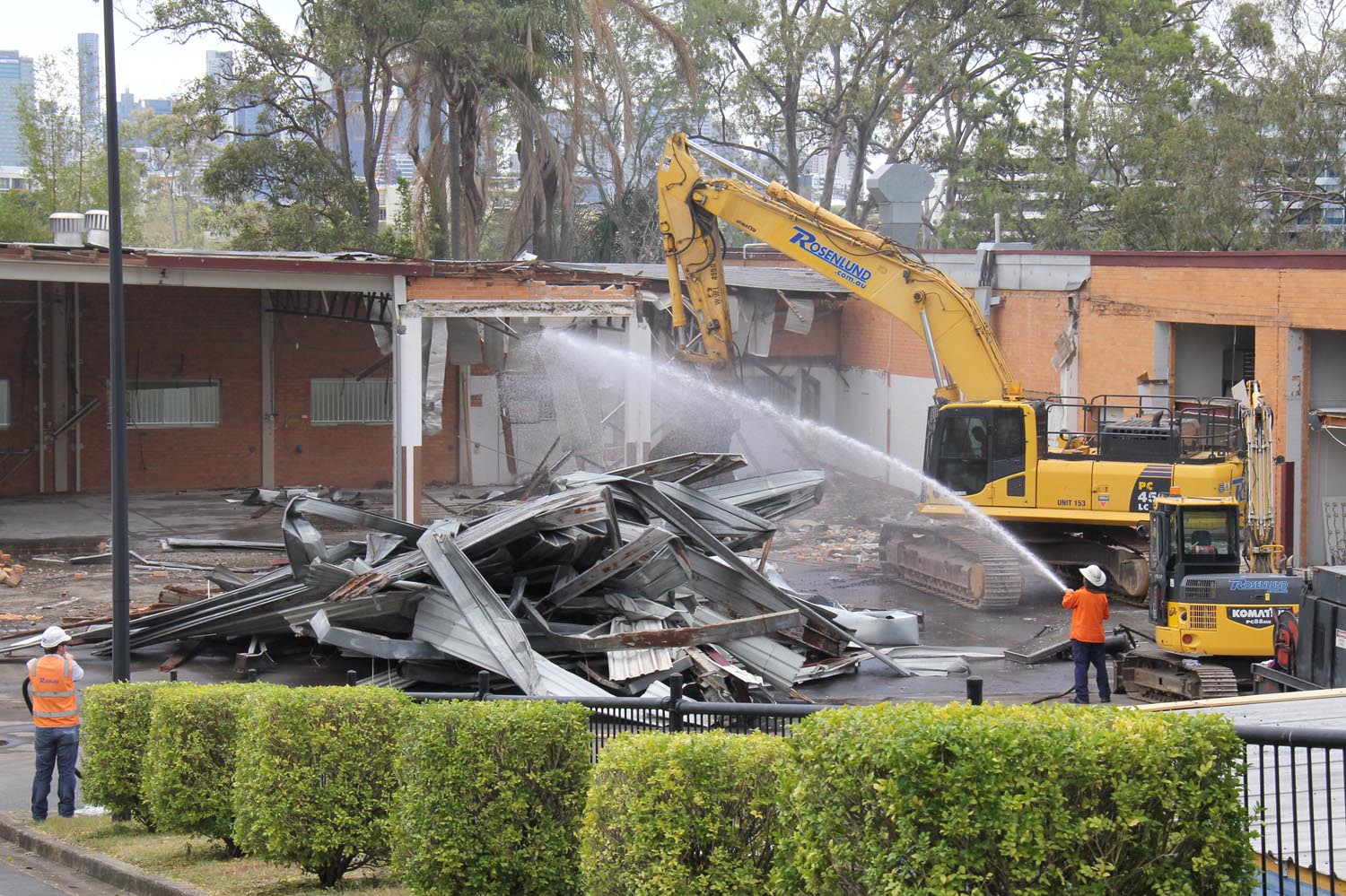
Toowong ABC site

Managing director Mark Scott says 400 jobs will go and the property portfolio is to be reviewed. This will overjoy developers, who have long slavered over the central locations of many ABC-owned buildings. In Brisbane the ABC sold its riverside site at Toowong (left) and moved to a new campus at South Bank (above).

Concerto, East Perth

In Perth, listed developer Finbar and its Singaporean joint venture partner have already pre-sold 43% of the 226 apartments planned for Concerto, a 38-level apartment building at 189 Adelaide Terrace, East Perth, the 1.28ha former site of the ABC, bought by Finbar’s partner in 2008 for $37.58 million.

If only Mark Scott had called me earlier! The answer is so simple – re-introduce the concept of an annual public radio/TV licence.  People used to pay an annual licence fee back in the 1920s and continued to do so until the introduction of colour TV in the early 1970s.
An annual fee of $35 per Australian household would raise $273 million a year. That’s it, job done. The licence would allow households to listen to ABC and SBS radio and all of its variations and watch ABC TV, SBS and NITV, as well as catch up on Iview and SBS on Demand.

The problem with a public radio licence is that roughly half the people in this country will scream blue bloody murder about being asked to cross-subsidise those dangerous lefties at the ABC. If you read stories online about the budget cuts, keep on scrolling down and read the comments. It’s a hilarious debate between left and right wing ideologues. I know the ABC monitors comments and approves or disapproves, but surely they must realise what a loaded bunch of nonsense this is, as the lobby groups on both sides of the debate give it their best shot.

You can learn a lot about a large organisation by reviewing its annual report. Scoff if you like, but that’s how Warren Buffett made billions, by assiduously poring over company reports and then getting to know the companies better through site visits until he decided to buy.  The ABC’s annual report contains what all such reports should – a high degree of disclosure. On page 115 we find a summary of contacts received from the public in 2013-2014, totalling 52,287 emails, letters, faxes, texts and phone calls.
There were 26,484 complaints, although most of them were about programme standards and scheduling. Sure, people complained about bias. There were 2,812 contacts alleging party political bias, 2,038 contacts alleging bias other than party political, 1,439 contacts complaining about factual accuracy and 810 claiming a lack of balance.
In short, only 9.3% of the contacts were about bias or party political bias.
So if you strip out allegations of leftie bias, what’s the motivation for the funding reduction? Not much really – just a government intent on cutting funding to many areas that the previous government deemed important. (Alas, the previous one burned so many bridges we fear they will never find a way to cross back over the River of Discontent.)
It is politically dangerous work, tampering with the ABC. People in the bush and the outback rely on it utterly for news, weather, and information about the wider Australia and, if there is a crisis (a flood, a ‘super cell’ a la Brisbane last night, a bushfire, a pending tsunami) the ABC is their only lifeline.
The ABC’s critics often complain about “middle management bloat” (which happens to any large organisation). But an examination of the wages bill shows ABC staffers don’t get paid as much as those who drive trucks or trains for multinational mining companies.
Wages and salaries at the ABC rose 6% to $368.1 million in 2013-14, for an average salary of $67,615 (compared to the Aussie ‘average’ full-time wage of $75,556). I know that’s not how it works in the real world, but it gives you a bit of a picture. More than half the ABC’s 5,444-strong workforce (57.9%) earns less than $85,000 a year. Another 1,050 earn between $85,000 and $100,000. There are 161 men and 98 women who earn more than $145,000. Just how much more than $145,000 is not stated (page 109). However, according to a ‘leaked report’ passed on by the Australian newspaper in November last year, Lateline host Tony Jones topped the list at $355,000, while half a dozen other presenters earned between $250,000 and $300,000. But what a responsibility: reporting to the Australian public and the Commonwealth Government as shareholder.
Comparisons are odious, but David Koch from Channel 7’s fluffy ‘Sunrise’ programme is said to be on $1million.

But as I was saying about radio licences
Some of the older readers out there will remember the days of radio licences. The original concept was a radio which was tuned to one station and then sealed. The customer paid for a licence and that fee was handed over to the station his radio received. That restrictive system thankfully didn’t last too long and in 1924 licences were based on A class (public radio) or B class (commercial radio).
Class A stations received grants from the Commonwealth via radio licence fees and Class B stations were allowed to sell advertising.
That system lasted until 1972 when the reformist Whitlam government abolished radio and TV licence fees, decreeing that the ABC be funded directly by the public purse.
In the UK, the BBC still charges households £145 a year for a combined radio/TV licence. The BBC is being pilloried in the UK press, with its annual budget blowing out to £3.4 billion, partly because of the 2010 decision by the Chancellor of the Exchequer to freeze the television licence fee until 2016. The BBC, clearly the global benchmark for quality TV and radio, was forced to trim its budget by 20%, as it also had to take on the cost of running the BBC World Service.
Mark Scott has no doubt been looking at how they did this (redeploying or sacking staff, sharing programmes between stations and channels, sharing radio news bulletins, more repeats and a reduction in original programming).
I would happily pay $266 (£145) a year for the priceless freedom of choice the ABC and SBS/NITV has been providing. Who else is going to broadcast the likes of John Pilger’s Utopia, or Babakiueria, that satire on the history of Australia’s settlement, or the ribald adventures of Rake’s Cleaver Green?

A super end to the week

Japanese abacus
A Davy Coogan https://www.flickr.com/photos/adavey/

In early 2007 our since-retired accountant sat back in his chair and asked the crucial question about starting a self-managed superannuation fund: “Can you tell me why you want to do this?” Then he explained in detail just how onerous it is to run your own super fund. He explained how you need to keep records for 10 years, how big a burden it is in terms of compliance, and, crucially, even when you get an accountant to do the books, the buck stops with you. We decided to go ahead and roll over our superannuation balances from large funds because, if you’ll recall, in 2007 the world markets were imploding and some large listed companies were facing annihilation. We had not been happy with the returns from our managed super funds for some time. She Who Has Not Been An Acronym For A While had slipped her money into cash in 2006 (smart, eh) but the paltry returns (less than 2%) were prompting us to manage our own affairs.

A Big Mistake
I say that from the viewpoint of someone who just wants to lead a quiet life. Our SMSF has brought us a positive return in every year bar one and, despite our expensive travel habits, the balance has not atrophied as much as we had thought. But on a personal front, keeping the books and making sure one does not breach the terms of the all-seeing Trust Deed has been a burden for one of the world’s many anxious people.
I have a theory about anxiety – it troubles conscientious, honest people far more than it bothers the people who hide their money in Luxembourg and pay sanguine lawyers and accountants to keep the Australian Taxation Office (ATO) at bay.

Speaking of the ATO, did you know that among the many functions of our under-resourced tax collection agency is supervising self-managed superannuation funds?
The ATO charged us a supervisory levy of $388 this year. I spend about 11 hours a month updating our internal accounts, filing paperwork and reconciling bank accounts. Any simple errors made along the way can double the amount of time spent. If there was any justice in the world, the ATO should be paying me $388 for supervising my own fund.
Actually, given the ATO’s workload and clearly inadequate staffing levels, it’s a wonder they get around to me. Did you know the ATO has 17.18 million “clients” including 12.3 million individual taxpayers, 2.7 million small businesses, 750,000 trusts and 534,000 SMSFs? All of this work was carried out in 2013-2014 by 23,631 people (before the ATO was required to cut staff numbers by 3,000). They are an efficient lot, though – the ATO’s annual report says the cost of collecting $100 is 69c.

Come back, it’s quite simple really
For those of you who run screaming from the room whenever anyone mentions superannuation, I can understand your anguish. I was a business journalist throughout the era when successive governments pretty much ballsed it up. In 1980-something I set up my first super scheme, before Paul Keating introduced the Superannuation Guarantee Levy (1992), without which many of us would get to 65 with no super whatsoever.
The way super rules were in the early 1980s, I could make after-tax contributions and claim them on my personal tax return. This was before salary sacrifice became a thing. Stay with me here – it’s not that hard to understand.
Historical data from the Commonwealth Treasury tell us that prior to the 1980s, no tax was paid on contributions to superannuation funds. Super fund earnings were tax exempt and tax was only imposed on 5% of lump sum benefits. Pensions or annuities were taxed at the recipient’s marginal rates. Sounds like a fair and simple system.

Tax havens and other sharp practices
Ah, but then the Greed is Good era began and all sorts of chicanery was invented to minimise tax. So in1983, the government moved to thwart the concessional treatment of lump sum superannuation and termination payments.
They introduced a complex system for eligible termination payments (ETPs). The full value of ETPs was included as income, with the post 1983 component taxed at a maximum rate of 30%. For those aged 55 and over, the rate was reduced to 15% up to a threshold.
This system was tweaked in 1988 so the government of the day could bring forward tax revenue. This involved reducing tax on the post 1983 component of ETPs and imposing a 15% tax on super fund contributions and earnings.
Reforms to superannuation in 2007 aimed to make superannuation easier to understand (hah!), and improve incentives to work and save. Superannuation benefits paid from a taxed fund to people aged 60 and over became tax free (hoorah!) The treatment of ETPs was also changed to differentiate between payments received from employers and those received from superannuation funds.

Tax-free Super (Yippee)
These rule changes are said to be behind the exponential growth of DIY Super, which 10 years ago represented less than 10% of all funds.
The ATO reported in June 2014 there were 534,000 SMSFs in Australia with total assets of $557 billion. About 28% of these funds have $1 million or more in assets, but the median fund balance is $518,000.
The ATO is collecting $207 million a year in supervisory levies. It seems iniquitous that they charge $388 whether your account balance is $2.95 million or $295,000. Scope for a sliding scale, perhaps?
I mentioned salary sacrifice before. For a two-income family, this can be a painless way of saving for your old age, which will come along soon enough. In the last eight years of my full-time working life, I was taking home a small wage and shovelling the rest of my pre-tax income into my super fund.
Along the way, there were sterling years when industry-based super funds earned 25%+ and charged very little for managing our money, so as a strategy it paid off. I still have an industry super fund which, now that I am a certain age, is just another bank account from which I can withdraw lump sums whenever needed (as long as it lasts).

Silas Palmer

Sennheisser headphones maybe?
“Whenever needed” can include expensive, age-related items like hearing aids, crowns, ride-on mowers and mobility scooters (which may or may not be deductible).
Or indulgences like producing an independent songwriter album, augmented by some amazing musicians including Silas Palmer and hopefully ready for sale and download in early 2015.
In coming weeks I will be writing about crowd funding, the creative urges of older Australians, the struggle of independent sound engineers, the death of the CD, the not-quite successful birth of the paid music download, the endemic practice of downloading and copying anything that is not tied down, occasionally mentioning a finely crafted recording of truly excellent songs.
Since you have all been so patient working your way through the perils of superannuation, I’ll leave you with the (free) version of Loudon Wainwright III’s protest song “Something for Nothing.”
Ain’t irony great!

620 road closures

King_Arthur_and_the_Knights_of_the_Round_Table
Bibliothèque nationale de France

I so rarely go to Brisbane and this week I’m there four times, just when the whole city goes into lock-down for the outrageously expensive and disruptive G20 conference. It started last Sunday with our annual garden concert at Fairfield – our former neighbours have been hosting this event for 10 years (not counting 2011 when their back lawn was awash). We started setting up our small PA system, all the while being “buzzed” by helicopters, supposedly on manoeuvres, rehearsing their role for the coming week’s shenanigans.
Finally at 3pm we go up to start the concert and just as we did, a lone helicopter hovered overhead. What was he thinking?
“Ten four, HQ, we got ourselves a folkie gathering.”
“Roger that – have they go a permit?’
“It looks like a private house – and…they all seem, like, elderly.”
“OK BravoEcho, move on.”

We’ve had our share of G20 vehicles up here in the hinterland – black limos, white vans, all with G20 number plates. We imagine they are making half-day tourism forays into the hinterland − checking out the Glasshouse Mountains, browsing the cheese shop, tasting a few local wines, buying an investment property or two. The conspiracy theorists point to our well located comms (radio communication towers) on hilltops and move their internet security settings to high.
Ah well, it’s good to know the G20 folk feel OK about freely driving about in our town while authorities make it as difficult as possible for us to visit Brisbane at this time. Crikey, they don’t even have to pay to park.
We had tickets to the ballet in West End yesterday and were wondering (a) how to get there and (b) how to get home again until friends who live in Bardon offered us a bed for the night.
Then we got an email from Queensland Ballet, warning us to “Please plan your trip and allow extra time ahead of your journey.” We ended up taking the Go Between Bridge (one of two Brisbane bridges – the other is the Goodwill Bridge – named after ‘famous’ bands). That was too easy – we were half an hour early, but had to park three blocks away.

And then, this Monday morning, at what my musician friend Silas Palmer calls “stupid o’clock”, we will be driving to Brisbane so he can catch the 5am red-eye flight to Melbourne. We’re driving to Samford on Saturday night where Silas is playing at a G20 Women in Docs gig (it’s free). Then we’ll take him back with us and spend a day in the studio while he adds piano and fiddle to my new songs. Hopefully by then the 620 (sorry G20), road closures will have ended and Monday’s 2.30am drive will be easier than today’s three-hour drive to Maleny via Woodford. The freeway was a car park today and last night, on account of people doing what Mayor Graham Quirk urged them not to do (leaving town for a three-day weekend at the coast).

Tabling the G20 agenda
While the Federal government is spending some serious coin to stage this event, the businesses that are affected by detours, road closures and barricades receive no compensation.
Sydney Morning Herald political reporter Heath Aston was apparently shown some Federal Government G20 contracts that outlined some of the expenses incurred over the two-day meeting. There was a lot of talk about the meeting table, which was commissioned for the G20 finance ministers’ meeting in 2006 (at a cost of $70,000). The Abbott government has approved a further $36,000 to extend the table and another $68,000 for chairs.
More than $10 million is being shelled out to house the 20 delegates and their entourages at some of Brisbane’s leading hotels. Another $250,000 has been earmarked for taxis and rental cars and $150,000 for “tablet devices”. Oh, and did I mention $34 million for security?

Excuse me – I have a question. What happens to the table (which will apparently cost $150,000 to be moved around between lead-up meetings to its final destination at the Brisbane Exhibition and Convention Centre) once the G20 is over?
Considering it is highly unlikely the G20 will return to Brisbane in our lifetime, why not put the table and chairs up for auction? I would think some cashed up city council would love to brag about that. Or a high class restaurant could grab it for their VIP room. Or perhaps one of the country’s idle rich would like a showpiece dining table. They’d have to extend the dining room of course, but what else is money for?
Then again, the table (and other recyclable detritus from the G20), could be donated to a clever timber worker with instructions to build a small, affordable, sustainable house – a display home for poor people, if you like, located on a suburban allotment donated by a kind-hearted developer (they do exist). This house (I’m thinking three rooms, a kitchen, a bathroom and somewhere to chain the pushbike), should be rented at $50 a week to the person on the bottom of the public housing list. This, I think, would make several points about a few things.

I’ll admit we live in a sort of utopian bubble up here, gathering at our local watering hole on Fridays to harrumph about this and that. Mr Clean had a few pointed questions for the G20 organisers. Had they not ever heard of Skype? Were they deliberately trying to incite dissent by occupying a city for two days and denying its people freedom of movement? They could have taken over Hamilton Island for the weekend and repelled all boarders. All good points, Mr Clean.
One of my old business contacts observed that the main risk with the G20 is that they will listen too much to economists, who spend most of their time looking out the rear window, and over-stimulate world economies with money-printing and fiscal incentives.
He says most world economies have been recovering quite well over the past three to four years without their help.
He is expecting a stoush and will be disappointed if there isn’t one, adding that, whatever form it takes, he hopes that some degree of common sense prevails.

From the mouths of babes
That left me pondering what you’d say to a four-year-old, in that ‘why’ phase of life, if he asked why Brisbane was hosting the G20.
Kid: “Daddy, what’s a Geetwenty?”
Dad: “It’s a meeting of 20 finance ministers and central bankers who play a significant role in ensuring that international and domestic economic policies work together to protect the global economy against future shocks.”
Kid: “Yes but why?”
Dad: “They meet so they can restore business and investor confidence and address the causes of the global financial crisis and ensure financial stability.”
Kid: “A dress like what Mummy wears?”
Dad: “They also have to make important decisions about inflation.”
Kid: “What’s inflation?”
Dad: “Well, if Mummy buys a dozen free-range, organic eggs from the co-op and they cost $7 and next week they cost $9, that’s inflation.”
Kid: “Why don’t we get chooks, then?”

The Climate Change Stakes

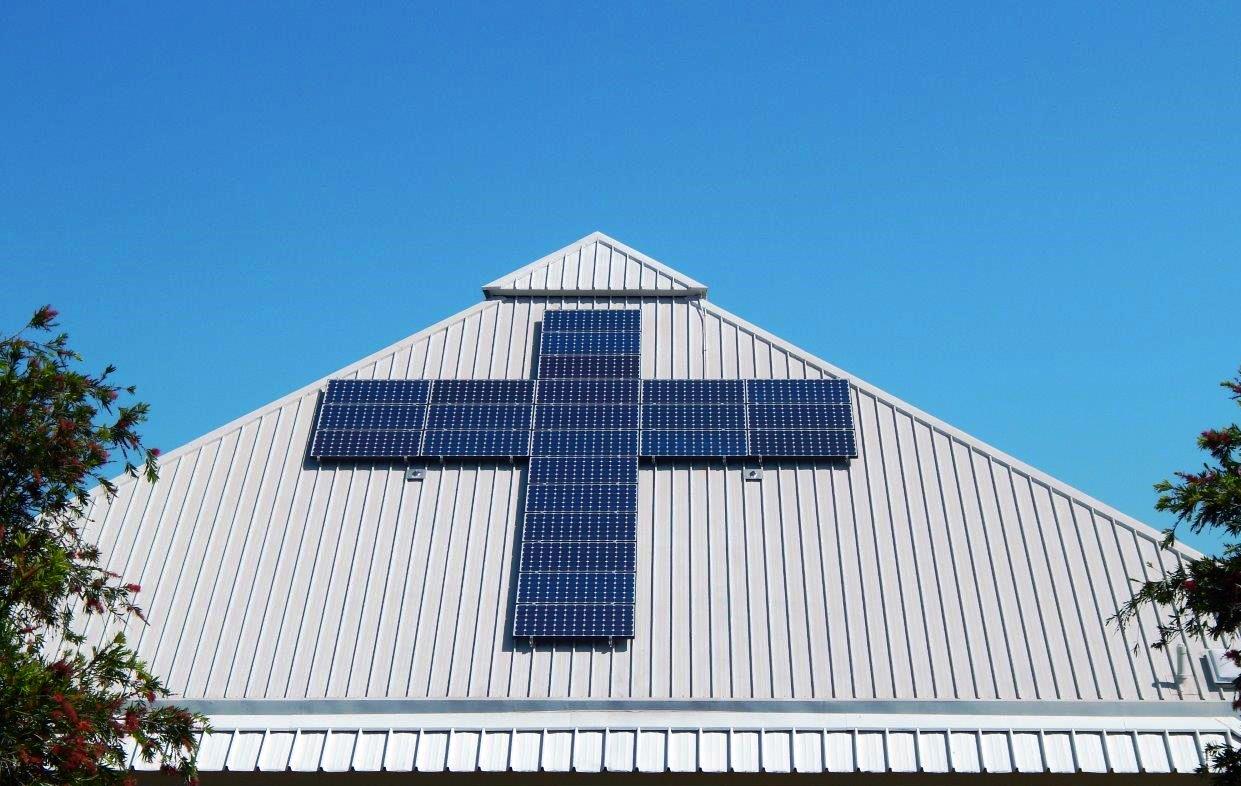
Taking solar to another level. Caloundra Uniting Church

Two dead horses and the outcry from animal rights groups that followed unfortunately pushed a telling United Nations report on climate change off the front page. In any other week, the report would have had a better run, without having to compete with horse form and breeding analysis, gossip and trivia, sweepstakes (there’s another page gone), fashions on the field and heart-tugging articles about little Aussie battlers trying to knock off cashed up European stables.
I acknowledge that the connections of Melbourne Cup contenders Admire Rakti and Araldo would have grieved when their horses died after the running of the 153rd Melbourne Cup. But these things happen in racing, and other sports for that matter. Professional racing people bury their horses; they claim the insurance and move on to the next race. The strappers and track riders who knew the horses best will be disconsolate for a while, but the world goes on.

According to the United Nations Intergovernmental Panel on Climate Change (IPCC), it will be a world of melting polar ice, rising sea levels, higher temperatures and extreme weather. The IPCC says worldwide we need to act urgently to stop burning coal, and to replace fossil fuels with renewable energy. We also need to stop producing greenhouse gases and to discourage investment in dirty industries.
The IPCC’s key findings are completely at odds with Team Australia, which has dismissed the carbon tax and is still trying to scrap or at least wind back the 2020 renewable energy target. Prime Minister Tony Abbott has been widely quoted as saying coal is “good for humanity” and has decried the efforts by some institutional investors to divest (sell) shares in carbon-intensive sectors.
However, the world’s top scientists have given their clearest warning yet of the severe and irreversible impacts of climate change. The 116-page IPCC synthesis report, a summary of its last three, is a dry read (no pun intended). But its message is blunt: greenhouse gas levels are at the highest they have been in 800,000 years. The most recent increases are largely blamed on the burning of fossil fuels.
“Continued emission of greenhouse gases will cause further warming and long-lasting changes in all components of the climate system, increasing the likelihood of severe, pervasive and irreversible impacts for people and ecosystems,” the report said.

Meanwhile, Prime Minister Tony Abbott, who says he is no punter, despite having a totally wild bet against the science of climate change and the burning of fossil fuels, tipped Signoff (4th) to win the Melbourne Cup.
The connections of Signoff might have picked up a healthy cheque ($250,000), but bookies don’t pay out on fourth. And voters seldom return a politician who has shown poor judgement on serious global issues.
Imagine if there was indeed a race, the winner of which would be allowed to implement their method of repelling the advances of global warming.

The Climate Change Stakes.
“The horses are parading for the Climate Change Stakes. Looking fit and determined in the birdcage is Mitigation, the 6-4 on favourite, heavily backed by every greenie on the planet. Climate Denier, a 33-1 pop with a reputation for coming home when least expected, is expected to struggle with its big weight and the track conditions (wet again). Pay the Polluters has found some support from the Society for Illogical Thinking. Carbon Tax Mk II, having his first run for the Green stable, will find it hard from the outside barrier, but if he gets an inside run coming into the home turn, look out. Solar Leader, a German import, will need a sunny day, as will Sunshine Valley Stables entry, South Australia’s Beam Me Up. The Northern Territory entry, Diesel Rules, is a late scratching. Apparently his transporter ran out of fuel. CeeCeeEss was disqualified for having a stupid name.”

It is now nine months since the chairman of the Climate Change Committee, UK conservative Lord Deben, described the Australian government’s then plan to scrap the carbon tax (which it has since done) as irresponsible.
“Australia’s actions are appalling,” Lord Deben (a former MP in the Thatcher government), said in a statement. “While the 66 countries that account for 88% of global emissions have passed laws to address global warming, Australia is repealing them.”
The IPCC’s synthesis report made four key recommendations, all based on broad scientific consensus.
If the planet is to be kept from warming by more than two degrees:
• Renewable energy (i.e. solar, wind power, wave power et al), nuclear energy and carbon capture and storage (CCS), should comprise 80% of the world’s energy by 2050 (it is currently about 30%);
• Investors need to switch their allegiances from polluting industries to clean energy sectors;
• The world must stop using fossil fuels by 2100 (unless fossil fuel power generation uses CCS),
• Greenhouse gases must be cut by 40% to 70% by 2050, and to less than zero by 2100.
Meanwhile, Team Australia got its Direct Action Bill through. An alternative to the carbon tax, it pays polluters to clean their act up. Under political pressure, the Abbott government is now talking about a renewable energy target of 5% by 2020, rather than scrapping the original RET of 20%, so there is a glimmer of hope.

My research assistant Little Brother found a gem of a story in The Guardian which harked back to Budget cuts in May. While Mr Abbott has recently said Australia’s energy future lies in coal, five months ago his government cut $495.3 million in forward research funding to develop carbon capture and storage technology. CCS captures carbon emissions that would otherwise have been expelled into the atmosphere and stores them underground. LB says there is only one large CCS plant in operation (in Saskatchewan, Canada). The science has many detractors.
The Labor government also slashed funding for CCS, so while it has been flagged as an alternative by the IPCC, it seems out of favour here, with just $191.7 million left to develop trial plants over the next seven years.
Despite all the obstacles in its way, the solar energy sector keeps signing up new industries (the Brisbane Markets is using the massive amounts of roof space it has at Rocklea to install a 1.06MW system). Construction will start next year and when completed it will be one of the largest in Australia.

Last time I wrote about renewable energy a reader studying the solar sector wrote to tell me that financially disadvantaged sections of the community continue to pay more for electricity as a result of past solar policies. And so far, commercial solar power stations can’t compete with coal-fired stations. But while that debate is played out, more households and commercial businesses are installing solar systems so they can control their own destiny. Smarter technology (thermal storage) and a mass market, will make solar a less expensive option. Besides, it’s irrelevant whether solar “stacks up” in the conventional sense of being the cheapest alternative. As the IPCC says, we have to act and we have to act NOW.

Anyone who had a harp

Custom harp
Custom six-tone harmonica Photo Jorge Royan http://www.royan.com.ar/

We’re back in the studio after our three-month road trip, trying to pick up the threads of what was as an intensive three-week recording session back in June. The last thing I did in the studio before we left was to re-record harmonica tracks with a new, $55 Hohner E harp. I use harmonicas a lot when we perform live, playing the instrument with a rack around my neck. The cheap harps I normally use did not stand up to scrutiny in the confines of a studio.

The humble mouth harp was given credence 84 years ago when a fellow called Larry Adler saw an advertisement in the Baltimore Sun for a mouth organ band. Adler went to the audition and a grand career was born. He worked with the likes of Fred Astaire, Dizzie Gillespie and George Gershwin. Vaughan Williams composed music for him. A jazz musician from the same era, Max Geldray, was a pivotal part of The Goon Show. He provided musical interludes and the closing music for at least 160 episodes of that madcap radio programme.

I was thinking about Max, who died in 2004 and Larry (in 2001), as they were without a doubt the people who helped me overcome shyness and make use of my natural musical ear to embark on a journey which, 55 years on, is still bringing me joy, even if my neighbour’s dog howls when I play harmonica.

I’m a lazy player, quickly inventing instrumentals to add colour to my songs and I clearly don’t practice as much as some of the people in the videos at the end of this essay. But I’m happy to report that my harmonica tracks survived the cut. I did my three tracks in a couple of takes. We got it done quickly because I know the stuff backwards, but also with my new hearing aids, I can hear snails sliding across the studio’s tin roof.

My laziness extends to the maintenance of my harps. When a great blues harp player, Matt Moline, came to the studio to add harmonica to one track on our first CD, he had a very large number of instruments encased in a soft travel pack.
We got on to the subject of cleaning them and I confessed I had never done that. Matt got that look on his face that you see when nurses are gowning up to go into the infectious diseases ward.

The author

It was all Santa’s fault
I sometimes wonder just how many children, apart from me, found a harmonica in their Christmas stocking when they were six or seven. It used to be a good way to assess if your child had any latent musicality. (I suspect a large number of said harmonicas were “lost” sometime on Boxing Day.)
The radio was our only entertainment in those days, so there was lots of time to learn things that require hours of practice, like knitting, embroidery, 1,000-piece jigsaws or learning to play the spoons. I was always coming second in talent quests, usually to a comely lass with a guitar and a sweet smile.

Once shunned as a toy instrument for the poor, the humble 10-hole diatonic harmonica has progressed to become a mainstay of contemporary rock, folk and blues music.
There are great players who have gone on to play harp in the choir invisible (Sonny Terry, Little Walter, Big Mama Thornton), and a good few who are still with us, including Australian players Chris Wilson, Doc Span and Jim Conway. Charlie Musselwhite is lauded by some, as are Charlie McCoy, Christelle Berthon and Stevie Wonder. Stevie learned to play when he was five and invented a completely distinctive style.

And (OMG I didn’t know this), Billy Joel played harmonica on “Piano Man”, inspired by Bob Dylan using a rack to play guitar and harmonica at the same time. The less said about “Piano Man” the better. I prefer Weird Al Yankovitch’s “Sling us a web; you’re the Spider-Man”.
You can spend $250+ on a chromatic harmonica (it has a slide which enables you to play sharps and flats). You need two, in different keys, to cover the complete range of anything you might like to play (William Tell Overture, Night and Day, Clare De Lune).
But most players today use diatonic, 10-hole blues harmonicas. They have a small range of notes and lack of sharps and flats, so in theory there is a limit to what you can play. I use a cheap set of seven Hohner harmonicas bought from the Internet for $99. They are what you think they might be! I have some old harmonicas I paid a lot of money for (Lee Oskars) and they are still better than the new ones in the box set.
You can pay upwards of $85 for a quality Lee Oskar, although you’ll find them cheaper on the Internet. Those of you obsessed with music trivia already knew this, but Lee Oskar is a Danish musician and harmonica manufacturer who featured in Eric Burden’s band War and performed in Cheech and Chong’s “Up in Smoke”.

People who don’t know how to do it think that being able to play guitar, sing and play harmonica at the same time is one of the dark arts. All you need to do is put a rack around your neck, insert the instrument (the right way up), keep a steady tempo going on the guitar, and save some breath for singing.
Kath Tait, a Kiwi who lives in London, has a special way of playing the concertina and a harmonica in a rack while singing. The harmonica bits happen in the instrumentals, but I guess you’ll figure that out.

Kiwi expat Brendan Power, now domiciled in the UK, is a harmonica virtuoso who manufactures, repairs and tunes harmonicas. He uses a loop pedal and other gadgets to put on a one-man show, but is still heard to best effect jamming with other musicians.
If you had no idea how versatile the harmonica can be, check out at least one of these videos. I especially like the fan comment (sic) at the end of M-S Blues: “I dont no who let you off the chain but you shore can play that thang.”