Living on top of the world

TrioIn the late 1990s, a Brisbane developer was briefing me on the future for the city’s yet-to-happen apartment boom. The empty nesters from Clayfield and Ashgrove (old suburbs, big houses and yards), would be the first to opt for the high rise apartment with views of the Story Bridge, he said. But not all of them would stay.

Living in an apartment is not for everyone – there are the benefits of lifestyle, location, security, city views and, for the busy professional, compact living with minimal housework. The body corporate takes care of all the maintenance issues and the utilities. All you have to do is pay and obey the rules. But downsizing comes at a price.
My developer contact was explaining how when the empty nesters sell their large Clayfield or Ascot family homes and move to a three-bedroom apartment with plasterboard walls, the reality starts to set in. What will we do with our antique mahogany dresser, the Yamaha baby grand, the eight-piece walnut dining table and matching chairs? We can get gallery wall hangings for some of the paintings and family portraits, but it’s not the same, somehow. And now that we’re in this apartment, which cost a pretty penny, let me tell you, what will we do with the garden tools and the ride-on mower, given we have been allocated one car space with about 5cm to spare on either side?

This is where the self-storage business comes into its own. Australians move house every seven years on average and typically the person on the move will be going interstate for a job on a two or three-year contract and renting an apartment when they get there. So they put most of their “stuff” in storage and pay at least $250 a month for the privilege.
So after a year or of living above the city and tiring of the traffic noise and nightclub doof beats floating up to the balcony, our typical empty nesters will sell and move to a ground-floor townhouse which is in the suburbs and has bigger built-ins, a small yard and a two-car garage.
The next wave of apartment buyers would be ambitious urban professionals, our developer continued; 32, childless and match-fit to work 16-hour days as the job demands it. They finish work about 8pm, walk next door to the Japanese restaurant, then take the lift to their apartment, where they collapse into bed until the smart phone alarm demands at 5.00am that they go downstairs to the lap pool and the gym. They are in the office by 6am and the whole circus starts again.

Queensland’s capital city was slow to get started building high rise apartments. First came David Devine’s medium-rise, affordable units in the heart of the city’s nightclub precinct, Fortitude Valley. From the year 2000 onwards, Brisbane City Council allowed more development amongst the city’s office towers. Now the tallest buildings in the CBD are either residential towers or a mixture of residential, office and retail.
In Sydney, where we spent couple of nights this week in a friend’s apartment, low to medium-density apartment blocks are proliferating in the inner western suburbs. Sydney town planners are bowing to the pressures of population growth, decreeing that medium density living is the best use of land along major traffic routes like Parramatta Road.
We took advantage of the inner city location to stroll from our friend’s apartment through Annandale parkland to the harbour, joining city workers and their dogs taking their daily exercise in the daylight saving hour. In this area, Sydney’s former trotting arena, Harold Park, is fast becoming unrecognisable, as listed developer Mirvac progresses its series of low to medium-density apartment blocks and terraced homes. The first stage of these, Eden, was launched in 2012 and sold out in hours, at an average price of $1.7 million. The Harold Park master plan is for 1,250 dwellings – one, two and three-bedroom apartments and the aforementioned terraced houses – 21st century versions of the old walk-up terrace house, some running to three levels.
The Trio apartment project, on the site of the old Royal Alexandra Hospital for Children, has been developed since 2007 into 11 medium density apartment buildings, each with two or more levels of secure basement parking. Trio sits within a landscaped environment of walking and cycle paths with restaurants and cafes just a few minutes’ walk away.

You’ll need $810k to buy into this dream

If that all sound attractive, good luck with the mortgage. The median apartment price within inner city Sydney is $810k, with prices rising 4.4% last year. Real estate folklore has it the only way to make some money along the way is to buy off the plan (before the building starts), sell at a profit and do it all over again.
By far the biggest participants in this market are Asian investors who often buy more than one apartment in the same building. Typically, their young adult children will live in these spaces while studying law, dentistry, architecture, engineering or medicine at one of our fee-paying universities. Their shrewd parents don’t mind making this kind of investment, as they will probably make a profit along the way or just hold for the next generation.
Now that we’ve been living in a country town for more than a decade, Sydney’s fast-paced, noisy, impatient atmosphere can be a little wearing. There’s a huge buzz about the city; you can eat out anywhere at any time of the day or night. (It is said there is a café somewhere in inner Sydney that closes only one hour per day (4am to 5am) for cleaning). But as its population of 4.57 million continues to grow (78% of the NSW growth rate in 2013-2014 was in the Greater Sydney area), it is clear to see why the city planners want real estate to go up and not further out.
As you might have read, the median house price in Sydney is now $1 million, which explains a bit about the demand for inner city apartments. The alternative is to buy a long way out and commute to work. Thousands of people already commute from places as far north as Wyong (93 kms) south from Kiama or Jervis Bay (100kms) or west from Katoomba (101kms).

Living in smaller spaces

While apartment dwellers enjoy proximity to the city heart, they have to get used to living in a compact space. Apartments are getting smaller as designers learn how to make more with less. One bedroom studios are rarely more than 50sqm, two-bedroom apartments around 85sqm and three bedroom units range from 100sqm to 125sqm. Compare that with your two-level McMansion in suburbia (300sqm is common). But apartment-dwellers can choose to do without a car, find time for a fitness schedule, stroll to theatres, cinemas or restaurants and become expert at using the synchronised public transport system. And they don’t have to mow lawns.
All this will come back to us, I’m sure, when driving down the 97m driveway to our two-level brick home on half an acre after being away for two weeks. The hedge needed trimming when we left. Hope we can tidy it all up before the house concert on the 29th!


Henry Lawson and a plague of locusts

Australian poet Henry Lawson on the old paper $10 note.

We were softly singing ‘Andy’s Gone with Cattle’ somewhere out near Sofala (western NSW), while picking out dead locusts from our radiator and various parts of the vehicle’s front grille. It was the Mike Jackson version of Henry Lawson’s classic poem we were humming, about a drover gone a-droving, with his missus and his dog pining for him. Mike told us he wrote his tune (one of many versions) in a minor key, as he read the song as a lament and felt the underlying melancholy of the minor key suited it very well.
We were driving across the western plains of NSW on our way to the Blue Mountains Music Festival when we ran into what some journalists would term “a locust plague of biblical proportions”.

Farmers out this way have been reporting swarms of locusts since late January and it seems they are still about. The cosmetic damage locusts inflict on vehicles does not compare to the damage they inflict on cereal crops in Australia.
Australian plague locusts reached such numbers in late 2010 that the world’s media picked up on the story because (a) it made for great television and (b) the statistics are sort of scary. A swarm of locusts one kilometre wide can chew through 10 tonnes of crops in a day. These ugly insects can consume up to a third of their body weight, so even low density swarms can wipe out an emerging wheat crop in a couple of days.

We arrived in Gulgong with a messy windscreen, planning a visit to the Henry Lawson Centre. Gulgong claims Lawson as a famous son, as he spent his childhood and early teens in locations between Gulgong and Mudgee. The environment and the experiences of these years greatly influenced Lawson. The Henry Lawson Centre walks the visitor through the phases of the writer’s life, from his birth in 1867 to his death in 1922.

As it turned out, a coachload of tourists beat us to the 10am opening, where they were being given a talk by Hazel, a local volunteer. Hazel let us know a few things we did not know about Lawson (e.g. he had a very productive period while living in New Zealand) and the things everyone should know – his influence on justice for workers, his advocacy for a republic, the plight of the poor, and support for the emancipation of women.

The Gulgong museum has some macabre artefacts of Lawson’s life, including a bronzed “death mask” of his right hand and the forceps a dentist used to extract all but one of Henry’s teeth (leaving him with the means by which to grip his pipe!).
There is also a first day cover from 1949, when Lawson’s image was emblazoned upon an Australian stamp. His craggy features also adorned the $10 note until the introduction of polymer currency in 1993. We need to reinstate Henry’s image on an Australian bank note. My suggestion would be to replace the Queen’s portrait on the $5 note when we become a republic.

I was amused and informed upon reading Lawson’s letter to the Bulletin magazine in 1903, the subject being his (temporary) sobriety. Problem drinkers could do worse than read this stark baring of the soul; the contradicting internal arguments, the ironic humour. You can find this on the Internet easily enough, which will save me breaching the “fair dealing” provisions of the Copyright Act. Lawson proclaims he is “awfully surprised” to find himself sober. He goes on to discuss drink and drunkenness and ask why a man does it to himself.
“I get drunk because I am in trouble and I get drunk because I’ve got out of it.”
“I get drunk because I had a row last night and made a fool of myself and it worries me, and when things are fixed up I get drunk to celebrate it.”
I spent an hour or so looking into Henry’s oeuvre, as I was fairly sure he had not written of locusts, but if he had, it would have been with the stark honesty he described his experiences in the bush. Lawson was often the bad cop, telling it like it was, whereas good cop A.B Paterson overly-romanticised the bush.

Lawson was sent out to Bourke by the Bulletin’s owner J.F. Archibald, the hidden agenda being to dry poor Henry out, as he was a perpetually broke drunk who often fell off the wagon. Lawson came back from western NSW with graphic images of the drought. In “Up the Country” he begins: “I am back from up the country – very sorry that I went.” He describes “burning wastes of barren soil and sand,” “barren ridges, gullies, ridges! Where the ever maddening flies – Fiercer than the plagues of Egypt – swarm about your blighted eyes.”
Henry Lawson’s work has often appealed to composers and folk musicians, who latched on to the easy meter of his ballads, the immaculate scansion and the succinct use of language.

The Gulgong Lawson Centre’s collection of CDs could do with some updating; the readings by Jack Thompson and Leonard Teale and the Slim Dusty album are just a representation of what has been produced.
At the very least, they ought to find a copy of Chris Kempster’s 1989 collection, The Songs of Henry Lawson (a second edition was released by the NSW Folk Federation in 2008). And former Redgum front man John Schumann and his Vagabond Crew are known for their Lawson album released in 2005.
We saw the Vagabond Crew perform this work at the Gympie Muster, when they engaged veteran stage actor Max Cullen to play the part of the ghost of Henry Lawson. The shabbily-dressed ghost, with battered hat and stick, would emerge from the ruck of the band as the song finished, reciting a poem and giving the audience a glimpse into the peripatetic life of one of our favourite literary sons.
There are many versions of Lawson’s poems set to music – ‘Andy’s Gone with Cattle’ and ‘Scotts of the Riverina’ in particular.
I have often marvelled at Lawson’s knack for observing whole landscapes and human longing in a handful of words.
“The gates are out of order now, in storms the ‘riders’ rattle,
For far across the border now Our Andy’s gone with cattle.”
“The old man burned his letter, the first and last he burned
And he scratched his name form the Bible when the old woman’s back was turned.”
(Scotts of the Riverina)

Poor Henry, chronically poor, deaf since childhood, not ever in robust health, pursued for maintenance by a needy ex-wife, he died of a cerebral haemorrhage, aged just 55 – an age which today is considered to be the prime of life.
Lawson’s life could become a major Australian movie, proceeds of which should go into trust to support promising writers; to help them get started, to send them to the Buttery if they fall off the wagon, and to stop ruthless publishers ripping them off.
Not that this is ever likely to happen under a conservative government or a monarchy.
“Wait here, second class.”

Pinandok

??????????????????????????????????????????????????????????????????????????????????????????????????????????So I’m at the IGA checkout buying three or four organic items, as you do. The young woman behind the till has a Trainee badge on her shirt. “Plastic bags?”

“It’s OK, I brought my souvenir Fred Smith ‘Dust of Uruzgan’ cotton bag,” says I, with a subtle hint about a splendid house concert coming up on the 29th of March.

“Community benefit number?”

“Umm, it starts with a 2…”

“Savings or credit?”

“Credit,” I say, as it is four more days until the Centrelink payment hits the bank account. I sneak a look at a card inside my wallet where several pins are cleverly disguised as phone numbers. I know, I know, the banks tell you never to do that – in fact, if my account gets hacked, some clever Johnnie at Bobsbank will be on to me, claiming poor card security on my part – and he may have a point.

“Pinandok.”

Pardon? Oh, yes. Surprise – it works.

“Extra cash out?”

“Well, if you’re handing it out, yes.”

She has a literal sense of humour – frowns and thinks to herself, “He’s just like my Dad, always a joke or a pun and he expects you to get it every time.”

So I leave the Supermarket and head to the Post Office, only then remembering I parked behind the IGA. It’s a fairly new car and it looks like every other faux four-wheel drive on the road today. “What’s the Rego number?” I say, searching my memory bank, but the bank’s empty.

And now I have become a “webmaster” which these days can be applied to anyone who bought WordPress for Dummies and just jumped in (as I did).

One of the major drawbacks of being in charge of a website is that you need to know and maintain a half-dozen logins and passwords, all of them combinations of letters, numbers and symbols, with the aim of keeping eastern European hackers from turning your pretty little folk music website into a den for Hot Russian Brides.

At last count I had 63 logins and passwords stashed away in a “secure” corner of my computer and another 130 logins, account numbers and passwords on an electronic diary guarded by a master password. In case I get sudden early onset, I have scribbled that master password down for She Who Knows Where To Look. (Don’t count on it – I have enough trouble remembering where mine are. Ed)

About five years ago when it because apparent that this could be a problem, I made a spreadsheet, pasted it to a word document and copied it on to a CD. Unhappily, I password-protected the word document then forgot the password! Alas, it seems the only password-protected document types which can’t be opened by password-busting programs like Brute Force are simple word document passwords. This I know, because in a fit of Scorpio-like secretiveness I password-protected a 56,000-word novel I was working on and now can’t open it because I forgot the password. I think it was about losing your memory.

Transactions over the internet are becoming more and more common for the majority of us. When was the last time you received a bill in the mail and either mailed a cheque or walked down to the Post Office to pay in cash? A whitegoods repair guy came and did a job on our dishwasher recently, then emailed the invoice to She Who Knows Where To Look, who promptly got on to internet banking and paid the money into his bank account.

The good things about this kind of transaction – they’re quick, easy, and there’s an electronic paper trail if there’s a dispute. The bad thing is that every day we hop on to the Internet, we run the risk of having someone with IT skills and bad intentions gain access to our bank account, investments and phone and computer accounts. Not to mention Centrelink, the Australian Tax Office and Medicare, all of whom are hell bent on having us create an online account and a complex password so we can logon to update the data that (a) they should be updating and keeping secure and (b) should be keeping people in jobs.

If you have become drawn into the online way of doing things, consider having a periodic house-cleaning. The first thing to do is unsubscribe from lists you don’t want to be on. Sometimes this is not as easy as it ought to be. I recently bought a book from an online bookshop which kept sending newsletters and other exciting announcements about “specials” when I clearly do not recall ticking the boxes to say I wanted them.

To unsubscribe from this list I had to log on (with my password), and go through several steps to get off their pesky list. This is a bad way to do business, as is the tactic of pre-selecting choices that you as the consumer should be free to make.

When we flew to north Queensland for Christmas, I hired a car, not noticing that the option to purchase a 7-day travel insurance policy was pre-ticked.

In the interim, She Who Approaches Such Matters with More Caution had already bought a travel insurance policy elsewhere (with a Seniors’ discount). The car hire company did cancel the policy and refund me, but it underlines how careful you need to be online.

There is a protocol when you send out emails to more than 20 or 30 friends, as I do every week. Internet Service Providers (ISPs) require you to advise recipients that if you don’t want to be on the list, just email back “unsubscribe”.

If someone wants to unsubscribe, I just open my Excel spreadsheet and delete the person’s name and email address. I suspect that this does not happen when you decide you don’t want to hear from Cheap and Nasty Hotel Bookings.com.

The electronic database is a scary thing – your local takeaway pizza joint, for example, has your home number, mobile number, home address, probably your email address and, moreover, whether you are susceptible to up-selling (do you want Pepsi-Max and garlic bread with that?).

Our email addresses, home addresses, full names and DOBs are floating around inside dozens of databases, hardly any of which have ASIO-level security in place. Increasingly this data is being exported to the “cloud,” a nebulous place where organised crime is busy working out how to make said cloud rain money.

Web browsers like Internet Explorer and Firefox aim to make things easy when you’re online. You can choose to save your passwords on your computer and the Web browsers slot them in as required. But I was horrified to find just the other day, that you can not only open the place on your PC where these logons and passwords are stored, you can also make them visible! I was less unhappy when I found you can’t select-all and copy or print the list out.

Or so they reckon!

Ah, just what your cash-strapped Grade 10 kid with advanced computer skills and a dope habit was looking for – go to that old writer fella’s PC – he never locks up.

What’s next for the humble CD?

Pix and Bob2My sound engineer Pix Vane Mason (left) depressed the hell out of me last December when he predicted the demise of CDs within the next two years.
“But Pix,” I said. “I just ordered 500 of the buggers!”
Whether you can still sell CDs today comes down to the demographic segment which is most likely to buy your music. A famous singer whose fans are mostly in the 70+ category, sold out of CDs on a recent tour of Queensland. But that may well be the exception to a rapidly changing rule.
The Australian Recording Industry Association (ARIA) says digital music revenues overtook physical sales in Australia for the first time in 2013. Digital music revenues accounted for 54.7% of the market, bringing in over $192 million, while CDs, DVDs, and other physical media made up the remaining 45.3% share. Paradoxically, vinyl is back in favour, with LP sales up 40% to 6 million in 2014, according to Melbourne-based tonedeaf.com.au. Artists favouring vinyl (usually as another sales avenue), include Madonna, Nick Cave, Mark Knopfler, Bjork and ex-Oasis singer Noel Gallagher.

Swimming in the digital stream
Billboard and Nielsen Soundscan say the big music trend has been a 54% rise in on-demand streaming, with 164 billion song streams played by consumers in 2014. Meanwhile, physical music sales in the US continue to decline, with compact disc sales dropping to 62.9 million, from 78.2 million in 2013.
Gen Xs and Gen Ys, with the possible exception of DJs, who have whole suitcases full of CDs, almost exclusively download music direct to their smart phones, Ipods, Ipads and computers. Or they pay to subscribe to music streaming websites like Pandora, Grooveshark and Spotify. Streaming audio gives you access to a vast database of music; you can play it through speakers in your house, but you can’t download it. The download option is great if you are looking for a must-have song you heard on the radio or at a live gig. This typically costs $1.99, although independents can charge what they like. Some digital music sites like ‘band camp’ give customers the option to pay what they think the music is worth.
The big plus for independent musicians is that once their music is uploaded to an Internet ‘shop’, there are no overheads, apart from the fees taken by the website. You may, however, read about how little musicians get paid by the proliferating streaming services. They get massive exposure but earn less.

Remember when CDs cost $30 and imports could cost $35 or $40? It doesn’t seem that long ago (1982), since Billy Joel released 53rd Street on compact disc, coinciding with the launch of Sony’s first CD player. CD prices have dropped sharply in the last couple of years as retailers fight to keep their market share.
In a perverse way, the now old-fashioned compact disc favours independent artists who have dipped into their own funds to create a work of art. It not only sounds good, but has interesting artwork; it comes signed by the artist, you feel warm and fuzzy about supporting someone you might actually know, and it has the one quality digital music lacks – collectability.

Truth be known, true music lovers and audiophiles want the whole cake – their expensive Bose speakers dispersed through the house, they play CDs, stream music via Spotify, play songs from their vast Ipod database and, after they’ve been out for an evening drive in the vintage Torana, the old Van Morrison tape hissing away, they’ll come home, slip on their archivist’s gloves, ease the mint copy of Dark Side of the Moon from its sleeve, gently place it on the Denon turntable and settle back with a nice glass of red (log fire crackling in the corner…but that’s probably laying it on a bit thick).

Bob’s been making a CD, did you know?
So yes, we (The Goodwills) have been producing a new recording since May last year. These are all songs written over the last three years which had been burning a hole in my belly since I first wrote the list on a whiteboard in January 2013.
It began with five months’ pre-production (home demos) so that when we got to the studio, we would know what we were doing. (Ha!). It’s important to have an empathic relationship with your sound engineer. Pix and I started each session with a hug and a coffee and a half-hour discussion about what music we’re listening to and why. Multi-instrumentalist Steve Cook offered to help develop the songs. It is a gamble to let someone else interpret your songs, but it can also take them somewhere unexpected. After a month or two of bedding down instrumental tracks and guide vocals, it was time to bring in other instruments for colour and tone.
There were interruptions, creative differences of opinion, a momentary funding hiccup and of course the momentum was disturbed when we took three months off to tour around Australia.
It looks like this
We remain enthused about the 13 songs that emerged from this process, their possibilities augmented by the talents of Silas Palmer, Steve Cook, Rose Broe, Erin Sulman, Tim Finnegan and Mal Webb.
Once we were happy with the “mix”, the album was uploaded to a mastering engineer David Briggs. If you don’t know what a mastering engineer does, when you hear a song on the radio and the singer’s voice floats above the instruments – that’s mastering.
Then it was time for the artwork – designing a cardboard wallet and a 16-page booklet. Someone (that would be me – ed.) had to type out all the lyrics and the commentary about each song, source appropriate photos, come up with ideas and engage a graphic artist (Steve Cook), to make it all work. Once that was done, the whole package was sent to a replication firm which printed the artwork, made 500 copies and delivered them to our door – on time, but a tad over-budget.

The Last Waterhole cover CD BabyIt looks like this

At this level, making an independent CD can cost considerably more than $5,000. So to break even, it has to be good, and/or you need generous friends and acquaintances. So tomorrow we’ll launch ‘The Last Waterhole’ at the New Farm Bowls Club and again on Sunday at the Old Witta School near Maleny. We’ve convened a four-piece band for the occasion.
The album will also be available for download on CD Baby. There are people we know who live elsewhere on the planet who might just do that, instead of adding $7.40 postage to the cost of the album.

But as for the five boxes of “physical product” under the bed, as Jeff Lang once teased an audience at the Byron Bay Blues Festival:
“Do any of you want a CD? I’ve got thousands of them and I don’t f’ n want ‘em.”

Footnote: Our new wordpress website should “go live” on Sunday night. www.thegoodwills.com

Ground control to Major Tom

Linsey Pollak plays a carrot clarinet

Today we’re taking a look at YouTube, 10 years old this month, a place where people can get noticed for making a clarinet out of a carrot (left) or singing a David Bowie song while floating in a spaceship. If you are not one of the 24.7 million people who have seen the YouTube video below, go make a cuppa and take five minutes out of your day. Watch it now, and then come back! I was typically late in catching on to Chris Hadfield’s cover of David Bowie’s Space Oddity. Commander Hadfield, a Canadian astronaut, performed Bowie’s 1969 epic in space. After striking a deal with Bowie’s publishers, he put it on YouTube for a year. The video had 23 million views before Hadfield took it down in May 2014 to honour the agreement. Over the next six months, the lawyers and music publishers who negotiate such things struck a new deal to have the video, um, relaunched. Meanwhile Hadfield got more famous in Canada than Tim Horton, and that’s saying something.

I decided to write about this Internet phenomenon after the sixth person I engaged in conversation about YouTube professed to not know what it is. So, if you just walked in, YouTube is a way of putting your home movies on the Internet and then trying to harness the attention of the millions of people who spend hours trolling through it looking for their pet interest.
My Kiwi nephew, for example, plays the bagpipes and has a long list of YouTube videos of really good pipers doing their thing. He saves them as “favourites” so he can watch over and over.
The thing about YouTube is you can get actively engaged, opening an account and creating a “Channel,” which allows you to upload your own videos, stream other people’s videos and save them for repeated viewing. Uploading means transferring your video file to YouTube’s servers, a process which can and does take many hours. “Stream” means you can watch, but you can’t legally download the video to your computer.

YouTube is a great way to browse the music of someone you may have read about or heard at a live gig somewhere. You may decide, as I did after checking out mandolin virtuoso Chris Thele, to buy several albums from Itunes. Or you might just develop a late-night habit of checking it out for free. Now that we’re mentioning late night YouTube browsing, there is dubious material on there, some of which might ask you to prove you are 18 (which amounts to clicking “yes I’m 18”). But to Google’s credit, they are keeping it reasonably clean.

So what can YouTube do for you? There have been many overnight successes. Japanese ukulele player Jake Shimabukuro went on a world tour as a result of his consummate performance of While my Guitar Gently Weeps in New York’s Central Park. This video has had 13.6 million views.
YouTube videos with 100 million+ views tend to be of the Miley Cyrus twerking genre. There’s a much-viewed video of Miley swinging naked on a wrecking ball. It’s about as erotic as a cheese and tomato toasted sandwich. A link from Tumblr re-posted on Facebook by Mr Shiraz made a valid point:

“When Miley Cyrus is naked & licks a hammer it’s “art” and “music,” but when I do it, I’m “wasted” and “have to leave Bunnings”.

Mind you, she’s only Number 11 on the all-time YouTube hit parade, her antics eclipsed by Psy’s Gangnam Style (2.2 billion views), and Justin Beiber’s Baby (1.13 billion views).

Legal niceties

There are a few myths about YouTube I’d like to put to bed, if I may. The persistent one is that once you upload a video, particularly a video of you performing your own original song, the copyright no longer belongs to you. Well that’s just an urban myth, according to the good folk at the Australian Performing Rights Association. APRA currently distributes performance royalties each quarter to the top 4,000 most viewed videos on YouTube (within Australia) in three categories, user generated content, record label content, and other studio content. They’re in the process of expanding this distribution to a large pool of songs.
The trap for beginners who make a cover version of someone’s song and post it on YouTube is that they need licensed Synchronisation rights from the publisher/s of the song. If a video is posted without having first had those rights cleared, the video may be blocked or taken down. Alternatively, the copyright holders may choose to let the video stay up, and instead have ads placed around the video.

YouTube’s own statistics show how big this has become:
• YouTube has more than 1 billion users in 75 countries;
• Views per month are up 50% year over year;
• 300 hours of video are uploaded every minute;
• Half of YouTube views are on mobile devices;
• 1m+ advertisers (mostly small businesses) use Google ad platforms;

Advertise or not

While Google says 85% of its in-stream ads are “skippable,” usually the advertiser is going to claim your attention for six seconds, and for a savvy ad-writer, that’s all it takes.
A popular local musician in our own village, musician and innovative instrument maker Linsey Pollak, has made an impression on YouTube.
A video of Linsey at the Sydney Opera House making a carrot into a clarinet attracted 4.26 million views. The Tedx video went to nearly 62 million views when a Romanian Facebook Page edited the clip to make it shorter and re-posted it on their page.
Linsey says that while you can make money by “monetising”, he is not willing to have ads on his YouTube Channel.
“However I am constantly being approached by other Channels to partner with them in order to link to their channel (and Monetise).”
“There is a spin off in that my videos do get noticed and sometimes that leads to job offers, most of which come to nothing, but some do!”
He does most of his promotional work now on YouTube and cherishes it because it has created a “two-way conversation” between him and his larger audience.

Browsing on a rainy Friday night

So if you have nothing better to do tonight, go for a wander through YouTube. For sure you will get lost, somewhere between the myriad “how-to” videos, the moments of musical genius, bum-wiggling dancers and the current fad for getting your dog or cat to perform seemingly impossible tricks. Here are five diverse examples to get you started.
(right click mouse and select ‘open hyperlink’)
1/ The Blue Bird (Charles Stanfield) choral music by Matthew Curtis, singing all parts (and enjoying it). 16,266 views
2/ Beeswing – Richard Thompson (before he took to wearing his trademark beret)
548,578 views
3/ Dogs play bluegrass – it’s fake, but you’ll probably guess that.
1.12 million views
4 Bach’s Sonata No. 1 in G minor – IV – Genre-hopping musician Chris Thele won a $500,000 MacArthur Fellowship in 2012 (often referred to as a genius grant). He spent some of the money on “a very nice mandolin”). He started playing when he was two!
41,279 views
5/ Linsey Pollak turns a carrot into a clarinet, using a drill and a saxophone mouthpiece.
4.26 million views

A better man than I

(dreamstime stock photos)
Old man with walker

There’s a moment in the terribly sad yet life-affirming movie Still Alice when the husband of a woman with early onset Alzheimer’s says to his daughter, “You’re a better man than I”. Alex Baldwin’s character is ironically quoting Mr Kipling, as he admires his daughter’s ability to cope with Alice, her mind unravelling.
It is also the way, that when parents are faced with age-related illness and adversity, not all spouses or children are prepared to take up the challenge of becoming a carer. While I even now feel sadness and loss from losing my mother to cancer when I was 17 and she just 48, it is also true that I have escaped the difficult life changes that come with caring for ageing parents. The same goes for She Who Fell Down the Stairs But Got Away With It, who lost her mother at age eight. Both of our fathers have been gone 20+ years, so while there are empty seats at the Christmas table, we can just lock the door and drive around Australia for three months with a clear conscience.

I just had a visit from my cousin, who lives in the south of England, just up the road from where my Mum’s surviving sister lives. Auntie is 95 this year and still living independently. Just how long she can keep doing this is the question nobody really wants to ask, or what will happen if and when Auntie has to move into a nursing home. As many adult children faced with this dilemma know too well, parents don’t usually cope well at all with being moved into a 24/7 care situation.

A friend put me up to this particular topic (which had crossed my mind already, as you might guess). He and his wife have just moved her Dad in with them; at 89 he’s struggling with an illness and finding it too hard to manage on his own.
“That was always the plan,” he said. “But it has turned our lives upside down.”
And I can just hear Mr Shiraz turning away from his laptop and telling Mrs Shiraz: “He’s writing about the sandwich generation this week.” The Shirazes have done this twice, for each other’s mothers, now both gone to their graves. Mr S kept his friends in the loop on Facebook with photos of the daily baking adventures (therapists encourage this kind of activity for people with Alzheimer’s disease).
“It’s like ground hog day around here,” he told me. He also related something that may sound familiar – how mother had asked daughter “how many other old people do you look after here, dear?”

Caring for an elderly parent with Dementia and maybe underlying physical illnesses as well does take its toll on carers. Brothers and sisters weigh in with financial support and respite visits, but it is often down to one adult child and/or spouse.
On the other side of the city or in another city altogether, there may be a sibling who does not want to know. If they are well-off, they might ease their own burden of guilt by paying for live-in help. Or not.
As a nation of people, we are all living longer. As the line from one of my songs about a 100-year-old Morris Dancer goes: “They’re saying that a hundred is the new eighty that is what the birthday card did say.”
My white-haired Scottish Auntie now living in the south of England has survived a fall and a broken hip but is still coping home alone. She’d be one of the lucky ones – good genes and family support. She enjoys keeping up with sport on the tele, but needs a walker to get about and deafness makes it hard to communicate her needs.

The thing about volunteering to look after an aged parent in your own home is that no-one knows how long this arrangement may last. Five years is a common enough stretch but 15 to 20 years is not unrealistic. Meanwhile, the carers’ social lives are curtailed; their ingrained living habits fall away in favour of someone else’s needs.
There are ways of dealing with people who have started having short term memory loss or are sliding ever deeper into Dementia or Alzheimer’s disease.* Adult children quickly learn these tricks as a matter of survival.
What usually ends the familial live-in arrangement is a fall that requires hospitalisation, or when it gets to a stage where the carer can’t take any more sleepless nights.
I’m sure Mr Shiraz is not the first carer to be woken by a noise at 4am and on investigation finds Mother, more or less fully dressed, standing at the gate with a packed suitcase.
“Mike says we have to be at the airport,” she says, though Mike has been gone 12 years. The last time they went to the airport at 4am was when the kids were small and the family was going to Disneyland.

I’m changing names and circumstances, but those of you who care for or have cared for parents with Alzheimer’s disease or Dementia will recognise this story.
It is sad when someone who has managed to live into their 90s becomes frail and unable to cope, even if their mind is still relatively sharp. A mobility-related fall will accelerate the process; not just the fall, but the fear of having another one.
According to Australian Ageing Agenda, one in three people aged over 65 years fall each year. AAA, the media partner of the Australian Association of Gerontology, adds that fewer than 10% of falls cause a serious injury requiring emergency department or hospital admission.

All the same, that’s an awful lot of accidents waiting to happen. In 2010-2011, 92,150 people aged over 65 were hospitalised in one year for fall-related injuries. They were in hospital on average for seven days.
Head injuries and hip fractures were the most likely result of falls where someone required hospitalisation. About half of these falls were at or around the home, and about 25% happened in residential care facilities. AAA says many of the people who fell did not regain previous levels of mobility and independence.

So OK, there’s this frail, forgetful old character stumbling around the house in the middle of the night. He puts something in the microwave and sets it for 5 hours; the TV volume is too loud and there’s a funny old-man smell around the place. You were going to read the paper but he’s thrown it out – “They don’t even know who the Premier is and you reckon I’m losing it?”
Ironic, isn’t it, that he looked after you when you were a wriggling bundle wrapped in a smelly nappy; soothed you on his shoulder at 3am when you were teething; turned you on your side so the silly drunk teenager you were didn’t choke on your own vomit.
It’s your turn, son.
*The National Institute on Aging (NIA) defines Dementia as a brain disorder that affects communication and performance of daily activities. Alzheimer’s disease is a form of dementia that specifically affects parts of the brain that control thought, memory and language.

A few C-words about politics

Dust storm image by Aristocrats-hat /

As the dust settles after the huge dust storm that was the 2015 Queensland election, allow me to help rub some metaphorical liniment into the bruised egos and wallets of those who backed the wrong team.

We talked about Compassion over the festive season, and how we could all try a bit harder. A few wise people wrote to me at the time and suggested that first you have to give yourself a break. But this week I felt an unlikely pang of compassion for Tony A, under siege from his own party and the media. Just imagine how he might have felt going into the Press Club on the Monday after Queensland voters turned on the LNP. The PM has a thick hide, obviously, but I imagine he might have had to do some meditation or yoga or at least take a Valium before he fronted the media pack. While it seems clear that the LNP’s narrow defeat in Queensland, with the Premier losing his seat, was all about that government’s arrogance and can-do-ism, inevitably Tony Abbott got the blame.

In typical style, the PM did not refer to the Queensland election in his prepared comments for the Press Club, although some of his detractors rode that particular elephant into the room. You could hear the knives being sharpened from up here in the mountains. A backbencher got a run on Radio National this week saying he had texted the PM to say he no longer had his support. Whether the inexplicable decision to bestow a knighthood on Prince Phillip was the last straw or whether they’ve been keeping a list, we’ll never know. Whatever, I felt a bit sorry for the man. Being PM is an impossible 24/7 job that creates the kind of stress you and I would not want to know about.

(“What did Tony Abbott ever do for us?” I hear you say). True, the Abbott government seems to care less about people who struggle financially; the ones to whom a $7 co-payment is a big deal. This (Federal) government scores low on Compassion, as did the former LNP (Queensland Government), which apparently thought it could do what it liked and no-one would take it personally, or be able to do anything about it. Wrong.

The C-word I’d most like to introduce into contemporary politics is an old-fashioned one – Civility. ‘After you’, and ‘if it’s not too much trouble’, and ‘how has your day been?’. It costs nothing be civil with one another, but from my observations of political life here or in Canberra over the past 20 years or so, there is too much of the ‘us and them’ and ‘let’s get ‘em’. If you’re an Opposition Labor MP you have to vote along party lines, which means you disagree with everything the incumbent government has to say and ditto for the LNP when Labor is in power.

On that basis, the Queensland Parliament will be a shackled institution. The former Premier of Queensland would have us believe that hung parliaments are bad. But just why are they bad? Why not call it Consensus government? Imagine a Queensland parliament with 30 Labor members, 20 Libs, 10 Nats, 10 Greens, 14 independents and five ratbag parties to give us a bit of a giggle and keep the bastards honest. Select the most intelligent and fair-minded member as Speaker and we would indeed live in interesting times, when pollies would have to talk to one another to come up with policies that they can all agree upon.

Corruption is a C-word often associated with politics and politicians. The Honourable Tony Fitzgerald, who presided over a Royal Commission in the 1980s, warned people in the election lead-up that the State was at risk of being “sucked into another vortex of mismanagement and ultimately serious corruption”.

Now we’ll never know just how close we were to returning to the Joh days, when the Premier would pat media chooks on the head and say: “don’t you worry about that.”

Well pardon me for saying, but I do worry, about that and a whole lot of this and that. If we want a better State and a better country, we have to get involved.

Communism and Capitalism are both C-words, but they need to move aside and usher in a new era of Co-operation, Consensus and/or Compromise if we are to move on and rebuild a great country.

As an intriguing article in The Monthly suggests, we can open up the process to Citizen Politicians, formulating good policy in chat rooms on behalf of the people.

Authors Tim Flannery and Catriona Wallace used some of the research you might have read here last week to make their case about the numbers of Australians who did not vote in the 2010 election and the disengagement of the 18-25 generation.

As Flannery and Wallace observed, the internet and social media are making it harder for politicians of any flavour to hide their faults. I might add that sophisticated digital photography plays its part, catching pollies in unguarded moments (Campbell with his tongue out, winking Tony, that bad hair day (Labor Opposition?) fella.

The Monthly’s essayists reckon we can harness the power of the internet and create a new democracy. They imagine a time when you can join an online forum to craft policy in areas of special interest to you.

If you are a retired school teacher, yours might be a valid voice on education policy. If I may extrapolate; a triple-certificated nurse with 30 years’ experience could possibly know a thing or two about running hospitals; an ex-journalist with a strong sense of community could advise government on how to get on with business without overly engaging the media.

I was intrigued by how many successful Labor candidates interviewed on Saturday night said they had been conducting grassroots campaigns and had not been in the conventional media at all. The Courier-Mail (Brisbane tabloid), backed the wrong horse entirely and might now have to review how it addresses its readers, half of whom paid them no mind.

We have the technology sitting on our desks at home and in the office to devolve political policy to the people. We might not like some of what we hear – the right might want to re-introduce the death penalty, outlaw abortion, ban gay marriage and lock drug lord bikies up longer than the average bad bastard. Or the lefties who might want to leave coal in the ground, except for when we’re making steel at home and manufacturing (electric) cars, re-hiring all the coal workers for the proliferating wind and solar farms and green car factories.

As former Australian of the Year Tim Flannery says, near the end of a thought-provoking read, politics is the last of our great institutions that has not yet been transformed by the internet.

“What’s more risky?” asks Flannery. “Continuing with an increasingly unstable political system that delivers governments with ever more power and ever less authority (ed: Credibility), or trying something very new that permits the will of a well-educated populace to become manifest?”


Stop the votes

Senator Scott Ludlam at Mary Cairncross

We spent some hours on Survival Day re-recording a vocal on our new album, ‘The Last Waterhole’, which we just got back from a mastering studio in Melbourne.

Recording in a studio has its advantages – you can go back and re-do as little or as much of it as you want (or can afford).  As Brian Wilson (Smile), Guns n’ Roses (Chinese Democracy), Metallica, Portishead and others can attest, this process can last for many years.

No such luck when it comes to voting in a State or Federal election. You get one go at it, pretty much, and then live with your mistake for the next three or four years. And boy do we make some mistakes! It seems more than half of the 750,000 Australians who voted informally in the 2010 Federal election did so by leaving the ballot paper blank or by numbering only one box. Others put crosses or ticks instead of numbers. Some even wrote their own name on the ballot paper. About 127,000 people wrote rude things, substituted other names or otherwise defaced their ballot paper. (Somewhere in my lizard brain lurks a hazy memory of someone much younger than me, with long hair and a beard, writing “vote Wazza” on his ballot paper).

Melbourne University professor Sally Young says blank votes are difficult to interpret.
“Are they are expression of apathy, a rejection of the choices on offer, or acquiescence to the political status quo? Or do they signify confusion, frustration and even resignation at an inability to mark the ballot in the required manner?”

Political reporter Lauren Wilson of The Australian called it “the Latham effect” – referring to former Labor leader Mark Latham’s plea to voters on 60 Minutes to vote informally. As it turned out, the percentage of informal votes was above 5% in all the seats the Coalition wrested from the government.

The informal vote was dramatically lower in the 2012 Queensland election – just 2.15%, arguably because the system is easier to understand and there is no upper house to confuse people. But 53,797 lost votes is a lot if the result turns out to be tight.
Whatever you thought of the March 24, 2012 Queensland election result, tight it was not. The Labor Party suffered its biggest defeat since Federation.
From 51 seats in 2009, Labor was reduced to just seven seats. “They could all go to work in a Tarago,” went the joke that did the rounds for some weeks.
Despite the electoral rout, the four minor parties and independents took 24.22% of the primary vote (579,231 votes). Keep that number in mind while I make the case for urging people to not only vote in tomorrow’s State election, but to get it right.

The Australian Electoral Commission says more than 3 million Australians did not vote in the 2010 Federal election. Of those, 1.5 million were not enrolled, leaving 900,000 who were enrolled but did not vote and, as we already observed, 750,000 who voted informally.
That one in five Australians eligible to vote did not do so amounted to a “democratic deficit,” said Associate Professor Joo-cheong Tham. An expert in Australian electoral law at the University of Melbourne Law School, Tham told the ABC many young voters are not engaged or interested in the electoral process.
“It (not voting), is concentrated among the young. We are talking about people coming into the political process, reaching adulthood who are for one reason or another disengaged from politics.
“There should be much more public concern about that.”

Lucas Walsh and Rosalyn Black wrote about this in The Conversation after the 2013 Federal election http://theconversation.com/finding-the-missing-youth-vote-16958. Young people aged 18-24 comprise about 30% of the electorate, but are “not oriented in any persistent ideological direction”. Many also remain un-enrolled. Just think what a political party could do if they could somehow harness the voting power of 493,113 young people?

Did you know voting is compulsory in 10 countries (including Australia) that make an effort to prosecute people who don’t vote? Voting is compulsory in another 12 countries, but they don’t usually go to much bother to find out who didn’t vote or why.
According to the New Zealand Electoral Commission, Australia (91%), tops the list of OECD countries for voting rates in their most recent elections, way ahead of the US, Canada and the UK (all in the low 60s).

Europe wakes up
Despite Greece’s low score in terms of percentages of people who turn out to vote, the leftist Syriza Party was swept into power on Sunday. To be more accurate, their opponents were swept out, by Greeks finally fed up with five years of austerity. This result was achieved in a system where typically some 60% of eligible voters turn out. Strange things are happening quickly in European politics.
Parties that did not exist even two years ago are posing a serious threat to the incumbents. These parties range from right-wing anti-immigration parties who are finding plenty of support, to far left parties, also gaining traction from people fed up with austerity measures and high unemployment. Coalitions of the left and right are emerging and more could follow, in Spain in particular.

It is hard to see an Australian political party which can break the traditional Labor vs Tory nexus. But there’s always the Greens. Greens Senator Scott Ludlam (pictured), was in Maleny last Sunday to support local candidate David Knobel, a well-spoken young man with an impeccably groomed Ned Kelly beard. A small, but enthusiastic and committed crowd welcomed the Senator, whose presence, they joked, chased the rain, fog and low cloud away from the Glasshouse Mountains.

The Greens originated from the United Tasmania Group, the first “green” party anywhere in the world, which first ran candidates in the 1972 election. In 1992, the various State Greens parties launched the Australian Greens. In 2015, the Australian Greens hold the balance of power in the federal House of Representatives, the federal Senate, the Tasmanian Legislative Assembly and the ACT Legislative Assembly.

The Greens don’t have a seat in Queensland and they are unlikely to win our seat of Glasshouse, given they polled 15.64% of the votes in 2012. Local member Andrew Powell, now the State Environment Minister, polled 55.5%. So don’t expect young Knobel to roll the incumbent, although he did remind us to be outraged about the State Government’s new law that restricts objections to mining proposals to immediate neighbours.

So here’s a quick guide: how to vote in Queensland, which has an optional preferential voting system. In this State you can put No 1 in one box, ignore the other candidates and your vote still counts.
So: first make sure you’re on the roll, then, take the letter from the Queensland Electoral Commission (QEC) that you should have received or photo ID with you to the polling booth. If you don’t have either, don’t be deterred. You can still make a declaration that you are eligible to vote. Take your ballot paper and read the instructions. Then put the number ‘one’ in one box only, OR, number your voting preferences any way you desire, by marking some or all of the squares. (The QEC calls these options ‘single preference’, ‘partial’ or ‘full distribution of preferences’ respectively).Give your last number to the party you least want to win – or don’t mark their square at all. Pop it in the box.

Don’t steal the pencil.

Be alert, but not alarmed

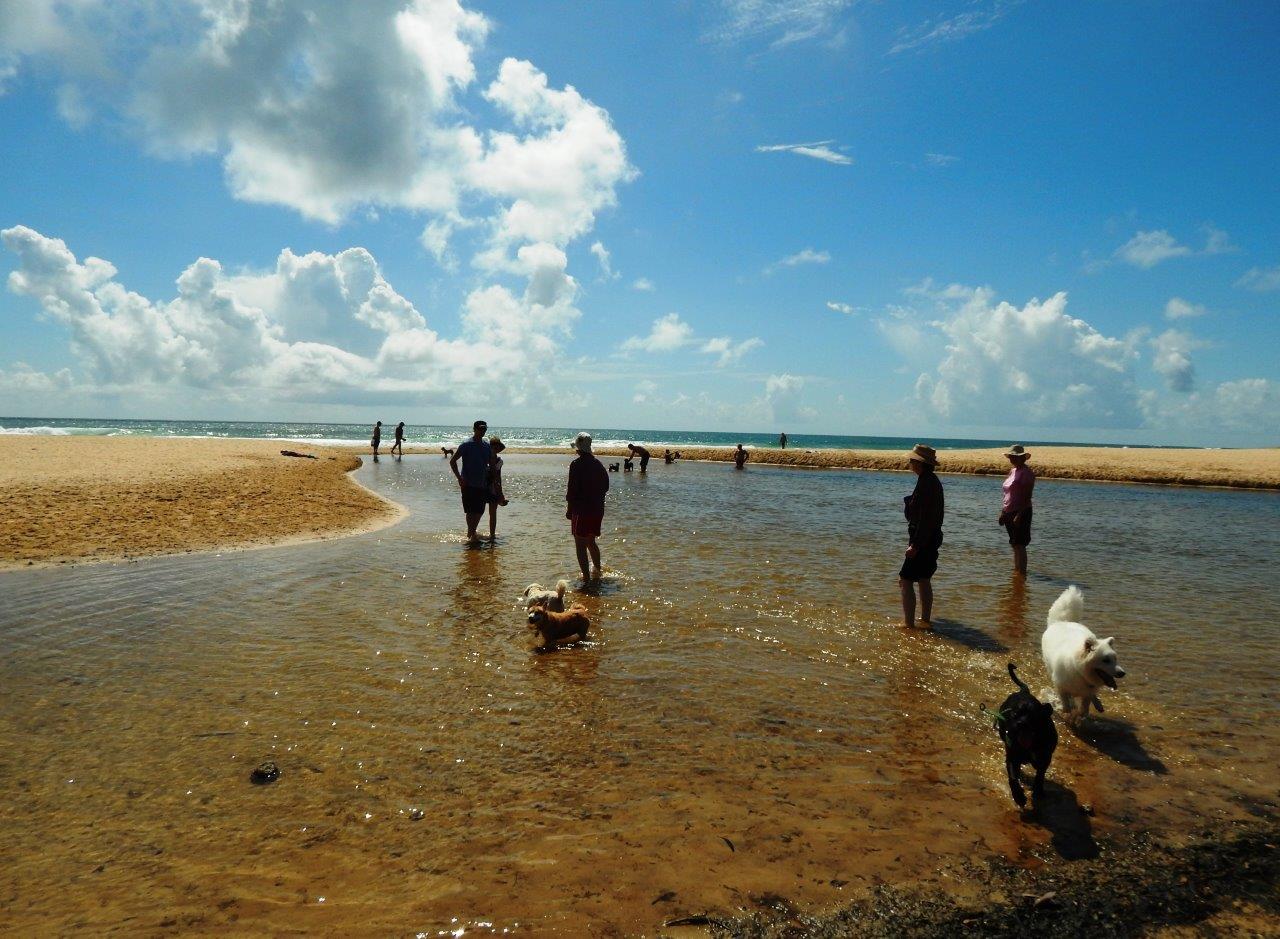
Doggie beachA couple of weeks ago, our local newspaper somehow invaded my Facebook page, wanting to know if I felt safe on the Sunshine Coast after the “recent spate of terrorist attacks”.

Excuse me? Actually, I’d feel less safe if I had a reason to be on the Mooloolaba Esplanade after dark, given that night club strip’s record of serious and even fatal assaults. And what in the hell is a spate, anyway? The word fits nicely into a tabloid heading, that much I know, along with flood, storm, havoc, hail, attack, axe, croc, shark, gay and CIA. But what does it really mean?

One definition of “spate” is “a large number of similar things coming in quick succession”. Surely location is relevant? There was the lone teenager shot by cops in Victoria. There was the poorly-handled Sydney café siege – not a terrorist, just a mentally troubled individual. Yes, the Taliban attacked an army school in Pakistan and killed 145 children, in retaliation for airstrikes on their tribal strongholds by Pakistan warplanes and CIA drones (CIA – hold that thought).

That for sure was a terrorist attack. But Peshawar is a long way from Mooloolaba and life and death, it could be said, has a different meaning to Pakistan’s population of 181 million. One could argue that death by gunshot, bombings, natural disasters, the collapse of poorly-built buildings or train/bus/ferry accidents is never far away in Pakistan.

Likewise the terrorist attack in Paris that eventually left a death toll of 17 was a long way removed from Australia, even if our media went on about it at length. Typically, the media will fall off a foreign story, be it a terrorist attack, plane crash or a natural disaster just as soon as all Australians are present and accounted for. That’s no surprise – the media works like that in every corner of the world. But in the case of the satirical magazine Charlie Hebdo, editors and illustrators took it personally and so began a crusade.

Other bad things have happened in Australia over the past three or four months, but up here in the Hinterland, I couldn’t say I perceived them as a spate (also known as a flood or inundation; a sudden or heavy rainstorm). Not much of that up here.

Headlines as a trigger for depression
You may have read some months ago that I/we were having a media ban because we didn’t think it was helping us out of our respective bouts of depression. Counsellors talk about “the straw that broke the camel’s back” and for me it was December’s inflammatory, racist, inaccurate, scare-mongering, populist and plain stupid newspaper headlines. The Australian published 84 items about terrorism in just 12 days and The Courier-Mail gained international notoriety for the ‘Chef and the Shemale’.

Well OK, it’s their business to sell newspapers and a sensational headline will do it every time – that and bingo cards or the equivalent. Within the sweaty halls of tabloid journalism in 2015 I would probably now be known as a “do-gooder”.
No, I just want them to get it right and not insult people or damage their reputations.
Like other people, I’m feeling as if the media and its masters want us to feel constantly anxious about everything (so we’ll vote for strong government).

The Sydney Morning Herald makes a welcome change to the populist rhetoric pumped out by The Australian, but they follow the same form book: if it bleeds, it leads. If you read every story in the Guardian Weekly, which has the best round-up of international news, you would wonder if there are any happy people living in happy countries, where there is plenty of food and water, no drug addiction, child abuse, human rights violations or corruption.

But if you don’t keep up with the news, people tell me, you’ll miss things and get out of touch. Oh really? I found out by accident (I was flicking through Monday’s Herald in the library looking for the TV guide), when I read a front-page report that said Katrina Dawson, who died in the Sydney café siege, may have been struck by a stray police bullet.

“Jings,” as my Baptist minister friend says.

Pity the relatives of this unlucky person, who may or may not have been told about this angle before they read it in a newspaper. As if they didn’t have enough grief.
If you’re not happy about rabid bias and hyperbole in the media, you just have to do something about it.

A week or two ago I sat at my desk in the home office and spent a bit over $400 signing up for what I call “Fair Trade” media subscriptions. That’s about $8 a week – less than what I was spending on daily newspapers. Soon I’ll be getting the Guardian Weekly in the post box, followed by The Monthly and the New Internationalist. Not to mention online versions of The Guardian, Crikey and a (free) website called The Conversation.

The history of Terrorism
Despite our local paper’s farcical attempt to find a home angle, I’m here to tell you that terrorism has been with us a long while – there have been major incidents in every decade of the 20th century, many entwined with world wars, minor wars, civil wars and attempts by the CIA (remember them), to identify and “neutralize” (via infiltration, capture, terrorism, torture and assassination), communist cells such as the National Liberation Front of South Vietnam or Viet Cong.
If you want to follow the thread of that particular exercise during the Vietnam War, look up http://en.wikipedia.org/wiki/Phoenix_Program.

So, without too much effort, I can point to the Red Brigade, Patty Hearst, Black September, the Popular Front for the Liberation of Palestine and the 1972 Olympics hostage drama as examples. It was always thus; the only real changes seem to be improvised explosive devices (IED), and the willingness of suicidal zealots to wear vest bombs.

I don’t mean to disrespect the Australians who have been killed or injured in terrorist attacks or their kin, but it is time for a media reality check.
Seventeen people have died in 10 terrorist attacks on Australian soil in the last 100 years (three of whom were killed by police bullets). Over the same period, 108 Australians were killed in terrorist attacks overseas.
The incidence of death by terrorism at home, therefore, is one every six years or so.

Over much the same period, heatwaves killed more than 2,500 Australians, 12,000+ died in the Spanish Influenza epidemic of 1918-1919 and 1,013 people died from polio between 1946 and 1955.

So I was musing about all of this and more while at the Currimundi doggie beach with our neighbours and four dogs of sundry breeds. There were about 100 people strolling up and down and at least 50 dogs. It was hot, so we all had our tongues out. We looked alert, I thought, but not necessarily alarmed.

Hear, Hear – What?

??????????????????????????????????????????????????????????????Let’s start with a famous pangram (a phrase using all letters of the alphabet) – The quick brown fox jumps over the lazy dog. We’ll get back to that later.

When I went to the bedside cabinet drawer on Monday to change my hearing aid batteries, I had just two left (they last about 7 days). Next day I rang my service provider who said they would post some to me, as per the terms of their 12-month contract. Australians dispose of approximately 156 million lithium hearing aid batteries per year. That is a serious amount of lithium in the landfill. Some hearing aid manufacturers now sell rechargeable hearing aid pods (the batteries last for a year). It’s about bloody time.

It started off being wryly amusing. For years I thought Jimi Hendrix was singing, “S’cuse me while I kiss this guy”, (now the name of a website which chronicles mis-heard lyrics). Is Billy Joel really singing, “You made the rice, I made the gravy”? Does the line in Toto’s Africa sound like “There’s nothing that a hundred men on Mars could ever do?” Or Canada’s national anthem – “Oh, Canada, we stand on cars and freeze?”

After five years of asking people to repeat what they said and seeking refuge in my favourite three words – “What?’ “Pardon” or “Mm,” I had my hearing tested.
Six months into the quixotic world of hearing devices, I have mixed feelings; good days and bad days and also much for which to be thankful. Gone are the days when I thought my wife said “Hearty Elephant” when she actually meant “hardly relevant”. I could go on, but you hard of hearing blokes out there know about which I speak.

If you are losing the high frequencies (and we all do as we age), if it gets too bad you won’t discern between words like ‘list’ and ‘fist’, you will turn the TV up louder than your partner will like and you’ll avoid going out to places where people gather.
But hearing loss is not just a problem for older people. The Ipod generation and those who frequent dance clubs and rock concerts are at high risk of damaging their hearing. There’s a lot of difference between the 50 to 60 dB level of normal conversation and the 140 dB pumped out by some of the world’s big stadium bands.

Phillip Adams is one of the few mainstream writers who confessed in public to needing hearing aids. Adams canvassed themes with which I had become entirely familiar, through five years of denial and hogging the TV remote.
“I developed a preference for foreign films with subtitles,” Adams wrote in The Australian Magazine, December 2012, adding that he rather enjoyed the self-censorship which came with deafness “..allowing me to ignore a bombardment of banal conversation or unattractive views”.

BHA (Before Hearing Aids), we’d be watching the splendid US spy thriller Homeland (with subtitles) which might read “birds chirping” or “dog barking in distance”. I could not hear those sorts of noises at all. AHA (after Hearing Aids), as the audiologist warned me, flushing the toilet evoked memories of a trip to Niagara Falls in 2010. I no longer heard faint chirping in the Bottle Brush tree next to our front veranda – I could hear and identify honeyeaters, wrens, whip birds, cat birds as well as the sound of frogs and the creek gently running at the bottom of our block, 100m away.

They say it can take your brain a year to adjust to being able to hear high frequencies again. The audiologist patiently heard the problems I reported when playing guitar or whistling. I complained it sounded like an effects pedal and there was feedback and other unpleasant sounds. After some tweaking of compression and other frequencies, these problems diminished. Now I am finding the handiest thing about these devices is the volume button. I turn it down if people’s voices sound brassy and loud up close and up when, say, listening to a speaker in an auditorium. Oh and the wonderful music programme button – four-part harmonies and fiddle/mandolin solos never sounded so sweet.

The amazing thing, considering the estimated 1.45 million Australian who have hearing aids, is why there is so little dissent about the disproportionate cost. Even mid-range hearing aids can set you back $3,000 each and if your hearing loss is serious or your job depends on hearing every word, you’ll be in double that figure in no time. Meanwhile, you can go to a computer shop and walk out with the latest Mac laptop for less than $2,000 and enough computer power to run an international online business. Or you can use a smart phone’s GPS, telecommunications suite, camera, video, skype, email, internet access and hundreds of apps for no money at all. Just sign here and pay your bill every month.

While hearing aids fall into the category of a big ticket retail item, it pays to shop around. There are sales-oriented hearing clinics out there which will lure you in with a free assessment and then push you fairly hard to sign a contract.
I got assessed by a couple of private clinics then went with the Federal Government’s voucher system (for the over-65s), opting to pay for a “top-up”. My mid-range, programmable hearing aids (I have two) cost me $3,400 and the government paid the rest.
Choice magazine surveyed 525 people to find the main reason people get hearing aids is to overcome social disconnection and isolation. But half of the people interviewed had problems with their hearing aids and one is six were dissatisfied, so it is no simple fix.

Choice said people also shop around online, citing a member who was quoted $12,000 for a pair of top-end hearing aids and ended up buying online from a UK retailer for about $4,250. The retailer programmed the hearing aids according to his audiogram. The member later found a local clinic to service his aids for $100 to $200 per appointment.
There can be warranty issues taking this approach, but increasingly, older Australians are starting to add hearing aids to the list when they go to Thailand or the Philippines for dental work or knee replacements.

Whatever the options, I can say I’d rather have my hearing aids, imperfections and all, than go back to the muddy pond that was once my hearing.

Meanwhile, for those of you who do not (yet) suffer hearing loss, consider this. Occupational health and safety advocates nonprofitrisk.org says the permissible top limit for noise exposure over an eight-hour period is 90 decibels. If you don’t know what that means, here’s a short list:
• 80 decibels: city traffic, manual machine, tools;
• 90 decibels: lawn mower, motorcycle, tractor;
• 100 decibels: woodworking shop, factory machinery;
• 110 decibels: chainsaw, leaf blower;
• 120 decibels: ambulance siren, heavy machinery, jet plane on runway;
• 130 decibels: jackhammer, power drill.

So if you’ll recall the pangram we cited in the first paragraph. If you’ve got moderate hearing loss, Australian Hearing says this is what you will hear:
__e _i_ brown _o_ jum_over _e _azy dog.
Scary isn’t it!